Showing posts with label History. Show all posts

Sunday, September 28, 2025

स चा ह

 स चा ह 


हा लेख लिहून कमीत कमी पाच-सहा वर्षे तरी झाली असतील, कदाचित जास्तच. Covid च्या आधी लिहिला होता हे नक्की. पण post करण्याचं धाडस होत नव्हतं 🙂

आता करतो आहे, आणि का, ते लेखाच्या शेवटी लिहितो. 


———————


महाराष्ट्राच्या इतिहासाला एक मोठं वळण केवळ ‘ध’ चा ‘मा’ झाल्यामुळे लागलं असं म्हणतात. असेलही. पण माझ्या मते ‘स’ चा ‘ह’ झाल्याचा परिणाम खूप जास्त विचार करायला लावणारा आहे.


जेंव्हा शब्द एका भाषेतून दुसऱ्या भाषेत जातात तेंव्हा त्यांचे उच्चार बदलणे स्वाभाविक आहे. ‘प’ / ‘फ’ / ‘ब’ एकमेकांत बदलतात तसंच ‘स’ आणि ‘ह’ सुद्धा. वर्णावलीत जसे ‘प’ / ‘फ’ / ‘ब’ एकत्र मांडले जातात, तसे ‘स’ आणि ‘ह’ सुद्धा आणि ते ह्याच कारणामुळे.  


वैदिक संस्कृत आणि प्राचीन फारसी ह्यांचा जन्म एकाच भाषेतून झाला होता ही कल्पना नवीन नाही. आणि गेल्या काही दशकांमध्ये झालेल्या संशोधनामुळे भाषाशास्त्रज्ञाचं आता ह्या बाबतीत एकमत आहे. त्यामुळे ह्या दोन्ही भाषेंतील काही शब्दांचा उगम एकच असणे स्वाभाविक आहे. त्यात काही शब्दांचा प्रवास खूपच रंजक आहे.


प्राचीन काळी, जो शब्द वेदकालीन संस्कृत मध्ये “मास” असा आला, तोच शब्द जेंव्हा प्राचीन फारसी मध्ये गेला तेंव्हा, ‘स’ चा ‘ह’ झाला आणि त्याचे रूपांतर ‘माह’ मध्ये झाले. दोन्ही अर्थ तेच राहिले - “moon” आणि “month”. चंद्राच्या कलांनुसार दिवस मोजणी होत असल्यामुळे एकच शब्द moon आणि month साठी असणं स्वाभाविक आहे. त्यावरून चंद्र ह्या अर्थाशी निगडित असलेले फारसी शब्द, माहताब, माहरू वगैरे, उर्दू कवितां मधून सतत आपल्यासमोर येत असतात. उर्दू कवींच्या अशा काही लाडक्या शब्दांचा उगम फारसी आणि संस्कृत ह्यांच्या मूळ भाषेत आहे. फारसी मध्ये ‘माह’ वरून शब्द बनला “महिन:” (مہنہ). तो आपण मराठीत घेतला ‘हि’ दीर्घ करून ‘महीना’ असा.


आपण ‘मास ‘ आणि ‘महीना’ असे दोन्ही शब्द वापरतो. दोन शब्द, उगम एकच आणि अर्थही तोच. पण प्रवास वेगळा असल्यामुळे थोडे भिन्न वाटतात. 


तीच गोष्ट अजून एका शब्दाची. जो शब्द वेदकालीन संस्कृत मध्ये "सप्त" (seven) असा आला, तोच शब्द जेंव्हा प्राचीन फारसी मध्ये गेला तेंव्हा 'स' चा 'ह' झाला, आणि 'प' चा झाला 'फ' आणि शब्द झाला 'हफ्त:' (ہفتہ). हिंदी मध्ये "week" अर्थाने असणारे दोन्ही शब्द 'सप्ताह' आणि 'हफ्ता' ह्यांचा उगम एकाच प्राचीन शब्दातून. एक आला सरळ संस्कृतमधून, तर दुसरा फारसी मार्गे. मराठीतही दोन्ही शब्द आले. जरी 'सप्ताह' चा अर्थ तसाच राहिला तरी 'हप्ता' चा अर्थ झाला 'installment'. मुंबईतल्या बोलीभाषेत 'हप्ता' चा अर्थ अजूनच वेगळा आहे, हे तर सर्वांना माहित आहे. 


आधी म्हटल्या प्रमाणे, शब्दांचा प्रवास खरोखरच खूप रंजक असतो. 


पण ह्यात विचार करायला लावण्यासारखं काय आहे?


ह्याच 'स' चा 'ह' होण्याच्या प्रक्रियेमुळे 'सिंधु' नदीचं आणि त्या पलीकडल्या प्रांताचे नाव प्राचीन फारसी मध्ये झाले 'हिंदू'. त्या प्रांतात राहणाऱ्या लोकांनाही तेच संबोधन प्राचीन फारसी मध्ये रूढ झालं. ऋग्वेदामध्ये ज्या प्रांताचा उल्लेख 'सप्त सिंधू' असा आहे, त्याला अवेस्तां ह्या पारसी धर्मग्रंथा मध्ये 'हप्तहिंदू' असे म्हटले आहे. (अवेस्तां हे भाषेचही नाव आहे, जी जुन्या फारसी भाषेशी निगडित आहे.) ऋग्वेद आणि अवेस्तां ह्यातलं साधर्म्य आणि फरक हा एक मोठा आणि अतिशय रोमांचक विषय आहे, त्यावर अजून अभ्यास करायची माझी खूप इच्छा आहे. 


इथे काही गोष्टींवर लक्ष देणं आवश्यक आहे. फारसी मध्ये हिंद आणि नंतर अरबी मध्ये (अल हिंद - الهند) हा शब्द भौगोलिक अर्थाने आहे, धार्मिक नाही. त्यावरून इंग्लिश मध्ये गेलेला शब्द India हा ही भौगोलिकच आहे. हिंदुस्तान हा शब्द पहिल्यांदा प्राचीन फारसी मध्ये वापरला गेला होता. हे नाव ज्या मूळ सिंध प्रांतामुळे पडलं, तोच आता आजच्या हिंदुस्तानात नाही, पाकिस्तान मध्ये आहे. आणि भारतात मात्र सिंधी भाषिक राज्य नाही. पण एका जुन्या संदर्भाने आपण सर्व ‘सिंधी’ आहोत असं मला म्हणावंसं वाटतं. 


त्याही पेक्षा उपरोधात्मक आणि विचार करायला लावणाऱ्या गोष्टी आहेत. भारतीय भाषांमध्ये "हिंदू" ह्या शब्दाचा अर्थ केवळ धार्मिक राहिला आहे. आपण हिंदू जे आपल्या धर्माचे नाव म्हणून वापरतो ते इराण मधल्या मुसलमानांच्या पूर्वजांनी (मुसलमानांनी नाही) ह्या भौगोलिक प्रदेशाचे ठेवलेले नाव आहे. हिंद प्रांतातले लोक जी भाषा बोलतात त्याला फारसी भाषिकांनी नाव दिलं हिंदी. भाषेतून “परके” शब्द काढून टाकायचा आग्रह जे करतात, त्यातल्या किती लोकांना ही माहिती आहे की ह्या भाषेचे नावच “परक्या” लोकांनी ठेवले आहे? सद्य परिस्थितीत ही सर्व चर्चा दुर्दैवाने भावनिक आणि अतिशय प्रक्षोभक होऊ शकते.  


सांगायचा मुद्दा असा की, 'स' चा 'ह' होण्याचा परिणाम 'ध' चा 'मा' होण्यापेक्षा खूप गहन आहे.  


असो. वातावरण थोडं हलकं करण्यासाठी शेवटी गंमत म्हणून अजून एक वेगळीच व्युत्पत्ती, ह्याच सिंधचा हिन्द होण्यामुळे झालेली. 


अरबी लोकांबरोबर भारताचे व्यापारी संबंध खूप जुने आहेत. जेंव्हा अरबी लोकांनी चिंच बघितली, तेंव्हा ती त्यांना थोडी खजूर सद्दृश्य वाटली असावी - काळा चिकट गर, आत एक टणक बी. हा केवळ माझा कयास. कारण काही असो, त्यांनी चिंचेला नाव दिलं "हिंदचा खजूर". खजूराला अरबी मध्ये एक शब्द आहे - तमर. म्हणून अरबी मध्ये चिंच म्हणजे "तमर-ए-हिंदी" (تمر هندي ). त्याचे इंग्लिशमध्ये रूपांतर झालं "Tamarind". आता “date tamarind chutney” ज्यावेळी खाल, तेंव्हा हे लक्षात ठेवा की ती दोन प्रकारच्या खजुरांपासून बनली आहे. एक अरबस्तानातला खजूर आणि दुसरा हिंदुस्थानातला. 🙂


———————


आज हे सर्व लिहिण्याचं धाडस केलं, कारण हिंदू शब्दाची व्युत्पत्ती आता खूप लोकांना माहित आहे. आणि म्हणूनच “सनातन धर्म” हे नाव वापरण्याची प्रथा वाढत चालली आहे. त्यामुळे उलट्या सुलट्या आरोपांचा भडीमार माझ्यावर होण्याची शक्यता आता कमी. म्हणजे निदान अशी आशा तरी करू शकतो 🙂 आणि तरी सुद्धा काही शंका किंवा आक्षेप असेल तर अजून एक माहिती. वीर सावरकर, ज्यांनी हिंदुत्व ह्या शब्दाची निर्मिती केली त्यांनीसुद्धा अगदी हीच व्युत्पत्ती स्पष्टपणे समजावून सांगितली आहे. (बघा https://hwatchmediabucket.s3.amazonaws.com/wp-content/uploads/2019/11/12143419/Essentials-of-Hindutva-by-Vinayak-Savarkar.pdf)



Sunday, January 5, 2020

Sapiens

Book Review : Sapiens
Author : Yual Noah Harari
My Rating : 5 out of 5 stars

The complete title of the book is “Sapiens : A Brief History Of Humankind”.

Only once in a while a book gets written that is immensely vast in scope, challenges your worldview at a very fundamental level and tackles extremely difficult topics in such an accessible manner that everyone can enjoy it. Sapiens, is such a book.

Ever since Dr Stephen Hawkings wrote “A Brief History Of Time”, there have been way too many books that announce themselves as “Brief history of …”. This book by Dr Yual Noah Harari deserves to be in the same league of the trailblazing book by Dr Hawkings. 

It’s impossible to put Sapiens in one simple category. The twenty odd amazing chapters cover everything from evolution, history, economics, politics, religion, spirituality, science, anthropology, psychology, philosophy and so on. It would have been a great feat just to weave these disparate threads into one cohesive book, but to do it in such an easy to read manner is an astounding achievement.

The book starts at the evolutionary beginnings of Homo Sapiens and ends at a chapter that speculates what might be in store for us as a species. Along the way almost every branch of knowledge gets covered in surprising detail. Now, this book is not an overview or a survey of these fields. Neither is it an introduction to all fields of human knowledge. It travels through these vistas with a singular destination in mind - to explain how we Homo Sapiens have evolved differently than any other lifeform.

What makes the book impossible to put down, is the spicy mix of opinionated commentary with generally accepted scientific theories. The range of topics and author’s fearless discourse almost ensure that everyone is going to be at least somewhat angered and/or offended. True, it will most likely offend religious and conservative readers more, but the liberals and free market capitalists are also likely to find many arguments difficult to digest. And a friendly warning to readers from India, you in particular may not like many discussions, especially if you have a defensive conjecture about how casteism took roots in Indian society. 

I am not saying that the author is deliberately trying to offend. No, not at all. And leaving aside the topics such as religion and social customs, that raise the heat rather quickly, that’s not the primary focus of the debate either. Most of the topics are morally ambiguous to say the least. A simple binary good or bad evaluation misses the really important nuances. For example, are we really happier than our hunter gatherer ancestors? Was the nexus between imperial colonialism and science good or bad? Is industrial animal farming the largest cruelty in the history of mankind? Are our cherished ideals of democracy and human rights, just a myth that exists and works only in our collective minds? The book is full of debates on such thorny issues.

So, before you embark on reading this, and it does get my “must read” recommendation, ask yourself. Do you like to be challenged on your most fundamental beliefs? Do you like to read intelligent arguments even when you don’t agree with them? Do you like to be intellectually stimulated with subtleties of historical analysis? For liking such a book, you have to be welcoming to opinions that make you uncomfortable.  That’s my view. I did agree with most of what the author had to say. But I also appreciated the views that I did not agree with. In the end, I came out with a far deeper understanding of Home Sapiens. And for that, I absolutely loved this book, and cannot recommend this highly enough. Do yourself a favor and read it.

Tuesday, January 5, 2016

The Fifth Gospel


Book Review : The Fifth Gospel
Author : Ian Caldwell
My Rating : 4 out of 5 stars

After reading the blurb on the cover of “The Fifth Gospel”, it’s very natural to think of “The Da Vinci Code", or “Angels and Demons”. A Vatican murder mystery involving an artifact from Christian history, has to remind us of Dan Brown’s novels. That would be a wrong expectation to set, as Ian Caldwell’s sophomore effort is at the diagonally opposite corner.

The story is told to us in the voice of Father Alex Andreou, a Greek priest who grew up in Vatican. Right at the beginning of the story, he gets a call from his brother, Father Simon, that their mutual friend Uno has been shot. Uno was a curator at the Vatican Museum, and was going to open a new exhibit in a few days. That exhibit, about the “Shroud Of Turin” and its relation to the so called “Fifth Gospel” was expected to have a profound impact on the relations of Vatican with Orthodox Christians. With so much at stake, such a project was receiving both support and opposition from different powerful forces within the Vatican. Father Simon is put on a trial for killing Uno, but he decides to remain silent and not defend himself. The rest of the book follows this trial, what did Uno discover that put his life in danger, and the mystery of who killed Uno.

There are clear similarities between this plot and “The Da Vinci Code”. But the treatment is very different. Dan Brown wrote a page turner with a controversial interpretation of history. Here, Father Alex is a very simple man, for whom family comes first. He is a bit too sentimental in my opinion, but I understand why that’s the case. All other characters are very well drawn, and most are likeable. There is a lot of focus on feelings and relationships. The phrasing is literary in places. There are lots of details about the Vatican, and especially its legal system. There is some puzzle solving and interesting investigation of history too. Overall, the story feels lot real, and the reader is bound to empathize for Father Alex.

I learned a lot about the history of relationship between Catholic and Orthodox segments of Christianity, and the differences between the gospels. The details about internal workings of Vatican were interesting too.

The book does feel dragged at places. The mystery aspects works well, but the intermediary surprises are often unexciting. For example a chapter would end with you wanting to know more, but when the surprise is revealed, it’s a “duh” moment. I cannot elaborate on this without giving any spoilers, but you would understand what I mean, when you read the book.

I definitely recommend this book if you set your expectations right. This is a medium paced, uncontroversial and sincere book. It aims to educate, as well as entertain with a believable mystery.

Thursday, December 24, 2015

Bajirao Mastani

Movie Review : Bajirao Mastani
Language : Hindi
Director : Sanjay Leela Bhansali
Genre : Historical Drama
Starring : Priyanka Chopra, Ranveer Singh, Deepika Padukone
Released : December 2015
My Rating : 6 out of 10

I have watched only two or three movies directed by Sanjay Leela Bhansali. I was extremely impressed with “Black”, while I simply couldn’t stand “Devdas”. When I heard his other movies also valued “style over substance”, I didn’t bother to watch any more. In spite of fearing the same for this movie, I still wanted to watch it.

This is a story that I am very familiar with. The history of Maratha Empire is something I have studied in detail in school. Since I have always been interested in History, I have also read many semi-fiction, semi-history Marathi novels that have been written for this period. This period is part and parcel of Marathi culture and Marathi pride. References to Peshwai are common in Marathi speech. In short, this topic is very close to heart, and at the risk of sounding narrow-minded I will say, this is a history of my people.

With that background, I can provide my understanding of “Raa’u”, the book written by Naa. Sa. Inamdar, and on which this movie is based. Bajirao-Mastani, is not, very emphatically, not a Marathi version of Romeo-Juliet. Bajirao, a Brahmin by birth, was an undefeated leader, known for his legendary skills of maneuvering cavalry. They say, he lived his life on a horse. After his marriage with Mastani, a Muslim woman, he tried very hard, but did not succeed, to give legitimacy to their relationship. His disregard for social norms was scandalous in the ultra-religious, ritualistic society of that time. This strained his relationship with his own family, especially his brother who was loyal to him like Lakshman was to Raam. This combination of rebellious love of a Hindu Brahmin leader with a Muslim woman, family drama, military triumphs and the political conspiracies that were all too common in those times, makes it a very complex and potent story. It should naturally lead into making a great movie.

Unfortunately, Bhansali’s adaptation turns out to be a movie with a split-personality. He has succeeded in bringing our attention to many aspects of the story, especially Bajirao’s naive struggle to get the society to accept his marriage to Mastani. But then he chose to make it a Romeo-Juliet in the end. His casting of secondary characters is perfect in case of Milind Soman (as Ambaji Panth) and Vaibhav Tatwawadi (as Chimaji Appa), but is laughable in case of Ayush Tandon (as the eldest son of Bajirao). The settings are very realistic in some cases (especially the inside of Shaniwar Wada) and totally fake in many. Please try to not look at the background sky. Especially the moon looks straight out of 70s movies. The dialogues are occasionally memorable, but often times feel like forced marriage of words (“dhalta sooraj, khilta chaand” etc), and sometimes just idiotic (Bajirao's repeated line of “Cheeteh ki chaal …”). This overall, cannot be termed as competent direction.

I am told that Bhansali’s movies are to be watched for the lead actors frolicking in the opulence of costumes and sets. Well, some of the sets are indeed impressive, with nods to Mughal-e-Azam (courtesan dancing in a room full of mirrors), a set out of Paakeezaa which interestingly is used to picturize a holi song without any real holi, go figure. 

Coming to lead actors. Both the ladies manage to show different shades of emotions. These are complex roles, especially Kashibai (Priyanka Chopra) who justifiably feels wronged by her husband. Deepika Padukone is perhaps the best choice today to play the role of Mastani. I was neither particularly impressed by the acting of both, nor do I have anything to complain about.

The main problem is Ranveer Singh. This is the first time I have watched him, and I don’t think he is a good actor to begin with. On top, he and Bhansali have chosen to portray Bajirao as an unpolished crude, almost a brute, as opposed to a civilized, inspiring leader. Maybe they had an “angry young man” in mind, but this interpretation comes across more as a goon than a king. His body language is awkward and sometimes comical. His dialogue delivery has no gravitas. This is my main objection to the movie. I am OK with all the artistic liberties even though I cringed watching the Peshwas dance. I really don’t understand that decision. Was it necessary to have Bajirao and Kashibai dance? I am not offended, but I don’t see the point.

On the positive side, I am happy someone brought this great story to wider audience. I hope it brings more awareness to Bajirao’s positive impact on India. It was his farsightedness that established at least three major confederacies (Baroda, Gwalior, and Indore) outside Maharashtra, which ensured the continuation of Hindu rule.

This movie has more depth and substance than “Devdas”, but still falls short of being a good movie. In case you want to watch it, I recommend watching it on a big screen to enjoy some eye candy it presents.

Monday, July 6, 2015

The Big Ratchet

Book Review : The Big Ratchet
Author : Ruth DeFries
My Rating : 4 out of 5 stars

The complete title of the book is "The Big Ratchet: How Humanity Thrives in the Face of Natural Crisis : A biography of an ingenious species".

It's often said that the kids born in this age would take a lot of technology for granted, unable to imagine life without touch screens. Although I agree with it, I think it's not only this generation, rather every generation takes some things for granted. In my view, it’s definitely true in every society that has seen the benefits of what the author calls as "The Big Ratchet".

For example, we do marvel at the wonders of technology, but how many of us who live in a developed country, especially US, marvel at the amount and variety of the food available at the local grocery stores, and how affordable it is? Intellectual progress rarely happens on empty stomach, so this availability and affordability of food has contributed a lot to our success in every other endeavor.

How did that happen? Producing food was not easy, even after humans transitioned from foraging to agriculture. Unpredictable yields, amount of physical labor, heavy dependence on weather, diminishing fertility of soil, plant diseases, pests who attack stored food are just few of the problems that we had to solve to get to this point. All this and more, is discussed at length in this superb book by Ruth DeFries, a professor at Columbia University.

She explains that this progress came with humanity going from one level of success to another, like a ratchet wheel, only to be followed by the problems associated with that success. Then another brilliant idea is needed to solve that, which acts as a pivot to move our species to the next ratchet, and then it’s again followed by a hatchet associated with the new solution. The cycle has been going on forever since we started agriculture.

It’s more common to hear extreme viewpoints which say the planet is doomed due to our over-indulgence, or the unapologetic optimism that proclaims our ingenuity will continue to solve future problems. This book, right at the beginning, announces that a more nuanced approach is needed that looks at a much broader history of the species. And the author delivers in spades. I will highlight a couple of examples.

About 50 years ago, India had a huge problem of generating food. Dire warnings of mass starvation were common. But no such thing happened. In fact, what happened was the “Green Revolution”. I vividly remember my father explaining to me how it happened - the building of dams, the modernization of agriculture (especially in the state of Punjab). What I didn’t know (or remember) was how the hybrid wheat played a major role in improving yields. Thanks to this book, now I know about Norman Borlaug who was crucial in this agricultural revolution, and not only in India, but worldwide. He was awarded Padma Vibhushan, India’s second highest civilian honor, as well as the Nobel Peace Prize. No one is claiming, India doesn’t have people who go hungry to bed, but the impact of Green Revolution is as clear as daylight.

No such success comes without it’s problems. There is no better example of the hatchet-following-ratchet than the now infamous pesticide DDT. Paul Hermann Muller was awarded a Nobel Prize for his discovery of the properties of DDT. It eliminated many deadly diseases in 40s and 50s, and saved countless lives. But its use in agriculture ensured that the toxins went up the food chain, and caused myriad problems for all species, including humans. The battle against DDT was started by one lady, Rachel Carson, with the publication of the milestone book, “Silent Spring”. As a result, once heralded as miraculous, this chemical is now widely banned.

The study of this endless cycle of ratchets and hatchets is fascinating. There is so much more in this book. I vaguely remember studying the Nitrogen cycle in school, but I had forgotten all about the Phosphorous cycle. The kind of solutions that have been tried in history are simply astonishing. I am pretty sure most readers haven’t heard about bird poop being mined and hauled from Chile to Europe! 

If you are looking for vindication of your pessimistic or optimistic stand about what the future holds for us based on how we are treating our planet, then this is not a book for you. If you want to understand the history of how it all came to be, then this is a fabulous place to start. There are no predictions here. But the tone is generally optimistic, without belittling any challenges that face us.

I very highly recommend this book. I hesitated in giving five stars, because I found it a bit repetitive, and thought that it’s a bit dry than it should be. Of course it’s a scientific account, but in recent times, books like Omnivore’s Dilemma, have figured out a much smoother engaging style. It’s a minor quibble. Read this book.


Friday, November 30, 2012

The Miracle of Freedom


Book Review : The Miracle of Freedom
Authors : Chris Stewart, Ted Stewart
My Rating : 3 out of 5

The complete title of the book is "The Miracle of Freedom : Seven Tipping Points That Saved the World"

Do you think that we are extremely lucky to be born in these times ? I do. My understanding of History suggests that, common people on an average have never lived a better life. In many parts of the world, people have the freedom to self-govern. It's not a perfect world, there is hunger and oppression in many countries, but remember, just a couple of centuries ago, democracy was virtually unknown to the most of the planet. Even in Western Countries with established democracies, suffrage became universal only in last 150 years or so.

All throughout history, almost everywhere in the world, lives of commoners had been considered near meaningless by whatever form of regime that existed. Wars and destruction have been all too frequent. The chance of being born to slavery was always much higher than being born in a privileged family.

Today's democratic system is not a logical outcome of any evolutionary process. It happened by chance. Considering how fragile it is in many societies, it's continuation is not a guarantee either. So how did our species come to this social destination that values individual freedom, and pursuit of happiness for everyone above some vague glory for a king or a religion ?

That is an enormously fascinating subject that the authors Chris Stewart (Republican Congressman from Utah) and Ted Stewart (Chief Judge of US District Court in Utah) tackle in their book. Or should I say, claim to tackle in this book.

First the good part. Their position about the exceptional state of today's political system is easy to agree with. They have a knack of engaging writing and make this a page-turner. The format of interleaving history, with stories of completely fictional characters works most of the time. Much of the presented history is accurate.

The bad news is plenty. I have no issues with their choice of events. I didn't always agree with the importance they give to a certain event, but it's a subjective choice. The problem is not this choice. The problem is the assertions they make.

If I have to summarize the book's arguments in once sentence, it is this. These key events saved Christianity and Western Europe, hence we have a political system that is based on individual freedom.

That's a bold claim bordering on propaganda. Especially the Christianity part. It's really hard to accept that any organized religion can be given credit for capitalism and freedom of thought. I am always willing to listen to a well-reasoned argument. No such argument came forth in the book. Instead, just a lot of assertions are made. Even for the not-religious aspect, arguments are not strong enough. I don’t think the defeat of Xerxes saved the world. Because I don’t think there is any evidence that the Greek kings were in support for democracy, and by all accounts the Persian Empire founded by Cyrus the Great was famous for its respect for human rights.

Although I am not a religious person, I happen to have a favorable view of most religions. I think a lot of good has come from Christianity or any other religions. I am not making a politically correct statement. I very sincerely think that, even when you subtract all the atrocities committed in the name of the religion, the impact of religion on human happiness is still positive. That's just my viewpoint on this gray area. Nevertheless, I simply cannot accept that capitalism and freedom derived from Christianity.

On the other hand, I do agree somewhat with authors about the positive contributions of the Western Europe to the development of democracy and capitalism. This is another touchy subject for most people. But it is not as gray subject to me. Foundation of most of the "modern" achievements in all forms of human thinking indeed happened in Western Europe. This is not to say, that no other society achieved anything, or have not made any contribution. Hence the keyword "modern". Why this happened is a complex subject, and I encourage everyone to read Pulitzer Prize winning "Guns, Germs and Steel" by Jared Diamond - one of the best books I have read.

But was this achieved in Europe because of Christianity or in spite of it ? The authors agree that there was a dark medieval period due to corruption in the Church, but still claim that Christianity is somehow responsible for reason and freedom of thought. That's simply an overreach. I am aware that most of the scientists, including Newton and Darwin, were Christian and religious. Still, if Christianity played a role in their discoveries and inventions, it was miniscule. And what about the political thinkers and philosophers, who formulated the theories and affected our way of thinking ? How much of the credit for the work done by all the thinkers from Adam Smith to Carl Marx can be attributed to Christianity - probably none.

If there were no religious angle to their arguments, the book would have had great merit. As it is, I guess this book will have an appeal to someone leaning towards the Conservative Christian spectrum of politics. For most others, it will be frustratingly unsatisfying.

Sunday, September 16, 2012

Spartacus


Review : Spartacus (A TV series)
Aired on : Starz
Released : 2010
My Rating : 5 out of 10

Starz released the first season of the Spartacus series in 2010, titled "Spartacus : Blood and Sand". The lead actor - Andy Whitfield - was diagnosed with cancer, and production of the sequel had to be stopped. While he was being treated, Starz produced a prequel instead. Sadly, Whitfield passed away in 2011 and the sequel was later produced with Liam McIntyre playing the lead role.

I have only watched the season 1 on DVD, and this review is specifically of that season.  It consists of 13 episodes, each of 1 hour.

The story is loosely based on historical facts. In ancient Roman empire, around 70 BC, there was indeed a slave gladiator called Spartacus. He was probably captured from Thrace (modern day Bulgaria) and served in a "ludas" (gladiator school) in the city of "Capua". He organized a rebellion by forming an army of fellow slaves. The Roman Army eventually crushed their rebellion in what's now known as the "2nd Serville War".

Season 1 starts with the capture of Spartacus, and ends with the successful start of his rebellion. Almost all events in between are completely fictional as historical details of Spartacus remain obscure.

When I wrote the review for "Rome", I added a strong warning that it's not fit even for teenagers. Spartacus leap frogs Rome in the aspect of being offensive, and falls woefully short in everything else. If you couldn't watch Rome because it was too explicit, you shouldn't even think about watching Spartacus. If you liked Rome (and I did), for its gripping narrative, you shouldn't expect the same from Spartacus.

The idea here is to shock the viewers. Plain and simple. The appropriate name for this series would have been "Blood and Skin", as that's all the series seems to be interested in. It's possible that for some viewers, this is a guilty pleasure. To me, it was beyond saturation. The same types of scenes are shown over and over again.

There is a small kernel of a good plot here. Although these are gladiators, they are just glorified slaves, with no rights, no freedom and just objects that can be sacrificed for the entertainment of the elites. It's impossible to not feel their plight. There are some political machinations, and they add some intrigue to the storyline. The focus of the series is elsewhere. To appeal to the base instincts, by showing beautiful women fawning over bare chested savage hunks, who are bent on killing each other in the most grotesque way. With the topic being gladiators, one might expect fight sequences that keep you on the edge of your seat. Alas, they are quite unrealistic - inspired more by the movie 300, than say Troy. (Note : Troy was NOT a good movie, but had great duels. And 300 was a visually impressive movie, but it's not famous for duels.)

The acting is a bright spot. Andy Whitfield as the lead actor is superb and convincing. A trivia : In the late 90s, there was a series with more modest aspirations, called "Xena: The Warrior Princess". It had good ratings in the demography "adult male", solely because of Lucy Lawless. She expertly plays the role of Lucretia here. The best performance though is by John Hannah who plays the role of Quintus Batiatus, owner of the ludas, which happens to be the only multidimensional character in the story.

I am not sure if I can recommend Spartacus. It's not that it fails at being good art. It's just that it has no intention of being a good art. The series is very clear about its goals. There is no point watching this series with the expectation of watching a historical fiction, and complaining that it fails to deliver. It delivers perfectly well, but something totally different - lot of sex and lot of unrealistic violence. If that's not what you want, don't watch this.

Tuesday, January 3, 2012

Cleopatra


Book Review : Cleopatra
Author : Stacy Schiff
My Rating : 3 out of 5 stars

The complete title of the book is "Cleopatra: A Life".

This is yet another book that I decided to read because the author was interviewed on "The Daily Show". Stacy Schiff has written a few biographical works and won the Pulitzer Prize in 1999 for "Vera".

The idea behind the book is great. Everyone has heard of Cleopatra, but how many know what is fact and what is fiction ? The book's cover conveys its theme well. A portrait without the face. We don't know a whole lot about her.

Naturally, it's hard to arrive at historic truth about someone who lived more than 2 thousand years ago. So author Stacy Schiff has decided to mix meticulous research with intelligent speculation. Based on what we know about the times and places, she suggests what might have happened around the facts that we know for sure. It's a very interesting approach that I personally liked.

Still, the book lost me. Stacy Schiff is really a very good writer. Her style never gets dull. But the book is too big, too detailed and eventually got tedious. If you are seriously interested in history, this may be a great book. If you just want to know more about who Cleopatra was as a real person and unlearn what Hollywood has taught you, then this book gets overwhelming. I learned a lot about Cleopatra, and even how life was in Egypt. Some of the insights were surprising, and I am happy to know them now. Nevertheless, I think the length could have been reduced to half, and I would have still gotten all that knowledge.

The strength of the book - the amount of detail - was precisely what turned me off, and I started skipping sections to get to the finish. I really wanted to like this book. Sadly, I cannot recommend it, unless of course you are studying Egyptian History, in which case, I have no authority to make any recommendations to you anyway !

Friday, September 30, 2011

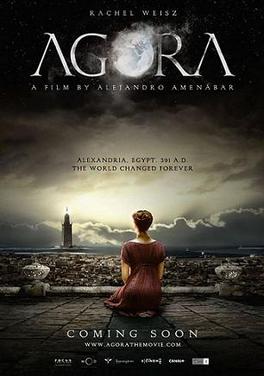
Agora

Movie Review : Agora
Director: Alejandro Amenábar
Genre : History / Drama
Released : 2009
Starring : Rachel Weisz, Max Minghella, Oscar Isaac
My Rating : 7 out of 10

I have always yearned for movies based on the lives of mathematicians, scientists and philosophers. Not all highly intellectual persons are whimsical, nor are their life stories boring. Quite contrary. Their stories are not as well known as those of kings and queens, and are often full of struggles and dramatic elements. Especially tragedy, which was always a strong possibility if the thinker was living in a society controlled by religious extremism.

Such is the story of Hypatia, perhaps the last woman scholar of antiquity, and around whose life the movie Agora is built. A bit of historical context might be helpful to understand and appreciate the movie.

Hypatia lived in 3rd - 4th century Alexandria, in Egypt. She was of Greek origin. Most Greeks and Romans in Alexandria were pagan. She probably was not religious, and was more devoted to science and philosophy. It was not uncommon in Egyptian society - especially in Alexandria - for women to have almost the same rights as men. Hypatia was a well-known scholar, a very well respected teacher and almost universally admired. Agora means a place for public assembly. In this case, the library hall, where Hypatia taught.

Alexandria was always a multi-cultural, multi-ethnic city ever since Alexander the Great established it. With the growing strength of Christianity, it also became a multi-religious society. This led to religious friction, which led to extremism and violent conflicts. During such times, intelligent, outspoken and respected women like Hypatia are considered threats by extremist men who want to grab power in the name of religion. Hypatia was lynched by a Christian mob in a most brutal fashion.

The movie picks up the story when trouble had just started brewing in Alexandria. It is not a story of Hypatia. It is a story of a city in transition. This choice allows the director to reconstruct every detail of how life was and how it changed. This turned out to be a mixed bag. The city life is magnificently reconstructed with clever techniques. While the political drama and mob violence is effectively portrayed, the central figure of the story, Hypatia, is a bit under-developed. It just doesn't feel complete. This is a fault of the script. Rachel Weisz, who won Oscar for The Constant Gardener, does a superb job as Hypatia. Other actors are not as well known. You might recognize Max Minghella (as Davus) who played Divya Narendra in The Social Network).

This is a movie based on good research of historical facts and tries very hard to remain accurate and fair. The pagans, the Jews and the Christians are all depicted without any bias. Among the graphic scenes of carnage, there are also moments of thoughtful reflection. Of course, the director has every right to take some artistic freedom and Hypatia's research is definitely fiction. It is not known if she really knew if the Earth revolved around the Sun or if the orbits were elliptical. Maybe she did, maybe she didn't.

This is a good movie. If you don't know much about the history of that period, you will definitely enjoy it. If you are just interested in watching well-directed movies, this fits the bill too. It is definitely not for kids.

Friday, February 18, 2011

Rome (HBO Series)

Review : Rome (a mini TV series)
Produced by : BBC and HBO
Aired : 2005 to 2007
My rating : 8 out of 10

HBO's "Rome" TV series covers the events of the Roman Empire in 1st century BC. It ran for 2 seasons in 2005 and 2007. Both the seasons are available on DVD. The first season has 12 episodes, starting with Julius Caesar's victorious conquest of Gaul and ending with his assassination on Ides Of March. The second season has 10 episodes beginning with Marc Antony discovering the assassination and ends with his eventual death (along with Cleopatra) when Octavian's (Augustus Caesar) army defeats him in Egypt.

With so many movies already filmed about all stories related to Roman Empire, what's the point in watching a TV series that cannot be really as "grand" ? Plenty of reasons, I would argue. It may not be as grand as a big budget movie, but it's very detailed. And in fact, the budget was not all that small. Due to expenses needed to recreate Rome, the series was cut short to 2 seasons, and the story at the end was compressed to a few episodes.

We follow 2 common soldiers in Julius Caesar's  army, Lucius Vorenus and Titus Pullo. Their lives are entangled with that of the nobility and all the dirty politics that was rampant during that time. The story of Roman Empire (as much as is covered by the series), remains very faithful to the known history than most of the movies I have seen. Of course, some kind of artistic license is needed to make it dramatic.

Rome is recreated as accurately as is possible. The sets, costumes, customs and daily lives of people in this series feel real. The acting is top notch. You understand every character, the motives and come to like them of hate them. Not a single soul is clean - in fact most are shallow, selfish and outright despicable. But that's how it was. Life was hard. Nothing mattered more than power. Revenge and brutality were commonplace. In spite of the lavish palaces and a Republic government (in theory),  it was not a pretty world for most people, and it's shown as it was.

That's the real strength of the series. It doesn't depict grand battle scenes with awesome CGI effects, but shows the lives of people in extreme close-up. It may be too much of a close-up for many viewers, but that's what the series is about.

I highly recommend this series. But with a strong warning. Things are way too explicit and graphic here. Subtlety is completely nonexistent. If your sensibilities are easily offended, then stay away. I am not exaggerating. This is correctly rated "MA" - and is not suitable even for teenagers.

Wednesday, December 23, 2009

A Brief History Of Mind


Book Review : A Brief History Of Mind
Author : William H. Calvin
My Rating : 3 out of 5

The complete title of the book is "A Brief History of the Mind: From Apes to Intellect and Beyond".

With a provocative title (obviously inspired by Stephen Hawking's blockbuster "A Brief History Of Time"), I was very enthusiastic about reading this book. But I came out much underwhelmed after reading it.

The book starts off well. The author is trying to trace the chain of events that must have led to the evolution of our mental abilities. It's mainly anthropology, with some neurobiology sprinkled in. Obviously, we start with investigating behavior of primates and then move along the evolutionary branches.

There is a wealth of information here. The author is trying to explain what must have been the "Big Bang" for our mental abilities. This turns out be the development of language, which seems a very logical conclusion. And it's also one which author arrives at by presenting a strong case.

So why am I not so happy about this book ? I am not a student of anthropology, but it does seem to involve a lot of speculation. That's not a problem to me, because even a lot of cutting age theoretical physics seem speculation to this layman. My problem is about the style of presentation. After reading many chapters, I was wondering, yes, the discussion is interesting, but how exactly does it help the argument move forward ? After reading a chapter, I would go back and read the summary of it in the contents pages, and then would I understand, "Oh, so that's what the point is of this chapter". Considering how short these chapters are, summaries should not be needed, but ironically, it was these summaries that made me understand the point of some chapters.

In many cases, the author presents what we think must have happened, only to discard it quickly, without presenting an alternative. I was not sure, if I was following the chain of reasoning correctly. Hence I didn't always detect a coherent theme and was getting lost once in a while. This reduced the enjoyment of such a nice idea for a book.

As a result, I am very much interested in reading and learning more about anthropology. I remember reading "Guns, Germs and Steel" written by Jared Diamond a few years ago and was extremely impressed with it. I yearn to read a book like that again.

I can only tentatively recommend this book. It's quite good, but it could have been so much better.

Friday, November 13, 2009

Hadrian's Wall


Book Review : Hadrian's Wall
Author : William Dietrich
My Rating : 2 out of 5

Hadrian's Wall is a historical fiction set in Britannia in the declining years of the Roman Empire. As the title suggests, most of the events happen around the Wall, which was constructed by Emperor Hadrian, to separate the Celtic barbarians in the north from the Roman Civilization. The plot involves Valeria, a Senator's daughter - who travels to the Wall to marry the newly installed Praefectus Marcus. This is a marriage of convenience - the Senator was paid money (useful to save his career) and Marcus got the bride and the command. The previous chief, Tribune Galba is understandably not happy at this, and is a prime suspect in the events that follow. These events are told to us by the investigator sent by Rome, who is also trying to guess what must have happened.

This could have been a great setting for a novel of intrigue, political maneuvers and suspense against the historical backdrop. The author does well to establish the context. The description of the lifestyles, villages, religious beliefs is good enough considering that this is not a history textbook. The ideas people have about the "other" side are expressed really well - how the Romans view the barbarians and vice versa, same for Christians v/s pagans.

The author definitely has a passion for historical details and has done his research. In the end there is a little bit of payoff in the form of some tragedy, good battle scenes and a little bit of suspense. But this cannot overcome the big shortcoming that spans most of the book - the love story between Valeria and Arden the Celtic Barbarian.

This whole idea of love story between a high born lady and a rogue enemy warrior is as old as hills. The presentation makes it worse. It's hardly different than a teen-age Hollywood romance. He teases her, she hates his confidence, then falls in love in due time. And yes, she saves life of someone in his clan, and gets accepted as one of them. As you can guess, this gets very boring. I was skipping pages at times. I felt deceived by the cover, title and description.

This was a wasted opportunity, and hence I do not recommend this book.
Related Posts Plugin for WordPress, Blogger...