Showing posts with label Religion. Show all posts

Saturday, August 8, 2026

Islam: A New History from Muhammad to the Present


Book Review: Islam 
Author: John Tolan My Rating: 4 out of 5 stars

The complete title of the book is “Islam: A New History from Muhammad to the Present”.

In today’s hyper-tribalistic world, few topics generate as many heated and intense discussions as Islam. In my social circle, mostly comprising of Indian diaspora, it’s a recurring hot button topic, and unfortunately, no points for guessing what kind of tone is used abundantly in these discussions. My interest in Islam is a byproduct of my interest in Urdu Poetry and a necessity to understand Urdu Poetry better. I am very attracted to poetry that has Sufism deeply embedded in it, and have always tried to learn more about the frequent historical references. That’s how I stumbled onto this book looking for a way to educate myself, and also, hopefully, a book that I might be able to recommend to others.


Now, I am not sure about the claim “New History” as made in the title, but I admit, I am not qualified enough to judge the claim anyways. What I can say is, this is comprehensive and concise, akin to a bird’s eye view, of the history of the Islamic world since its inception.


The period spans centuries, from the time of Prophet Mohammed to the recent times. The empires and kingdoms cover a vast geographical area from Spain and Northern Africa to Far East Asia. Entire books have been written about much smaller slices of time and space. So it’s not a surprise that for such a large scope, a single book can offer only a high level summary. In doing that, the book succeeds really well.


What is even more admirable, is the book clearly conveys how complex the societies were, how paradoxical the alliances and conflicts were. It’s easy to accept, after reading such a history, that discussions around complex topics cannot be simplistic and have to be nuanced.


At the same time, the tone of the book, while discussing history, can be appealing or problematic, depending on the point of view of the reader. It’s not an opinionated editorial, and judgements are infrequent. Those readers, looking for a positive or negative narrative supported by history, will be disappointed. I liked it that way as I prefer forming my opinions myself.


That can make the tone dry and less engaging. And I think many history books have that disadvantage. One chapter though, about the travels of Ibn Battuta in the 14th century, stands out in its story telling. This was all new information to me, and surprisingly so. Ibn Battuta, a Berber Arab from Morocco, traveled over 70K miles, far more than any other, including famous travelers such as Marco Polo. He lived in India for six years, and then traveled to Indonesia, China to name a few countries. He chronicled his travels and they provide a first hand account of life in so many parts of the world. It’s a fascinating story, worthy of a movie.


Interestingly, the tone changes as the book starts discussing recent events that happened after the Second World War. From the effects of decolonization and the drawing of arbitrary boundaries, which gave rise to bloody regional conflicts, to the emergence of what the author calls “Political Islam” are discussed with candor. The author presents a multi-faceted picture. He highlights efforts of numerous liberal Muslim intellectuals, feminists and activists who risked it all for fighting for democratic freedoms, and separation of religion from state. And he also does not shy away from calling it naive to say that “Islam is a religion of peace”, as history has shown that the struggle between pacifist and militant factions of Islam has been playing out for centuries.


I highly recommend this book for a quick and nuanced overview of a vast and complicated history. It’s a well researched book with pages of references, and has been updated for events in the 2020s.


Sunday, September 28, 2025

स चा ह

 स चा ह 


हा लेख लिहून कमीत कमी पाच-सहा वर्षे तरी झाली असतील, कदाचित जास्तच. Covid च्या आधी लिहिला होता हे नक्की. पण post करण्याचं धाडस होत नव्हतं 🙂

आता करतो आहे, आणि का, ते लेखाच्या शेवटी लिहितो. 


———————


महाराष्ट्राच्या इतिहासाला एक मोठं वळण केवळ ‘ध’ चा ‘मा’ झाल्यामुळे लागलं असं म्हणतात. असेलही. पण माझ्या मते ‘स’ चा ‘ह’ झाल्याचा परिणाम खूप जास्त विचार करायला लावणारा आहे.


जेंव्हा शब्द एका भाषेतून दुसऱ्या भाषेत जातात तेंव्हा त्यांचे उच्चार बदलणे स्वाभाविक आहे. ‘प’ / ‘फ’ / ‘ब’ एकमेकांत बदलतात तसंच ‘स’ आणि ‘ह’ सुद्धा. वर्णावलीत जसे ‘प’ / ‘फ’ / ‘ब’ एकत्र मांडले जातात, तसे ‘स’ आणि ‘ह’ सुद्धा आणि ते ह्याच कारणामुळे.  


वैदिक संस्कृत आणि प्राचीन फारसी ह्यांचा जन्म एकाच भाषेतून झाला होता ही कल्पना नवीन नाही. आणि गेल्या काही दशकांमध्ये झालेल्या संशोधनामुळे भाषाशास्त्रज्ञाचं आता ह्या बाबतीत एकमत आहे. त्यामुळे ह्या दोन्ही भाषेंतील काही शब्दांचा उगम एकच असणे स्वाभाविक आहे. त्यात काही शब्दांचा प्रवास खूपच रंजक आहे.


प्राचीन काळी, जो शब्द वेदकालीन संस्कृत मध्ये “मास” असा आला, तोच शब्द जेंव्हा प्राचीन फारसी मध्ये गेला तेंव्हा, ‘स’ चा ‘ह’ झाला आणि त्याचे रूपांतर ‘माह’ मध्ये झाले. दोन्ही अर्थ तेच राहिले - “moon” आणि “month”. चंद्राच्या कलांनुसार दिवस मोजणी होत असल्यामुळे एकच शब्द moon आणि month साठी असणं स्वाभाविक आहे. त्यावरून चंद्र ह्या अर्थाशी निगडित असलेले फारसी शब्द, माहताब, माहरू वगैरे, उर्दू कवितां मधून सतत आपल्यासमोर येत असतात. उर्दू कवींच्या अशा काही लाडक्या शब्दांचा उगम फारसी आणि संस्कृत ह्यांच्या मूळ भाषेत आहे. फारसी मध्ये ‘माह’ वरून शब्द बनला “महिन:” (مہنہ). तो आपण मराठीत घेतला ‘हि’ दीर्घ करून ‘महीना’ असा.


आपण ‘मास ‘ आणि ‘महीना’ असे दोन्ही शब्द वापरतो. दोन शब्द, उगम एकच आणि अर्थही तोच. पण प्रवास वेगळा असल्यामुळे थोडे भिन्न वाटतात. 


तीच गोष्ट अजून एका शब्दाची. जो शब्द वेदकालीन संस्कृत मध्ये "सप्त" (seven) असा आला, तोच शब्द जेंव्हा प्राचीन फारसी मध्ये गेला तेंव्हा 'स' चा 'ह' झाला, आणि 'प' चा झाला 'फ' आणि शब्द झाला 'हफ्त:' (ہفتہ). हिंदी मध्ये "week" अर्थाने असणारे दोन्ही शब्द 'सप्ताह' आणि 'हफ्ता' ह्यांचा उगम एकाच प्राचीन शब्दातून. एक आला सरळ संस्कृतमधून, तर दुसरा फारसी मार्गे. मराठीतही दोन्ही शब्द आले. जरी 'सप्ताह' चा अर्थ तसाच राहिला तरी 'हप्ता' चा अर्थ झाला 'installment'. मुंबईतल्या बोलीभाषेत 'हप्ता' चा अर्थ अजूनच वेगळा आहे, हे तर सर्वांना माहित आहे. 


आधी म्हटल्या प्रमाणे, शब्दांचा प्रवास खरोखरच खूप रंजक असतो. 


पण ह्यात विचार करायला लावण्यासारखं काय आहे?


ह्याच 'स' चा 'ह' होण्याच्या प्रक्रियेमुळे 'सिंधु' नदीचं आणि त्या पलीकडल्या प्रांताचे नाव प्राचीन फारसी मध्ये झाले 'हिंदू'. त्या प्रांतात राहणाऱ्या लोकांनाही तेच संबोधन प्राचीन फारसी मध्ये रूढ झालं. ऋग्वेदामध्ये ज्या प्रांताचा उल्लेख 'सप्त सिंधू' असा आहे, त्याला अवेस्तां ह्या पारसी धर्मग्रंथा मध्ये 'हप्तहिंदू' असे म्हटले आहे. (अवेस्तां हे भाषेचही नाव आहे, जी जुन्या फारसी भाषेशी निगडित आहे.) ऋग्वेद आणि अवेस्तां ह्यातलं साधर्म्य आणि फरक हा एक मोठा आणि अतिशय रोमांचक विषय आहे, त्यावर अजून अभ्यास करायची माझी खूप इच्छा आहे. 


इथे काही गोष्टींवर लक्ष देणं आवश्यक आहे. फारसी मध्ये हिंद आणि नंतर अरबी मध्ये (अल हिंद - الهند) हा शब्द भौगोलिक अर्थाने आहे, धार्मिक नाही. त्यावरून इंग्लिश मध्ये गेलेला शब्द India हा ही भौगोलिकच आहे. हिंदुस्तान हा शब्द पहिल्यांदा प्राचीन फारसी मध्ये वापरला गेला होता. हे नाव ज्या मूळ सिंध प्रांतामुळे पडलं, तोच आता आजच्या हिंदुस्तानात नाही, पाकिस्तान मध्ये आहे. आणि भारतात मात्र सिंधी भाषिक राज्य नाही. पण एका जुन्या संदर्भाने आपण सर्व ‘सिंधी’ आहोत असं मला म्हणावंसं वाटतं. 


त्याही पेक्षा उपरोधात्मक आणि विचार करायला लावणाऱ्या गोष्टी आहेत. भारतीय भाषांमध्ये "हिंदू" ह्या शब्दाचा अर्थ केवळ धार्मिक राहिला आहे. आपण हिंदू जे आपल्या धर्माचे नाव म्हणून वापरतो ते इराण मधल्या मुसलमानांच्या पूर्वजांनी (मुसलमानांनी नाही) ह्या भौगोलिक प्रदेशाचे ठेवलेले नाव आहे. हिंद प्रांतातले लोक जी भाषा बोलतात त्याला फारसी भाषिकांनी नाव दिलं हिंदी. भाषेतून “परके” शब्द काढून टाकायचा आग्रह जे करतात, त्यातल्या किती लोकांना ही माहिती आहे की ह्या भाषेचे नावच “परक्या” लोकांनी ठेवले आहे? सद्य परिस्थितीत ही सर्व चर्चा दुर्दैवाने भावनिक आणि अतिशय प्रक्षोभक होऊ शकते.  


सांगायचा मुद्दा असा की, 'स' चा 'ह' होण्याचा परिणाम 'ध' चा 'मा' होण्यापेक्षा खूप गहन आहे.  


असो. वातावरण थोडं हलकं करण्यासाठी शेवटी गंमत म्हणून अजून एक वेगळीच व्युत्पत्ती, ह्याच सिंधचा हिन्द होण्यामुळे झालेली. 


अरबी लोकांबरोबर भारताचे व्यापारी संबंध खूप जुने आहेत. जेंव्हा अरबी लोकांनी चिंच बघितली, तेंव्हा ती त्यांना थोडी खजूर सद्दृश्य वाटली असावी - काळा चिकट गर, आत एक टणक बी. हा केवळ माझा कयास. कारण काही असो, त्यांनी चिंचेला नाव दिलं "हिंदचा खजूर". खजूराला अरबी मध्ये एक शब्द आहे - तमर. म्हणून अरबी मध्ये चिंच म्हणजे "तमर-ए-हिंदी" (تمر هندي ). त्याचे इंग्लिशमध्ये रूपांतर झालं "Tamarind". आता “date tamarind chutney” ज्यावेळी खाल, तेंव्हा हे लक्षात ठेवा की ती दोन प्रकारच्या खजुरांपासून बनली आहे. एक अरबस्तानातला खजूर आणि दुसरा हिंदुस्थानातला. 🙂


———————


आज हे सर्व लिहिण्याचं धाडस केलं, कारण हिंदू शब्दाची व्युत्पत्ती आता खूप लोकांना माहित आहे. आणि म्हणूनच “सनातन धर्म” हे नाव वापरण्याची प्रथा वाढत चालली आहे. त्यामुळे उलट्या सुलट्या आरोपांचा भडीमार माझ्यावर होण्याची शक्यता आता कमी. म्हणजे निदान अशी आशा तरी करू शकतो 🙂 आणि तरी सुद्धा काही शंका किंवा आक्षेप असेल तर अजून एक माहिती. वीर सावरकर, ज्यांनी हिंदुत्व ह्या शब्दाची निर्मिती केली त्यांनीसुद्धा अगदी हीच व्युत्पत्ती स्पष्टपणे समजावून सांगितली आहे. (बघा https://hwatchmediabucket.s3.amazonaws.com/wp-content/uploads/2019/11/12143419/Essentials-of-Hindutva-by-Vinayak-Savarkar.pdf)


Sunday, August 2, 2020

A Universe From Nothing

Book Review : A Universe From Nothing
Author : Lawrence M. Krauss
My Rating : 5 out of 5 stars

The complete title of the book is “A Universe From Nothing : Why there is something rather than nothing”.

Most of the books that aim to explain physics to a lay person are written about prevailing complex theories. Only rarely, a scientist writes a book aimed at a lay person and at the same time, explaining his or her original ideas in theoretical physics. This is one of those rare books.

Theoretical physicist Dr. Krauss has a very clear purpose in writing this book. He wants to prove to us that it is not really necessary to believe in God. Please note the phrasing. This book doesn’t aim to prove that God does not exist. Rather, it argues that, perhaps the most fundamental philosophical and theological question does not require a belief in any supernatural being. That question is, “Why there is something rather than nothing?”.

Now that is a loaded question. First of all, defining “nothing” is not at all straight-forward. More importantly the reasons behind this question, and many different implications around it, will lead to a discussion that is completely out of scope for a blogpost. (Even if I had the competence to explain that, which I clearly don’t have.)

Superficially, the general premise of that question is, a Creator is needed to create something. Whether you believe in a God as defined by a religion, or you believe in a supernatural spiritual being - whatever that may be, that’s “who” created the Big Bang, or at a more fundamental level - the laws of physics. What Dr Krauss is driving towards is, even that is not necessary. “Something” will always pop out of “nothing”. Because, “nothing” is unstable!

Now there seems to be a lot of semantic jugglery going on there. Trust me, that's not the case. This is a book about advanced physics, not philosophy. The main argument being, as quantum mechanics predicts and it has been verified, at the sub-atomic level quantum fluctuations can cause “something” to be created out of “nothing”. But can it create a whole new universe?

To answer that question, Dr Krauss takes us on a fast paced tour starting with the general theory of relativity, how it predicted a non-static universe and based on Hubble’s observations, an eventual realization of the Big Bang. While these advances were happening in Cosmology, quantum mechanics was being developed and was offering a strikingly non-intuitive understanding of the subatomic world. As we know, these two theories have not been able to get married to each other, and we do not yet have a theory of everything. Still, Dr Krauss argues that these advances have sufficiently increased our understanding to see that nothing can produce something, even a universe, or infinite parallel universes.

It’s an argument that’s not easy to grasp, and not at all easy to explain. I am not sure I understood it perfectly. But I can see how it might be, because of Dr Krauss’ efforts. This philosophical argument makes the book stand out from many other popular science books. 

Another interesting new aspect I learned here, was about the future of this ever expanding universe. As Dr Krauss explains, many many billions of years from now, future cosmologists would simply not have any evidence that Big Bang happened. All they will be able to see is their local galaxy cluster, as all galaxies would have sped away far enough to be completely undetectable, no matter what technological advances happen. It’s a bleak picture.

This is a remarkable book. Dr Krauss has courageously taken the atheist argument to a whole new level and made it reasonably accessible to a layman like me. I had to read a few paragraphs again to make sure I understood them. So it wasn’t a completely smooth reading for me. In spite of that, I thoroughly enjoyed this book and highly recommend it.


Sunday, January 5, 2020

Sapiens

Book Review : Sapiens
Author : Yual Noah Harari
My Rating : 5 out of 5 stars

The complete title of the book is “Sapiens : A Brief History Of Humankind”.

Only once in a while a book gets written that is immensely vast in scope, challenges your worldview at a very fundamental level and tackles extremely difficult topics in such an accessible manner that everyone can enjoy it. Sapiens, is such a book.

Ever since Dr Stephen Hawkings wrote “A Brief History Of Time”, there have been way too many books that announce themselves as “Brief history of …”. This book by Dr Yual Noah Harari deserves to be in the same league of the trailblazing book by Dr Hawkings. 

It’s impossible to put Sapiens in one simple category. The twenty odd amazing chapters cover everything from evolution, history, economics, politics, religion, spirituality, science, anthropology, psychology, philosophy and so on. It would have been a great feat just to weave these disparate threads into one cohesive book, but to do it in such an easy to read manner is an astounding achievement.

The book starts at the evolutionary beginnings of Homo Sapiens and ends at a chapter that speculates what might be in store for us as a species. Along the way almost every branch of knowledge gets covered in surprising detail. Now, this book is not an overview or a survey of these fields. Neither is it an introduction to all fields of human knowledge. It travels through these vistas with a singular destination in mind - to explain how we Homo Sapiens have evolved differently than any other lifeform.

What makes the book impossible to put down, is the spicy mix of opinionated commentary with generally accepted scientific theories. The range of topics and author’s fearless discourse almost ensure that everyone is going to be at least somewhat angered and/or offended. True, it will most likely offend religious and conservative readers more, but the liberals and free market capitalists are also likely to find many arguments difficult to digest. And a friendly warning to readers from India, you in particular may not like many discussions, especially if you have a defensive conjecture about how casteism took roots in Indian society. 

I am not saying that the author is deliberately trying to offend. No, not at all. And leaving aside the topics such as religion and social customs, that raise the heat rather quickly, that’s not the primary focus of the debate either. Most of the topics are morally ambiguous to say the least. A simple binary good or bad evaluation misses the really important nuances. For example, are we really happier than our hunter gatherer ancestors? Was the nexus between imperial colonialism and science good or bad? Is industrial animal farming the largest cruelty in the history of mankind? Are our cherished ideals of democracy and human rights, just a myth that exists and works only in our collective minds? The book is full of debates on such thorny issues.

So, before you embark on reading this, and it does get my “must read” recommendation, ask yourself. Do you like to be challenged on your most fundamental beliefs? Do you like to read intelligent arguments even when you don’t agree with them? Do you like to be intellectually stimulated with subtleties of historical analysis? For liking such a book, you have to be welcoming to opinions that make you uncomfortable.  That’s my view. I did agree with most of what the author had to say. But I also appreciated the views that I did not agree with. In the end, I came out with a far deeper understanding of Home Sapiens. And for that, I absolutely loved this book, and cannot recommend this highly enough. Do yourself a favor and read it.

Friday, February 2, 2018

White Working Class


Book Review : White Working Class
Author : Joan C. Williams
My Rating : 3 out of 5

The complete title of the book is “White Working Class : Overcoming Class Cluelessness in America”.

After the financial crisis of 2008, there was a slew of books explaining what happened, why it happened and how a repeat can be prevented. It was exhausting to even look at the number of books on the same topic. A similar thing is happening after the 2016 election. Everyone is trying to explain the Trump victory which has been a crisis for most progressives. I was shocked myself, and wrote a blog post expressing my dismay.

Honestly I am getting tired of these explanations. They are getting very repetitive. It’s always the same theme - “how the liberal elitist globalists smugly ignored the middle class Americans devastated by changing economics who voted with their middle finger”. Not that it is wrong, it isn’t. But that’s not the complete picture, more about that in a minute.

So why did I pick up this book? The appeal was in the organization. One short chapter each for every important question. Author Williams does not shy away from asking direct questions. After explaining why we should talk about class, she first defines who is WWC (white working class). Then there are chapters on “Is the working class just racist”, “Why doesn’t the working class go to college” and so on. 

All the chapters are short. The author comes to the point quickly, directly and bluntly. It’s a very refreshing approach, irrespective of how much you agree with. These are tricky, controversial and often emotional issues. A complete agreement is nearly impossible. I agreed with most of the analysis, and I think most readers will. 

In spite of the agreements, I still have major objections to the approach. I know the author is trying to simplify, but dividing entire population in two groups, elites v/s working class, is completely lacking in nuances of the real world. Yes, a lot of people do fall in those two sets, but I don’t fall in either category, and I suspect many won’t. 

Another problem is putting all the blame on liberal elites. Of course there is blame, but this working class has made mistakes too. Many areas are deep red Republican, and have been for a very long time. Voting for the same candidate or the same party over and over again and getting angry about economic problems, indicates emotional voting patterns. The issue of police brutality is real. Not properly sympathizing with the angst represented by “Black Lives Matter” is unfair and results in more divide. We can disagree about the solution, but the refusal to admit Global Warming is laughable. So don’t blame the divide just on liberals.

At the same time, some real mistakes by liberals are simply ignored. The extreme liberal stance on immigration, which includes “sanctuary cities” is simply unpalatable to most Americans, myself included, and even to some liberals. The liberal hypocrisy, which routinely criticizes Christianity but fails to criticize far darker sides of Islam, is visible to everyone except the far left. Finally, the topic of guns gets no mention at all. Such omissions make an otherwise excellent explanation, incomplete.  

Relating this to 2016 election should have been done with other observations as well. Apart from the class divide there was another problem - namely Hillary Clinton - a candidate with a lot of baggage. It’s all speculation, but it’s possible to imagine Bernie Sanders winning against Trump, or even Governor Kasich winning against Hillary. I would have voted for Kasich. So not mentioning Hillary’s failure to stay out of suspicion is a flaw. Then praising Bill Clinton as someone who connected with the WWC, but not mentioning the role his legacy played in the election is a serious omission. Of course the class divide is real, but that wasn’t the only factor.

That’s what I meant above. Most such explanations focus only on the class divide, and fail to appreciate the chronic irrationality on both sides and severity of the flaws of the Democratic candidate. 

In the final chapters the author offers her thoughts on how the gap can be bridged. It’s all well intentioned, sometimes accurate but honestly, very weak in places. She is correct in pointing out that “higher minimum wage” is not what will solve economic plight of WWC. But saying that changing the slogan from “Pro-choice” to “Pro-child, pro-choice and pro-family” will have any impact, is just naive. 

It’s still a readable book. Don’t think of it as a complete analysis. Whatever has been analyzed, is insightful. That should be enough, as it’s small, feels just like a very long editorial and can be finished in one seating. 

Tuesday, January 5, 2016

The Fifth Gospel


Book Review : The Fifth Gospel
Author : Ian Caldwell
My Rating : 4 out of 5 stars

After reading the blurb on the cover of “The Fifth Gospel”, it’s very natural to think of “The Da Vinci Code", or “Angels and Demons”. A Vatican murder mystery involving an artifact from Christian history, has to remind us of Dan Brown’s novels. That would be a wrong expectation to set, as Ian Caldwell’s sophomore effort is at the diagonally opposite corner.

The story is told to us in the voice of Father Alex Andreou, a Greek priest who grew up in Vatican. Right at the beginning of the story, he gets a call from his brother, Father Simon, that their mutual friend Uno has been shot. Uno was a curator at the Vatican Museum, and was going to open a new exhibit in a few days. That exhibit, about the “Shroud Of Turin” and its relation to the so called “Fifth Gospel” was expected to have a profound impact on the relations of Vatican with Orthodox Christians. With so much at stake, such a project was receiving both support and opposition from different powerful forces within the Vatican. Father Simon is put on a trial for killing Uno, but he decides to remain silent and not defend himself. The rest of the book follows this trial, what did Uno discover that put his life in danger, and the mystery of who killed Uno.

There are clear similarities between this plot and “The Da Vinci Code”. But the treatment is very different. Dan Brown wrote a page turner with a controversial interpretation of history. Here, Father Alex is a very simple man, for whom family comes first. He is a bit too sentimental in my opinion, but I understand why that’s the case. All other characters are very well drawn, and most are likeable. There is a lot of focus on feelings and relationships. The phrasing is literary in places. There are lots of details about the Vatican, and especially its legal system. There is some puzzle solving and interesting investigation of history too. Overall, the story feels lot real, and the reader is bound to empathize for Father Alex.

I learned a lot about the history of relationship between Catholic and Orthodox segments of Christianity, and the differences between the gospels. The details about internal workings of Vatican were interesting too.

The book does feel dragged at places. The mystery aspects works well, but the intermediary surprises are often unexciting. For example a chapter would end with you wanting to know more, but when the surprise is revealed, it’s a “duh” moment. I cannot elaborate on this without giving any spoilers, but you would understand what I mean, when you read the book.

I definitely recommend this book if you set your expectations right. This is a medium paced, uncontroversial and sincere book. It aims to educate, as well as entertain with a believable mystery.

Saturday, December 27, 2014

PK

Movie Review : PK
Director : Rajkumar Hirani
Genre : Drama / Comedy
Language : Hindi
Released : December 2014
Starring : Aamir Khan, Anushka Sharma, Sanjay Dutt, Boman Irani
My Rating : 7 out of 10

I don’t get to watch too many new Bollywood movies, and whenever I watch, more often than not, I end up being disappointed at the waste of time. I have yet to understand the hype behind most of the big names, be them actors, or filmmakers. A few exceptions being Aamir Khan, Rajkumar Hirani and Vidhu Vinod Chopra, all associated with this movie. So it was imperative for me to see it.

I try very hard to watch any movie with as little information as possible. In the same spirit, I will try to reveal as little as possible in this review. So in case you like to watch a movie without knowing any plot details, your enjoyment will not be reduced by reading this.

Vidhu Vinod Chopra, has had both hits and misses in his long successful career. As for his directorial work, nothing will ever come close to the 1989 movie Parinda. As a producer, his teaming up with Rajkumar Hirani has produced wonderful movies. The previous movie "3 Idiots" was phenomenally successful at the box office, both in India and abroad. It was a fabulous movie by all measures, so naturally it raises the expectations when the same team gives us ‘PK’.

Unfortunately, it fails to reach those lofty standards of entertainment. In ‘Lage Raho Munnabhai’, Hirani masterfully blended Gandhism with humor. In '3 Idiots', beneath the roaring comedy, the undercurrent had many socially relevant themes that made you ponder. In ‘PK’ the formula is similar, mixing entertainment, with a strong social message. Although here, the concoction lacks potency. Because the comedy is laugh-out-loud only in a few scenes, and the social message is delivered in a borderline crude fashion, lacking any subtlety.

The movie is still very watchable. The topic is blind illogical faith in religion, and it’s misuse by the so called spiritual leaders. It’s a very important topic, and very relevant in India. I would say even necessary.  This same topic was quite nicely handled by Paresh Rawal starring ‘OMG’. I don’t think ‘PK’ delivered the message better.

Aamir Khan never disappoints as an actor. He gets most of the screentime. Anushka Sharma lends perfect support. Rest of the cast, including Sanjay Dutt and Boman Irani don’t get much opportunity.

The music is forgettable, and the picturization just elongates the movie that should have been at least 30 minutes shorter even otherwise. The length of the movie also makes it repetitive. 

I am fond of movies that are entertaining, as well as thought provoking. Over the years, many directors have made commercial movies that are also socially relevant. BR Chopra had his own style. Hrishikesh Mukherjee did it his way. Bimal Roy was the best in my opinion. Now Rajkumar Hirani has established his own style. Using contemporary comedy to drive home the point. For that he deserves full applause.

I recommend the movie, by saying, “good, but not great”. I think it’s appropriate for older teen agers, and they will also enjoy the movie, as well as agree with it.


Sunday, January 13, 2013

The Righteous Mind


Book Review : The Righteous Mind
Author : Jonathan Haidt
My Rating : 5 out of 5 stars

The complete title of the book is “The Righteous Mind: Why Good People Are Divided by Politics and Religion”.

Before I present the review of this phenomenal book, let me tell you about my moral beliefs, and ask you to pass a judgement on me.

Even before I came to US, when I was living in India, I remember getting a bit uncomfortable while watching a scene from an American movie that showed the American flag design - stars and stripes - being used on bikinis. Why would they do that, I wondered. I wouldn’t show such disrespect to any country’s flag, let alone my own country’s flag.

What did you think when you read the previous paragraph ? Leaving aside the funny responses like, “Dude, just enjoy the scene”, did you understand the reason for my discomfort ? That certain symbols should be treated as sacred. Now do you agree with me ? Or do you think I need to loosen up, accept that fashion is a freedom of expression, and most likely no disrespect was intended anyways.

Now take a step back, and answer a deeper question. How did you decide whether I was right or wrong in feeling that way ? Did you go through a long chain of reasoning weighing pros and cons of both sides of the argument ? Or did you just instinctively know if I was being right or wrong ? Think about that for a second. Do you see that people from different generations, from different countries, from different cultures would have different opinions about my discomfort ?

OK, you might now ask, so what’s the point ? Different people think differently, what’s the big deal ? Well, that’s true, but WHY do different people think differently ? That’s the real question.

That’s what this fascinating book is all about. How do people decide what’s right and what’s wrong ? And why do people disagree so vehemently about these decisions, especially when it comes to politics and God ? Why is it so subjective ? Or the people who disagree with “you” are being emotional or just not smart enough ?

I will only present a very short and superficial summary here, because I want you to read the book, which I have no problem proclaiming as one of the most illuminating books in recent times.

In the first part of the book, author Jonathan Haidt argues that, intuitions come first, moral reasoning comes next. He presents a lot of empirical evidence in support of this argument that we first decide what’s right or wrong, and then build up an elaborate case to support that decision. Note that he says, intuition, not emotion. After presenting the eternal debate over nature vs nurture, and reason vs feelings, he carefully separates intuitions from emotions.

In the second part, he shows that these intuitions are result of our evolution. Evolution which is based on not just competition between individuals but also between groups. This has created automatic responses in us, and they are multidimensional. He then explains each of this dimension, how it came to be and what role it plays in our decision making. This is why people disagree, because they have evolved with different intuitions. Such intuitions are further shaped by culture and our own life experiences.

In the third part, he shows how we use this intuition based morality, to bind with other people who think like us, and collectively become blind to those who disagree with us. Hence the disagreements are so strong. As you can expect, religion often does that. But, as the author shows, so does liberalism.

This is a very complex subject, and there is no shortage of all sorts of strong opinions. I am sure, not all the readers will be be equally convinced. That’s just the nature of the things. In such matters, even when it’s likely that we won’t agree with everything the author presents, I think a competent argument always enriches our thinking, and makes it worth reading.

As for me, in keeping with the spirit of the book, I should say that I was naturally predisposed to like it. Reading the first part was an “aha” moment - intuitively everything just made sense. Of course, we decide first, and argue later. We see it happening every day. When the second part of the book argues that Evolution has shaped both our bodies and minds, it’s hard to not agree with it. The last part of the book, was a formal confirmation of what I always speculated to be true. I am not religious at all, but I think the atheists make a mistake when they try to argue against God. Because the real benefit of religion in our history, according to me, was to bring together people, build communities and compete as a group. These benefits came so at a great cost, no doubt. As the author says, morality binds, and blinds. This has always been my view, so it was easy for me to agree with the author.

There is an important point to keep in mind here. The author, Jonathan Haidt, is a professor of psychology. He is interested in finding out what is, not what it ought to be. His arguments are not philosophical. They are mostly empirical. He builds his case on his own research, as well as many others, giving proper credit. He is absolutely not trying to find what is the “correct” morality. Do not make the mistake of evaluating this book based on what the author’s own viewpoints are on many contentious topics. This book is about how we decide, not what we should decide. The author makes it clear, and I too cannot stress it enough.

I absolutely highly recommend this book, and I am adding it to my “Must Read” recommendation. In this day and age of extreme and divisive politics, the timing couldn’t be better. Even otherwise, a book that makes great progress in explaining to us what we are and how we came to be this way, is always worth reading.

Friday, November 30, 2012

The Miracle of Freedom


Book Review : The Miracle of Freedom
Authors : Chris Stewart, Ted Stewart
My Rating : 3 out of 5

The complete title of the book is "The Miracle of Freedom : Seven Tipping Points That Saved the World"

Do you think that we are extremely lucky to be born in these times ? I do. My understanding of History suggests that, common people on an average have never lived a better life. In many parts of the world, people have the freedom to self-govern. It's not a perfect world, there is hunger and oppression in many countries, but remember, just a couple of centuries ago, democracy was virtually unknown to the most of the planet. Even in Western Countries with established democracies, suffrage became universal only in last 150 years or so.

All throughout history, almost everywhere in the world, lives of commoners had been considered near meaningless by whatever form of regime that existed. Wars and destruction have been all too frequent. The chance of being born to slavery was always much higher than being born in a privileged family.

Today's democratic system is not a logical outcome of any evolutionary process. It happened by chance. Considering how fragile it is in many societies, it's continuation is not a guarantee either. So how did our species come to this social destination that values individual freedom, and pursuit of happiness for everyone above some vague glory for a king or a religion ?

That is an enormously fascinating subject that the authors Chris Stewart (Republican Congressman from Utah) and Ted Stewart (Chief Judge of US District Court in Utah) tackle in their book. Or should I say, claim to tackle in this book.

First the good part. Their position about the exceptional state of today's political system is easy to agree with. They have a knack of engaging writing and make this a page-turner. The format of interleaving history, with stories of completely fictional characters works most of the time. Much of the presented history is accurate.

The bad news is plenty. I have no issues with their choice of events. I didn't always agree with the importance they give to a certain event, but it's a subjective choice. The problem is not this choice. The problem is the assertions they make.

If I have to summarize the book's arguments in once sentence, it is this. These key events saved Christianity and Western Europe, hence we have a political system that is based on individual freedom.

That's a bold claim bordering on propaganda. Especially the Christianity part. It's really hard to accept that any organized religion can be given credit for capitalism and freedom of thought. I am always willing to listen to a well-reasoned argument. No such argument came forth in the book. Instead, just a lot of assertions are made. Even for the not-religious aspect, arguments are not strong enough. I don’t think the defeat of Xerxes saved the world. Because I don’t think there is any evidence that the Greek kings were in support for democracy, and by all accounts the Persian Empire founded by Cyrus the Great was famous for its respect for human rights.

Although I am not a religious person, I happen to have a favorable view of most religions. I think a lot of good has come from Christianity or any other religions. I am not making a politically correct statement. I very sincerely think that, even when you subtract all the atrocities committed in the name of the religion, the impact of religion on human happiness is still positive. That's just my viewpoint on this gray area. Nevertheless, I simply cannot accept that capitalism and freedom derived from Christianity.

On the other hand, I do agree somewhat with authors about the positive contributions of the Western Europe to the development of democracy and capitalism. This is another touchy subject for most people. But it is not as gray subject to me. Foundation of most of the "modern" achievements in all forms of human thinking indeed happened in Western Europe. This is not to say, that no other society achieved anything, or have not made any contribution. Hence the keyword "modern". Why this happened is a complex subject, and I encourage everyone to read Pulitzer Prize winning "Guns, Germs and Steel" by Jared Diamond - one of the best books I have read.

But was this achieved in Europe because of Christianity or in spite of it ? The authors agree that there was a dark medieval period due to corruption in the Church, but still claim that Christianity is somehow responsible for reason and freedom of thought. That's simply an overreach. I am aware that most of the scientists, including Newton and Darwin, were Christian and religious. Still, if Christianity played a role in their discoveries and inventions, it was miniscule. And what about the political thinkers and philosophers, who formulated the theories and affected our way of thinking ? How much of the credit for the work done by all the thinkers from Adam Smith to Carl Marx can be attributed to Christianity - probably none.

If there were no religious angle to their arguments, the book would have had great merit. As it is, I guess this book will have an appeal to someone leaning towards the Conservative Christian spectrum of politics. For most others, it will be frustratingly unsatisfying.

Thursday, July 21, 2011

Doubt

Movie Review : Doubt
Director : John Patrick Shanley
Genre : Drama
Released : December 2008
Starring : Meryl Streep, Philip Seymour Hoffman, Amy Adams, Viola Davis
My Rating : 9 out of 10

I like to watch movies with as little information about them as possible. Due to the many nominations it received at Oscars and Golden Globe in 2009, I had filed "Doubt" in the long list I have for "must see it later, so don't read any more about it" :-) It shouldn't have taken so long for it to bubble up to the top of the queue. I should have watched it then, not later.

While watching, it was clear to me that this must have been based on a play. Indeed it is. Director Shanley has adapted from his own Pulitzer Prize winning play, and it's equally clear why the play won so many accolades.

The setup is deceptively simple. Sister Aloysius (Meryl Streep) is the Principal of a Catholic School in Bronx during 1964. An eighth grade teacher, Sister James (Amy Adams) brings to her attention that Father Flynn (Philip Seymour Hoffman) had called the only black student, alone to the rectory. Sister Aloysius suspects Father Flynn to be engaging in an improper relationship and sets out to oust him.

On the surface, the question is of course, is Father Flynn guilty ? With what we know about that period now, we are inclined to answer yes. But is it true ? This is not a detective movie, and in real life arriving at truth without any ambiguity is rare. So if you don't like loose ends, chances are, you will be unsatisfied when the movie ends. The lingering doubts harass the characters in the story, as well as the viewers. That's how the director intends it to be, and I found it very clever.

Both Sister Aloysius and Father Flynn claim to have nothing but good intentions, and may be that's true. But their approaches and personalities are polar opposite. Sister Aloysius is as strict as you would expect a principal to be in a Catholic school circa 1964. She doesn't even approve of ballpoint pens. I remember my teachers saying that ! Students are terrified by her. Father Flynn on the other hand is very accommodating and gentle. He has a good sense of humor, and kids love him. Is this difference in personalities the real reason of the conflict ?

On a deeper level, it's also a conflict between moral righteousness versus compassion. Father Flynn believes in forgiveness, whereas Sister Aloysius believes in justice. These two different faces of every religion are often incompatible.

And on an even deeper level, this is about the very nature of truth. In life, especially about behavior of real people, truth can be very illusive. How can you be certain - without any doubt ?

This ability to appeal us viewers on many different levels is why I think this is a great movie. It wouldn't have been so nuanced without the phenomenal acting by both Meryl Streep and Philip Seymour Hoffman. For Meryl, this earned her yet another nomination - one of her unbelievable total of 16 till date. And as for Philip Seymour Hoffman, I think he did better than Meryl ! His internal battles are clearly visible on his face. I cannot think of a better choice to play this complex role. Amy Adams provides good support, but her role is much simpler and we have seen this type of portrayal many times before. Viola Davis gets a fraction of the screen time compared to other actors, and yet, she manages to make as big an impact as others.

Director Shanley chooses to get noticed by not trying hard to get noticed. The story matter is handled with utmost respect and sensitivity. It's an uncomfortable topic for the viewers as well as for the characters. Shanley chooses to provoke thoughts in your mind, rather than jolting you out of your seat. As the writer, he paints the characters as mostly good, but not perfect. It's hard to strongly dislike any character here, each is trying hard to do what is right according to them. But it doesn't stop you from wishing that they had made slightly better choices. It's subtle and superb writing.

I definitely have a bias for character based movies, still I think this movie will impress a very large percentage of viewers. This is one the "must see" movies.


Sunday, December 6, 2009

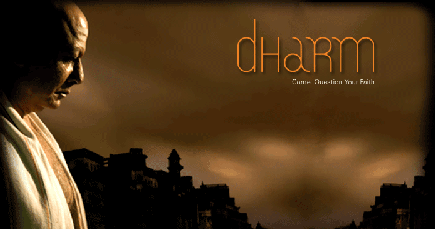
Dharm

Movie Review : Dharm
Language : Hindi
Released : 2007
Director : Bhavna Talwar
Starring : Pankaj Kapur, Supriya Pathak Kapur
My Rating : 9 out of 10

The Sanskrit word Dharm is often used in contexts where it can be interpreted as "religion" or "duty" or both. The point being, the right religion is duty and vice versa. The movie "Dharm : Come, Question Your Faith" stays true to this theme and forces the viewer to accept the broader meaning of "Dharm".

Pandit Chaturvedi (Pankaj Kapur) is a famous, scholarly priest. He practices what he preaches, hence even his adversaries respect him. He is not afraid to say the truth, has no political ambition and simply wants to live an austere life according to his interpretation of "Dharm". He has a loving wife and an obedient daughter. Together they are happy in their simple life.

One day a woman hands her baby to Pandit Chaturvedi's daughter and vanishes. She brings the baby to their home and assures her father that the baby is of Brahmin cast. When the police cannot find the mother, Panditjee wants the baby sent to a proper orphanage. But his wife and daughter are already attached to the infant and somehow convince him to keep the baby. As days and months pass by, he himself gets attached to the child. A father-son bond develops between the kid and the priest. And we see that the stern priest has a soft heart inside him. Then the real mother comes back to claim her child.

Not only is this a blow to the family, but a much harsher shock to the Pandit, as the boy's real mother is anything but Brahmin - she is a Muslim. The weeping boy - named Kartikeya by Panditjee himself - is sent off with his real mother. Now Panditjee has to fight to keep his social status. His real fight, though, is with himself. His belief system is at severe odds with his fatherly affection and tests every single drop of his resolve. But when the Hindu-Muslim riots break out, he realizes the true meaning of Dharm.

This is a simple and very powerful theme. Director Bhavna Talwar handles it without melodramatic cliches and remains very honest with the sensitive nature of the subject. She does not use the priest to preach wordy messages to the audience. Beautifully shot, everything in the movie feels real - the setting, the people, and the dialogues.

Of course, as important as the director is the lead actor. Pankaj Kapur gives a towering and flawless performance. The movie is centered on the character of Pandit Chaturvedi and his internal struggles, and Pankaj Kapur lives the part. Even his long silent moments on the screen convey his every single feeling clearly to the viewer.

I absolutely recommend this film. It's a slow paced feature without any entertainment. But it's immensely satisfying.

Related Posts Plugin for WordPress, Blogger...