Sunday, August 28, 2016

Rustom

Movie Review : Rustom
Director : Dharmendra Suresh Desai 
Genre : Crime, Mystery
Language : Hindi
Released : 2016
Starring : Akshay Kumar, Ileana, Pawan Malhotra, Sachin Khedekar
My Rating : 6 out of 10

In late 1950, a naval officer, Kawas Nanavati, returned from his duty to find out that his wife has been having an affair with his best friend. He checked out a gun from the naval armory, killed his friend and surrendered himself to the police. That incident, and the resulting court case has now become well known. A Marathi stage drama, “Aparadh meech kela” was based on it. In Hindi, Gulzar directed “Achanak” starring Vinod Khanna, which I remember watching as a kid, when it was later shown on TV. That movie only borrowed the affair and the murder part, but eschewed the court case and took a different route. It was quite a good movie back then.

The Akshay Kumar starrer, ‘Rustom’, has chosen to stay quite close to the real life story. Some minor details have been changed, like the names of the people involved. The plot is wider than the extramarital affair and revenge. At the same time, many important details, such as a tabloid trying to manipulate public perception, the battle lines drawn along communal lines - Parsi v/s Sindhi - are kept intact.

It’s a story that can make us think hard. Although a murder was committed, the reason is easily understood and something many would empathize with. A soldier risking his life, going away from his family for long duration, and getting betrayed by his wife and his friend. His revenge is a crime according to the law, but still feels justified to some extent. That was indeed the public perception at that time. His pain, his wife’s guilty conscious, the moral ambiguity of his actions, the difference in what the law says vs what people feel is justifiable - these are the right kind of raw ingredients to construct a story that touches us deep inside. The manipulation of public perception, and the communal elements should add to the tension and intrigue.

Unfortunately, Rustom, fails use these ingredients effectively. The movies focuses more on the courtroom drama and widening the plot to include a conspiracy. Which may not have been a problem. But it’s not a riveting court drama, rather it’s full of lame arguments infused with silly humor. The conspiracy that was supposed to shock us also turns out to be something that’s very shallow to start with and it can be easily guessed anyways. In all this, the pain of the betrayal and complex emotional issues surrounding it are subjugated to play a secondary role in the story. I had more expectations because of the association of Neeraj Pandey with the movie. His previous works, Wednesday and Special 26, were quite good.

The focus of the presentation has issues, but the rest of the effort is on the par. Acting is on the mark by almost everyone. Akshay Kumar has evolved into a dependable actor for such serious roles. No one else has comparable screen time, but they all do well with their roles. The setting of the movie is from late 50s, early 60s, and it’s done well. The camerawork is splendid, and the warm hues added to the print make it visually interesting.

As a chess buff, I have to mention this. The chess game played between Rustom and the police inspector is accurate. In chess world, the move sequence is famously known as 'Legal's Mate', and is often taught to the beginners. Kudos to the film makers for getting it right.

I only have a lukewarm recommendation for this movie. It’s definitely a decent attempt to make a movie that’s different from most commercial Bollywood movies, and I appreciate that. In my opinion, it should have been more serious, more emotional.


Tuesday, June 28, 2016

The Kill List


Book Review : The Kill List
Author : Frederick Forsyth
My Rating : 3 out of 5

Frederick Forsyth is my most favorite author for the genre “Thriller”, and by a wide margin. I have enjoyed books by many other authors in the same genre, but no one comes close. Who else does this level of thorough research and goes into such painstaking details? No one else could weave such intricate but realistic plots, smartly packed with surprises. Smart, being the operative word.

His first novel “The Day Of The Jackal” became a well deserved huge international bestseller. Many superb novels followed, many made into movies. I have read all, but after “The Fourth Protocol” I didn’t enjoy his next novels as much. Except “The Fist Of God”, which was as outstanding as his previous works. That’s natural, every artist eventually peaks, and Forsyth is now in late seventies.

The Kill List” is set in present times. The name of the book is based on the idea that there is a list of people deemed as serious enough enemy of the USA that the President has authorized them to be killed. Prominent on the list is a man simply referred as “The Preacher”. Inspired by his fundamentalist preaching over the internet, more than a few Muslims have conducted “lone wolf” style Jihadist attacks in US and UK. The best headhunter, known as “The Tracker” is assigned to find the identity of “The Preacher” and to eliminate him. The story then follows the investigation into discovering who the terrorist really is, and then the details of the operation to take the suspect out.

Forsyth has maintained his wry and dry writing style. His books often read like non-fiction. There is the typical jargon and unemotional description of even the most heinous events. His favorite Mossad and special forces play important roles. When required, he goes into absolute details to make us feel that we are there. There are parallel story-lines, that eventually meet.

So yes, there are many Forsyth elements in there, but not quite enough. Sadly the plot is not at all intricate. Hence the manhunt is interesting, but not the on-the-edge-of-your-seat kind. It’s also very linear, with almost no set backs. A lot of things need to go right, and they all do. In the end it seems all too easy. That means, there are also very few surprises. I am trying hard to point out the shortcomings without giving any spoilers.

It’s a decent read, but I don’t want to recommend it. If you have read and liked any of the celebrated books by Forsyth, then this book will most likely be a disappointment to you. If you haven’t read any of his books, then this is definitely not a good way to start. Read, “The Day Of The Jackal”, or “The Devil’s Alternative”, or “The Odessa File”, or “The Fist Of God”. Any of them, all of them. Skip this one.

Sunday, May 22, 2016

Diary Of A Multi-Color Rose

Finally, this year rain has shown some kindness towards California. That has immensely helped the plants in the backyard. Like so many others, I had also reduced the sprinkler duration to conserve water. Even if I hadn't, the sprinklers can never substitute the natural benefit rain water has for soil and consequently for the plants.

These photos are from the current spring season. This is a rose plant that I can literally spend hours marveling at. The photos barely do a justice to the incredible color transformation process each rose goes through, but hopefully they give some idea.

Note : You can click on any photo to start a slideshow.

The buds start with a deep pink color, with yellow at the bottom.


As the bud opens up, it gives some hint of the what's inside.


The inside petals are bright yellow, and the outside still keeps some pink.


As it opens more, it gives the impression that it is going to settle on the same yellow color.


When it opens up completely, the yellow starts to fade away, as if the flower is losing the color.


Then the flower changes its mind, and decides to slowly become pink again.


Even in the last stage, it still keep some yellow at the bottom of the petals.


Other flowers on the same plant, and even on the same branch, do not follow the same trajectory of color change, and end up in different states. Here are last 2 stages of another flower.


And much different stages for a third one.


The flowers on the same branch follow different timelines, so they have different colors at any given time.


And while this is happening, the entire plant has flowers that are at the various different stages of the blossom, resulting in a complete riot of colors.


I have no idea what's the name (scientific or otherwise) of this rose plant. Most likely this is a result of some hybrid experiment, and not because of some natural mutation. Whatever the cause, it's a delight, and the whole transformation is captivating. 


Saturday, April 9, 2016

Elevator Algorithm - A perfect interview question

For many years now, puzzle like questions have been very commonly asked during an interview for a Software Engineering job. If my memory serves me right, these were called the Microsoft Interview Questions during the 1990s. These days, they are more commonly referred to as Google Interview Questions.

Not everyone agrees with the strategy of asking these seemingly non-technical questions. For example, a famous question used to be about 4 people who walk at different speeds, and need to cross a bridge at night. The constraints being, there is only one flashlight available, and the bridge can safely take the weight of only two people. The task was to find the sequence that transports all of them in the shortest time, given the need that the flashlight has to be brought back once a pair uses it to cross the bridge. I liked that question, but I also understand, that it is only indirectly related to scheduling algorithms.

On the other hand, the “Elevator Algorithm”, as it is often called, is a much broader problem, and it is absolutely related to actual day to day coding tasks.

Let’s start with the simplest version. There is a very tall building, with one elevator to transport people. It’s just a regular elevator. On the inside there are command buttons corresponding to every floor, and every floor has request buttons for up and down. We have to design an algorithm to respond to the command buttons pressed by people inside the elevator, and the request buttons on the floors.

I am not giving a solution here, because the candidate has to treat it as a design problem, and more importantly as an “optimization problem”. There are different strategies available, and they optimize on different parameters.

The simplest strategy is of course, FCFS, First Come First Served. The elevator would respond to the first request button, go to that floor, drop the person to the requested floor and then move on to the next person. At first glance, it’s clear that this will generate excessive up and down movement of the elevator. It also will not be the most time efficient. But it’s not all bad. It’s very fair in terms of serving, if fairness means relative wait time. Choosing the next request would be very fast, based on a simple queue data structure.

A completely different strategy would be SSF, Shortest Seek First. Whenever the elevator drops a person to the desired floor, it can look at all the requests, and pick the request that’s originating at the nearest floor. It will minimize the distance that elevator has to travel to start serving another request. Clearly, there is a possibility that requests keep coming from a region of nearby floors, and the elevator doesn’t get a chance to serve older requests from floors that are far away. This can lead to starvation for some requests, as there is no upper bound on the wait time. Note that a slightly more complex structure than a queue, would be needed to store the requests, so that they can be searched quickly to find out the next best request. That would be another side question.

The two strategies above try to optimize different goals - fairness and the distance our elevator has to travel. These goals are in conflict of each other. A candidate can be expected to observe this conflict, and realize that this is an optimization problem, and not a simple coding exercise.

There can be other considerations as well, which will matter in more sophisticated strategies. For example the travel time once the person is on board, and the cost of stopping/restarting the elevator for picking up a person. 

It’s easy to see the relation of this problem to Computer Science. This is an old and very well known problem of Disk Arm Scheduling. The cost of seek as measured in time, and the movement of disk arm, both need to be minimized. A very similar problem exists for sorting items that are on tape, and is addressed by Knuth in his book.

The elevator problem, itself has been described on the Wikipedia page. It’s possible to tweak FCFS and SSF to add other considerations. For example, adding an upper bound on wait time in SSF, so that a request waiting over that bound gets priority over the nearest request etc. But the most widely used compromise relies on moving the elevator in one direction, serving as many requests as possible, and then changing the direction to serve requests in that direction, and so on. That's what is actually known as the Elevator Algorithm.

More fundamentally, the core of the problem is sequential access. In my opinion, that realization is more important than knowing an implementation of Elevator Algorithm. The idea behind this problem will appear in one form or another whenever you are restricted to sequential access. For example, the data in memory could in a very big doubly linked list. Today, in the world of Big Data, sequential read is the most common access pattern, and a variation of this problem will confront you, whether you do map-reduce or some other implementation.

Hence, in my opinion, this is one of the best interview questions to gauge the candidate’s grasp on the fundamentals of Computer Science. In addition, this one can be extended in many different directions, making it an ideal problem to see how the candidate thinks. It's easy to make it an object oriented design problem. It can be used to discuss different data structures that will help in the implementation. If needed, it can be made even more complicated by adding multiple elevators serving the building, where a request button summons the most appropriate elevator. That is another nice optimization problem. But the core single elevator problem is often good enough to judge the ability of a candidate to see different trade-offs inherent in any design.

As a side note, the original elevator analogy for sequential access and/or processing is not as straightforward anymore. Real life elevators have other complex considerations, such as time of day, special floors etc. Some have more complex floor controls, where people can also express where they intend to go. And so on. It’s a topic in itself, as can be seen by a rather large tome named Elevator Traffic Handbook. You can preview that book on Google Books if you want to dig deeper on this topic. :-)

Friday, March 11, 2016

The Affair (Season 2) : Showtime Series

Review : The Affair (Season 2)
Aired on : Showtime (2014 - )
My Rating : 8 out of 10

NOTE : This is a review for the second season. I have tried to not mention any spoilers, but if you haven’t watched the first season, I recommend that you read the review of season 1.

The Golden Globe winning TV Drama Series “The Affair” uses the same “Rashomon Technique” to present the next part of the story of season 1. This time, in addition to Noah (Dominic West) and Allison (Ruth Wilson), we also get to hear the perspectives of their respective spouses, Helen (Maura Tierney) and Cole (Joshua Jackson).

The story picks up where it left the last season. Noah and Allison are living together, in a place loaned to him by a friend. He is making good progress on his book. Allison is keeping herself busy. Helen is trying to get on with her life, but Cole is having a tough time to live without Allison. All that’s in the past tense. In present, the investigation that cast a dark shadow in the first season, has become a trial, which casts a similar shadow here. But this time, things are darker even otherwise.

The strength of the first season was writing and acting. The acting is once again perfect. That should not be a surprise, as it’s the same cast. Ruth Wilson and Dominic West are simply fantastic. Maura Tierney is perfect, even the newly added characters are played well.

That brings me to the other strength. The writing is brilliant. It’s better than the first season. One of the things I generally dislike about later seasons, is the addition of characters to get the story going for more and more seasons. The new characters are few and do not feel superfluous. The focus still firmly stays on the original characters.

It’s not just the absence of negative. The writers have done a fabulous job of advancing the story much further. Not in time, but in terms of filling in the details. In the first season, I felt the plot was not very interesting. This time, the plot is developed very nicely. As a result the season is much more than just a close-up look at adulterous human nature. Make no mistake, there is still a lot of sex, and for all characters. But, many questions that were deliberately left unanswered by the first season have been answered, and answered well.

There are new surprises too. I don’t know if these were always in the story, or were planned later. In any case, they work very well. For this, the writers had to add some darker shades to the characters. I think I dislike almost every character now. That’s not a complaint, a good story does not have to have noble characters.

The master stroke is how the season ends. In spite of resolving all the mysteries, the story from this point onwards can turn in many plausible ways. It’s smartly done, and it’s all very believable.

In my opinion season two is better than season one. In the first season, there was a novelty of using the multiple perspectives. It’s no longer a novelty. This season actually has a better plot. 

If you have watched the first season and liked it, I think you will find season two very satisfying. It’s correctly rated as TV-MA and it's not suitable for even teenage kids.

Wednesday, February 17, 2016

Natsamrat


Movie Review : Natsamrat
Language : Marathi
Director : Mahesh Manjrekar
Genre : Drama
Starring : Nana Patekar, Medha Manjrekar, Vikram Gokhale
Released : January 2016
My Rating : 9 out of 10

Theater has alway been a big and integral part of Marathi culture. Like many cultural heritages, sadly, the standards have been in a long decline. The industry may still be thriving, but the Golden Age of Marathi Theater is long over.

The most exquisite jewel from that age is the Sahitya Academy Award winning play, “Natsamrat”. Written by one of the most respected and accomplished Marathi writers, Vi. Vaa. Shirwadkar, also known by his pen name, Kusumagraj, this play not only set a very high bar, but also influenced the society like no other play has.

It’s the story of the last phase of life of, Ganapatrao Belwalkar (Nana patekar), a beloved stage actor of his generation who was referred as “Natsamrat” (Emperor of Acting) by his admirers. After he retires, he chooses to give all his wealth to his son and daughter, and decides to play the real life role of a grandparent. His style of grandparenting is unsophisticated, and that creates disputes with his daughter-in-law. So he and his wife go to live with their daughter who is now married. Even there, his outspoken and blunt personality creates uncomfortable situations. The suspicion of theft becomes the last straw for the aging couple, and they decide to move out even in their bad health, and with almost no money. It eventually ends in a tragedy as you can expect.

It’s a simple plot and is unabashedly melodramatic. It manages to go beyond that, by raising its own level with help of realistic situations that touch the very core of human heart. The play was released in early 70s, when the social structure was changing from the one based on joint families to smaller nuclear families. This change was hard for the generation that believed in handing over the keys to their offsprings in order to enter the next stage of life, “vanaprasthashram” as it’s called. As we all know, unfortunately in some cases elderly parents were mistreated.  Natsamrat brought this dark side of the society out in open and became a cautionary tale. The lesson was loud and clear. Never give up your financial independence. Definitely not to your kids.

The writer of the original play, Kusumagraj was an extraordinarily gifted author/poet/playwright. He later won the Jnanpith Award Winner and was also honored with the title of Padmabhushan. With his literary prowess, the story then scales the heights of drama by infusing dialogues that are both poetic and hard hitting at the same time. The original drama had long monologues, that are permanently etched in memory of theatergoers. The strength of the words here make it a more than just a drama. This is now classic literature.

Whatever I have written so far, applies more to the original drama on which the movie is based. The movie has left the essence untouched, including the famous monologues. There are modifications, some I agree with, some I don’t. The character of Ganpatrao’s friend, is added in the movie. It blends well with the story. The character of Ganpatrao himself has been made to have some negative shades that are not in the drama. In the drama, he is not the drunkard that he is shown here. Overall, in the movie he is a bit difficult to deal with which was not the case in the play.

Apart from being a milestone play, it also created a dream role for any serious ambitious actor. It is a monumentally difficult role to pull off. The weight of the dialogues would easily crush an actor who is not a complete master of voice control, modulation and timing. On stage, the role was played mainly by Dr Shriram Lagoo, and then by Datta Bhat among others. Today, there is no better actor than Nana Patekar who can rise to this challenge. He is simply outstanding. I don’t think I have words to explain what he has accomplished here. It’s a performance that has to be seen and heard. Even if you do not understand Marathi, just watch the movie for his performance. The subtitles are quite good and should help.

Mahesh Manjrekar is back to directing great movies again. I remember his superb Astitva, and then the disappointing movies that followed. Now he has Kaaksparsh and Natsamrat under his belt, and that bodes well for us. Hopefully the trend continues, and we get to see more movies with a story and a soul, like these two.

Medha Manjrekar (in the role of Ganpatrao’s wife) and Vikram Gokhale (in the role of Ganpatrao’s friend) have given memorable performances. Most other actors have also lent good support.

The core idea of the play, has later been seen in many movies, from Avatar (featuring Rajesh Khanna) to Baaghbaan (featuring Amitabh Bachchan). It’s really wonderful that a movie has now been made to remind us all of the greatness of the original play. I highly recommend this movie, and think everyone should watch it. It’s absolutely safe for kids, and I would recommend that you watch it with them.

Tuesday, January 5, 2016

The Fifth Gospel


Book Review : The Fifth Gospel
Author : Ian Caldwell
My Rating : 4 out of 5 stars

After reading the blurb on the cover of “The Fifth Gospel”, it’s very natural to think of “The Da Vinci Code", or “Angels and Demons”. A Vatican murder mystery involving an artifact from Christian history, has to remind us of Dan Brown’s novels. That would be a wrong expectation to set, as Ian Caldwell’s sophomore effort is at the diagonally opposite corner.

The story is told to us in the voice of Father Alex Andreou, a Greek priest who grew up in Vatican. Right at the beginning of the story, he gets a call from his brother, Father Simon, that their mutual friend Uno has been shot. Uno was a curator at the Vatican Museum, and was going to open a new exhibit in a few days. That exhibit, about the “Shroud Of Turin” and its relation to the so called “Fifth Gospel” was expected to have a profound impact on the relations of Vatican with Orthodox Christians. With so much at stake, such a project was receiving both support and opposition from different powerful forces within the Vatican. Father Simon is put on a trial for killing Uno, but he decides to remain silent and not defend himself. The rest of the book follows this trial, what did Uno discover that put his life in danger, and the mystery of who killed Uno.

There are clear similarities between this plot and “The Da Vinci Code”. But the treatment is very different. Dan Brown wrote a page turner with a controversial interpretation of history. Here, Father Alex is a very simple man, for whom family comes first. He is a bit too sentimental in my opinion, but I understand why that’s the case. All other characters are very well drawn, and most are likeable. There is a lot of focus on feelings and relationships. The phrasing is literary in places. There are lots of details about the Vatican, and especially its legal system. There is some puzzle solving and interesting investigation of history too. Overall, the story feels lot real, and the reader is bound to empathize for Father Alex.

I learned a lot about the history of relationship between Catholic and Orthodox segments of Christianity, and the differences between the gospels. The details about internal workings of Vatican were interesting too.

The book does feel dragged at places. The mystery aspects works well, but the intermediary surprises are often unexciting. For example a chapter would end with you wanting to know more, but when the surprise is revealed, it’s a “duh” moment. I cannot elaborate on this without giving any spoilers, but you would understand what I mean, when you read the book.

I definitely recommend this book if you set your expectations right. This is a medium paced, uncontroversial and sincere book. It aims to educate, as well as entertain with a believable mystery.

Thursday, December 24, 2015

Bajirao Mastani

Movie Review : Bajirao Mastani
Language : Hindi
Director : Sanjay Leela Bhansali
Genre : Historical Drama
Starring : Priyanka Chopra, Ranveer Singh, Deepika Padukone
Released : December 2015
My Rating : 6 out of 10

I have watched only two or three movies directed by Sanjay Leela Bhansali. I was extremely impressed with “Black”, while I simply couldn’t stand “Devdas”. When I heard his other movies also valued “style over substance”, I didn’t bother to watch any more. In spite of fearing the same for this movie, I still wanted to watch it.

This is a story that I am very familiar with. The history of Maratha Empire is something I have studied in detail in school. Since I have always been interested in History, I have also read many semi-fiction, semi-history Marathi novels that have been written for this period. This period is part and parcel of Marathi culture and Marathi pride. References to Peshwai are common in Marathi speech. In short, this topic is very close to heart, and at the risk of sounding narrow-minded I will say, this is a history of my people.

With that background, I can provide my understanding of “Raa’u”, the book written by Naa. Sa. Inamdar, and on which this movie is based. Bajirao-Mastani, is not, very emphatically, not a Marathi version of Romeo-Juliet. Bajirao, a Brahmin by birth, was an undefeated leader, known for his legendary skills of maneuvering cavalry. They say, he lived his life on a horse. After his marriage with Mastani, a Muslim woman, he tried very hard, but did not succeed, to give legitimacy to their relationship. His disregard for social norms was scandalous in the ultra-religious, ritualistic society of that time. This strained his relationship with his own family, especially his brother who was loyal to him like Lakshman was to Raam. This combination of rebellious love of a Hindu Brahmin leader with a Muslim woman, family drama, military triumphs and the political conspiracies that were all too common in those times, makes it a very complex and potent story. It should naturally lead into making a great movie.

Unfortunately, Bhansali’s adaptation turns out to be a movie with a split-personality. He has succeeded in bringing our attention to many aspects of the story, especially Bajirao’s naive struggle to get the society to accept his marriage to Mastani. But then he chose to make it a Romeo-Juliet in the end. His casting of secondary characters is perfect in case of Milind Soman (as Ambaji Panth) and Vaibhav Tatwawadi (as Chimaji Appa), but is laughable in case of Ayush Tandon (as the eldest son of Bajirao). The settings are very realistic in some cases (especially the inside of Shaniwar Wada) and totally fake in many. Please try to not look at the background sky. Especially the moon looks straight out of 70s movies. The dialogues are occasionally memorable, but often times feel like forced marriage of words (“dhalta sooraj, khilta chaand” etc), and sometimes just idiotic (Bajirao's repeated line of “Cheeteh ki chaal …”). This overall, cannot be termed as competent direction.

I am told that Bhansali’s movies are to be watched for the lead actors frolicking in the opulence of costumes and sets. Well, some of the sets are indeed impressive, with nods to Mughal-e-Azam (courtesan dancing in a room full of mirrors), a set out of Paakeezaa which interestingly is used to picturize a holi song without any real holi, go figure. 

Coming to lead actors. Both the ladies manage to show different shades of emotions. These are complex roles, especially Kashibai (Priyanka Chopra) who justifiably feels wronged by her husband. Deepika Padukone is perhaps the best choice today to play the role of Mastani. I was neither particularly impressed by the acting of both, nor do I have anything to complain about.

The main problem is Ranveer Singh. This is the first time I have watched him, and I don’t think he is a good actor to begin with. On top, he and Bhansali have chosen to portray Bajirao as an unpolished crude, almost a brute, as opposed to a civilized, inspiring leader. Maybe they had an “angry young man” in mind, but this interpretation comes across more as a goon than a king. His body language is awkward and sometimes comical. His dialogue delivery has no gravitas. This is my main objection to the movie. I am OK with all the artistic liberties even though I cringed watching the Peshwas dance. I really don’t understand that decision. Was it necessary to have Bajirao and Kashibai dance? I am not offended, but I don’t see the point.

On the positive side, I am happy someone brought this great story to wider audience. I hope it brings more awareness to Bajirao’s positive impact on India. It was his farsightedness that established at least three major confederacies (Baroda, Gwalior, and Indore) outside Maharashtra, which ensured the continuation of Hindu rule.

This movie has more depth and substance than “Devdas”, but still falls short of being a good movie. In case you want to watch it, I recommend watching it on a big screen to enjoy some eye candy it presents.

Sunday, November 1, 2015

True Detective

Review : True Detective (Season 1)
Aired on : HBO (2014)
My rating : 8 out of 10

For over a decade now, Cable (AMC, HBO, Showtime etc) is where good serials have been happening.  I haven’t watched the second season yet, but the first season of  “True Detective” is another feather in HBO’s cap. I say that, in spite of this series not tackling any new subject.

The Movie and TV industry has had a long and strong fixation with serial killers. Way too many movies, and TV serial episodes have been produced about them. It’s not easy for a yet-another-serial-killer story to differentiate itself. We have been shocked in so many different ways that it’s getting more and more difficult to produce such stories that command investment of our time. The unbelievably over the top “Dexter” was one approach to be different. For me, it was too gory to watch, and I gave up after the first season. Thankfully, “True Detective : Season 1” has taken a very different, and much classier approach.

It succeeds in deserving our time, by not overemphasizing the thriller dimension, and getting the two lead characters in much sharper focus. The nice thing is, it excels in both the aspects.

The story is told to us via flashbacks, which come during the interviews of three people - two ex-cops, Rust Cohle (Matthew McConaughey) and Marty Hart (Woody Harrelson) and Marty’s ex-wife. Rust and Marty were partners once. Many years ago, they solved the mystery of a series of murders committed as part of some devil worshiping rituals. It was a significant achievement, but their partnership had broke after that. Soon afterwards, Marty separated from his wife. Then Rust left the force, and so did Marty after some time. Now the police want to talk to all of them, to get help on a similar case. But they don’t seem very friendly, and are cross checking stories told by each.

This sets up multiple suspenses. How was the mystery solved? Who was the culprit referred as the “Yellow King”? Was it really solved? What really happened during the investigation? Why did all the relationships broke? Why did they leave the force after such a great success? And so on.

As the episodes progress, you will realize that this is not just another murder mystery, but it’s also a buddy story. Now it’s very common for the buddy stories to feature diagonally opposite personalities, and it’s true to some extent here as well. Marty is religious, while Rust has a very cold logical way of looking at things. But the commonality between them is the drive for justice. That drive binds them together, and makes them overcome the differences. That drive also helps them partially redeem themselves, because both of them are flawed individuals.

This intermingling of personal drama with a very serious crime mystery is done masterfully. Nothing is trivialized, and there are no guilty pleasures here. It’s serious, disturbing and still makes us root for the flawed characters.

As you can expect from this synopsis, the two lead characters together get almost all the screen time. Such an arrangement wouldn’t be successful without exceptional performances by the two actors. Matthew McConaughey has a perhaps the more memorable part as the comparatively flamboyant role of Rust. I was also very impressed by Woody Harrelson, playing a more complex role of a cheating husband who also deeply loves his family.

The characters and the drama is a huge plus. The mystery aspect, is almost as good. Almost. I thought it ended a bit hurriedly. The series is not short, but the way the mystery gets resolved was too quick.

I very highly recommend this season. Every episode wants to make you watch more, so many might find themselves, binge watching this one. According to the format, every season will have a different story, and different characters. So I presume, seasons can be watched in any order. This is correctly rated TV-MA and is not for kids.


Friday, October 2, 2015

Brilliant Blunders


Book Review : Brilliant Blunders
Author : Mario Livio
My Rating : 3 out of 5

The complete title of the book is “Brilliant Blunders: From Darwin to Einstein - Colossal Mistakes by Great Scientists That Changed Our Understanding of Life and the Universe”.

Yes, that’s a mouthful, and sadly, not accurate.

When I started reading this book, I got the impression that the blunders as committed by these great scientists somehow helped us understand the truth eventually. After reading the book, I am sure my impression was wrong, but I don’t even agree that these were some colossal blunders.

Author Mario Livio presents five case studies of great scientists and their revolutionary contribution to science. He also wants to show what blunders they made. There is a lot to disagree here. First, it’s beyond argument, that Darwin and Einstein, both have changed our thinking profoundly. The same cannot be that easily argued about Lord Kelvin. Not that Kelvin was not a great scientist, he indeed was. But I don’t think his contribution can be kept on the same pedestal as Darwin and Einstein.

Secondly, I completely failed to see the so called blunder in most cases. Let’s talk about the chapters on Darwin as an example. The theory of evolution needs a compelling theory of inheritance. At that time, no such theory was known. Darwin was aware of the gap, and tried coming up with his own theory of inheritance. It was flawed and he himself wasn’t very convinced. By stroke of pure bad luck, he missed out on paying attention to what Mendel was documenting. The author has done some original historical research to support what he is saying, and I believe what he has written. But where is the blunder? Darwin tried filling the gap, but couldn’t. That’s no blunder. 

The course of scientific discovery has never been a straight line, or a simple act of building knowledge upon knowledge. There have been enormous number of dead ends, discredited theories, stubbornly wrong scientists etc. We all know that. Yes, even great minds sometimes cannot solve all the pieces of the puzzle. I cannot call it a blunder.

To be fair, the author is not trying to ridicule anyone. He is clearly trying to explain why it happened. What was the mental block, where did the intuition failed and so on. That’s not what the title, or the introduction conveys correctly. The title definitely does bad service to the book’s impact. While the author may have succeeded in explaining some cases, he simply has not, in others.

That criticism apart, I have to give credit where it’s due. The author has written wonderfully about Fred Hoyle, one of the best known cases of a scientist sticking to a discredited theory. His great mind made huge contributions to cosmology, including the “Steady State Theory”. That theory was eventually won over by the “Big Bang Theory”, whose name was ironically coined by Hoyle himself. But Hoyle could not let go of his own theory. Mario Livio does a good job of explaining why it might have been so.

I think the best historical research done by the author comes at the end. Many popular science books tell us that Einstein called his introduction of the cosmological constant as hist worst blunder. You will find here a very conclusive case, that Einstein never said so, and the origin of this myth is perhaps a prank by Gamow. This is some nice contribution to the history of Science.

Overall it’s an easy book to read, and in spite of my criticisms, I can recommend it. I must mention that it’s more about the history than the science. So if you are looking for understanding the theories themselves, you will have to look elsewhere.

Saturday, September 5, 2015

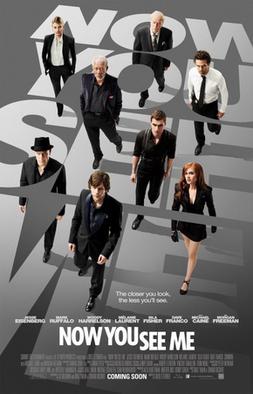
Now You See Me

Movie Review : Now You See Me
Director :  Louis Leterrier
Genre : Thriller
Starring : Jesse Eisenberg, Woody Harrelson, Isla Fisher, Dave Franco, Mark Ruffalo, Melanie Laurent, Morgan Freeman, Michael Caine
Released : May 2013
My Rating : 7 out of 10

I was in India when the movie “Dhoom 3” came out with a huge hype. I was very disappointed by the movie. I thought it was an inept imitation of the one of the main premise of “Prestige”,  a movie I had liked. Then I heard that it was more inspired by “Now You See Me”, so I made a mental note of not watching it. But a lazy weekend made me needy enough to watch an entertaining movie. I put it on, and I must say that it was a fun ride.

As the movie starts, we are introduced to the four main characters in an impressively efficient way. Daniel Atals (Jesse Eisenberg) is a street magician, Merritt McKinney (Woody Harrelson) is a mentalist, Henley Reeves (Isla Fisher) was once an assistant to Atlas and Jack Wilder (James Franco) is a con artist. These first few minutes set the tone for the entire movie. It’s clear from these opening scenes that we shouldn't be expecting much character development, the dialogues are going to be one liners and it’s going to be a fast paced movie that will try to dazzle us. Some viewers, may be reminded of “Ocean's 11”.

The movie happens in three acts. The first act involves the four protagonists stealing a French bank as part of a live magic show in front of a stunned crowd. The end result is no illusion, and FBI gets involved.

Detective Rhodes (Mark Ruffalo) gets this case, and is extremely unhappy about the assignment. He doesn’t want to believe in the capabilities of these magicians, but gets outsmarted at every turn, and then is forced to work with a French female agent from Interpol. It soon becomes a personal battle for him to expose the gang. Helping him with cryptic hints, is an ex-magician Bradley (Morgan Freeman). Of course, there has to be an all knowing wise old man in such stories.

The second act is an equally impressive (and equally improbable) magic trick. Uptil this point, the high energy, witty dialogues, fast paced music and the ideas of the tricks keep everything very interesting. We learn more, and the real mystery starts slowly revealing itself.

Then, sadly, the third act starts. From this point, the plot relies on very convenient and unbelievable twists. The final magic trick is even more unreal. Well, all the magician movies that I have enjoyed, require the viewer to not question everything that is shown on the screen. “Prestige” was superb, and had that requirement. So did Edward Norton’s excellent movie “The Illusionist”. So I am OK with so called “suspension of disbelief”. What fails “Now you see me” is that the final trick is kind of boring, a bit predictable and too contrived, all at the same time. So the final payoff is a flat out disappointment.

In spite of that, overall, it’s packed with entertainment, and it will put a smile on your face, at least till the third act. The cast is A-list. It’s a big list, and hence everyone gets a small ration of screen time. But there is enough individual talent to shine through, and they will make you remember every character.

Director Louis Leterrier doesn’t rely on CGI here as much as did in his other movies (The Incredible Hulk, or Clash Of The Titans). There is also much less action compared to those movies. Still, this feels like a higher octane movie than those, and I think the director deserves credit for it.

A sequel is planned. I think I will watch that one too. I recommend the movie, but be aware that there are plot holes, and this movie is not to be taken too seriously. It should be fine for older teenagers.


Tuesday, August 4, 2015

The Sixth Extinction


Book Review : The Sixth Extinction
Author : Elizabeth Kolbert
My Rating : 5 out 5 stars

The complete title of the book is "The Sixth Extinction: An Unnatural History".

Environmental issues have been on our social psyche for many decades now. From global warming to deforestation, we associate the cause of all that to our modern lifestyle, which includes burning fossil fuels and the seemingly uncontrolled growth of population. That’s true, no doubt, but from the viewpoint of anthropology, the story is much deeper than that, as documented by this Pulitzer Prize winning book of 2015.

The reason for the incalculable change we have caused to Earth’s ecosystem, is just us. We being the weedy species that we have evolved to be. Period. Author Elizabeth Kolbert argues convincingly that modernity has only accelerated the impact. Even before the advent of modern lifestyle, we made irrevocable changes to this planet, and some would argue, damage is a more appropriate word than change.

Most of us know about the shrinking habitats for many species, and how the wildlife numbers are dwindling down. What is perhaps unlikely to be wide knowledge is, even the number of species is rapidly going down. Yes, species, entire species, are going extinct at an alarming rate. This rapid extinction began when humans started spreading out of Africa.

Species going extinct is part and parcel of the evolutionary process. When the reasons are not evolutionary, but an ecological disruption, mass extinctions can occur. Scientists estimate that there have been many such mass extinctions throughout the history of our planet. Out of those, five were truly horrific, and wiped out almost all species, save a few. The most well known of these is the asteroid impact that eliminated dinosaurs. What’s going on since last 200,000 years or so, is the sixth extinction, caused by us.

This is at once a morbid and sobering topic. If it wasn’t for the skillful writing by Elizabeth Kolbert, it would be just a boring accumulation of facts and stats. She has made a story out of this which keeps the reader completely engaged, and informed at the same time. She gives a nice primer on the history of theories as we go along. I was unaware how long it took us to even understand that mass extinctions have occurred, let alone figure out the reasons for it. The asteroid impact theory is only 3 decades old!

Another reason why it has become such an easy to read book is, she tries very hard not to be an alarmist, but remain completely factful. It’s a tragic story, some chapters like the demise of the Great Auk hit you very hard. At one point, their numbers were in millions, but it took us less than three centuries to hunt them to extinction. Many such flightless birds perished quickly on encountering humans. We eliminated many mammals, like Mastodons in North America, and perhaps the entire megafauna of Australia. The theory of the extinction of hominids like Neanderthals is depressing, as well as disturbing. On top of this, what we don’t kill via hunting, we kill by introducing viruses and predators against which the native species haven’t had a chance to evolve survival techniques. Make no mistake, this is not a happy book, but being a journalist, the author is adept at presenting in a way that will keep you turning pages.

Somewhere in the middle of the book is one of the most poignant observation I have read in a long time. She notes that for all the talk of our ancestors living in harmony with nature, the truth is, humans never ever lived that way. It may anger people who are proud of their heritage, but I think it’s true. Very true.

She also points out that, in spite of all that, we also show very altruistic behavior, and on an individual level, go to great lengths to lessen the speed of extinction. We have just barely started realizing the magnitude of our impact to this planet. So there is a long way to go, but there is a glimmer of hope.

It’s a superb book. I am giving it five stars but I was a tad surprised at the Pulitzer Prize. Of course, I haven’t read other books that were nominated, but at the end this book did feel a bit hurried. I would have also preferred some explanation of the scientific terms at the very beginning, and even more pictures. Those are minor quibbles. This book must be on your reading list.

Related Posts Plugin for WordPress, Blogger...