Saturday, July 13, 2013

Maasai Mara : Elephants And Monkeys

One animal that really fascinates me is the Elephant. Most people are not aware how intelligent and emotional elephants are. The African Elephants live in a tightly knit family led by a matriarch. Babies and calves are at the center of the family's attention. Their intelligence is comparable to apes and dolphins, but emotionally they are perhaps the most advanced of all the wild species. They have been recorded to show remarkable altruistic behavior, and showing empathy not only for other elephants, but towards humans and other animals too. Elephants show self-awareness, as well as a great understanding of life and death. They grieve their dead, exhibit some sort of burial rituals and remember their family members forever. They are friendly and caring animals. Very unusual for a wild species.

In the outskirts of Nairobi, is an Elephant Conservatory which takes in orphaned baby elephants, raise them and then release them back in wild. Most common reason for them losing their mother is poaching. For ivory. Its really heartbreaking to see the wobbly walk of this 2 month old motherless calf. It still needs a blanket to help regulate its body temperature.


There are so many of orphans. Elephants are a "keystone species", necessary for protecting the environment. Hence the conservation efforts are essential.


They are taken good care of. But they are not allowed to get too friendly with humans, as they have to go back to the wild, and then stay away from potential poachers.


Growing up in India, I have had many opportunities to see and touch an elephant. But seeing them in wild, freely enjoying their life, protecting their young in their in large families is a wonderful experience.

A solitary elephant, probably a male, as the adolescent males leave their family to start their own.


This is a small family, with babies born perhaps an year apart.


Elephants make excellent photographic subject!


We came across a fairly large family, with many babies in all sizes.


They were happily playing with each other for a while. Such a magnificent creature, and we humans kill it just for its teeth so that we can make some trinkets!

It was obvious who was the matriarch. She was the largest and never took her eyes off us.


Once more and more safari vehicles started arriving to see them, the matriarch got uncomfortable and quickly led her family away.


For more photos of elephants, check out the set on Flickr.

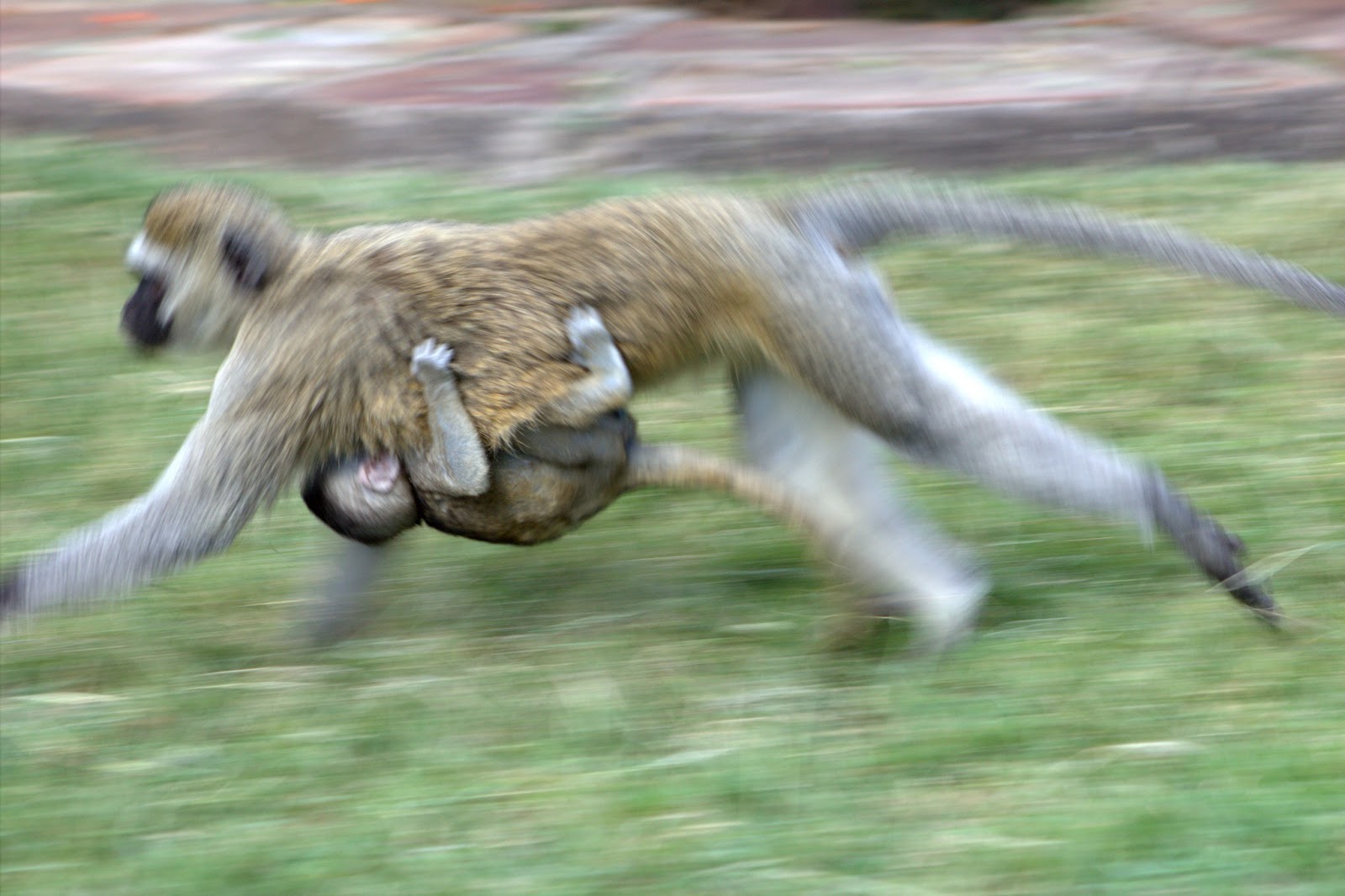
Comparable to Elephants, Monkeys also display intelligence and care for their young. But it's more obvious to us, as they look a lot like us.

They are also pests and create quite a bit of nuisance. Apparently they love the honey from the flowers of this plant, "golden shower".


One was curious enough to check out what's in my tea cup :-).

Not finding it tasty, it ran away.


The next is a baboon, a very aggressive and dangerous creature.


The colobus monkey is quite good looking.


You can click on any photo to start a slideshow.

For more photos of monkeys, check out the set on Flickr.

Friday, July 12, 2013

Maasai Mara : Buffalo And Antelopes

You can click on any photo to start the slideshow.

In addition to the 2 million strong population of zebras and wildebeests, there are many other grass feeders in Maasai Mara. The Cape Buffalo is considered one of the "Big Five". It is indeed very massive, but what has made it famous is its dangerous nature. They unite together to extract revenge on the attackers, be it lions or human hunters. Entire herd joins in to ferociously protect their young.

The face has a clear expression, 'Don't you mess with me'.

The white spots below the eyes indicate that it's an older buffalo.

Birds are happy eating the insects on their back, and buffaloes are happy to get rid of the pests. A mutually beneficial relationship.

This was the largest heard we saw.

For more photos of the buffalo see the set of Flickr.

Then there are many species of antelopes. We got to see all the major ones. Maybe the biggest is the waterbuck. It's a misleading name, as they don't spend much time in water.

Hartebeests are also a large antelope, and generally very clam.


Topi is very similar to the hartebeest, but much darker in color. I do not have any photos of just the topi, they were always together with some other animals.


Smaller than these, is the impala. With a beautiful golden brown coat and stunning horns, which is a very distinctive feature and makes it easy to identify them. My favorite of all antelopes.


Look at this beauty!

Smaller than impala, is the Thompson's gazelle, the absolute favorite food of the cheetah, due to its small size. They have distinctive black stripes across their body.


All these antelopes are often found together in the savannah, in various combinations.

Zebras, topis and impalas.

Zebras, impalas and gazelles.

And all of these together!

The smallest and the shyest of them is the definition of cute. It also has a funny name : Dik-dik.


All these animals are abundant in the Serengeti / Maasai Mara area. For more photos of these antelopes, check the set on Flickr.


Wednesday, July 10, 2013

Maasai Mara : Zebras and Wildebeests

Serengeti is a huge region mostly in Tanzania. The part of it that is in Kenya, is called Maasai Mara. It's considered on of the natural wonders of the world, due to "The Great Migration". An estimated 2 million animals move as part of this migration, following the rains and fresh grass. This large collection of herbivores support a high population of predators, especially lions, leopards and cheetahs. Hence it has provided a frequent settings for documentaries related to nature and made it a popular tourists destination.

Watching this migration is an experience that simply cannot captured. Neither in words, nor in pictures. The documentaries have captured amazing moments and unforgettable scenes, but there is nothing like being surrounded by countless zebras and wildebeests, stretching as far as you can see.

You can click on any photo to start a slideshow.

In the picture below, all the dots in the distance are wildebeests!


They often form a single line while moving.


The wildebeest is not a particularly good looking animal. But they are crucial in supporting the ecosystem and the circle of life here.


Even the babies are not all that cute.


The zebra on the other hand is a beautiful animal.


Their babies are adorable.


Sometimes, all you can see is zebras, without wildebeests.

For more photos, check out the set of photos on Flickr.

Sunday, June 9, 2013

Diary Of A Rose - Part 1

The first bloom of 2013 is over. This year, I tried taking photos of the roses as they go through various stages of the bloom.

Exactly two years ago, (see post here) I moved this rose plant, and it took a while for it to recover from the shock, but it has come back strong.

First, a few photos of some flowers as they were blossoming. Some have been taken with my Samsung Galaxy 3. Others with a prime lens, and it's obvious which are these :-)

You can click on any photo to start a slideshow.

First the young buds.


As I captured previously (see post here), ladybugs are frequent visitors on a rose plant due to aphids.


Blossoming !


Getting bigger and bigger.


Even bigger.


A size comparison is needed to truly appreciate the size of these flowers. Every flower is size of a small cabbage. :-)


Now some photos of the plant in the full glory - in different stage of blossom.


Tuesday, May 21, 2013

Tinker Tailor Soldier Spy

Movie Review : Tinker Tailor Soldier Spy
Genre : Thriller / Suspense
Director : Tomas Alfredson
Starring : Gary Oldman, Colin Firth, Tom Hardy, John Hurt
Released : 2011
My Rating : 8 out of 10

David Cornwell worked in the UK Secret Service in the 50 and 60s. Drawing from his experience with MI5 and MI6, he wrote psychological thrillers that portray the world and life of spies as realistically as possible. His novels are unlike anything you will ever find in James Bond movies/novels. They are also unlike anything Ludlum ever wrote in his many end-of-the-world conspiracy novels or his celebrated Jason Bourne series. When his spy novels started becoming international bestsellers, Cornwell chose to become a full time author. The novels written using his pen name - John Le Carre - have defined the standard by which all spy novels are measured.

These novels are devoid of physical action and packed with mental tension. Leisurely paced and full of jargon, they require complete attention from the readers to follow the chess games that are being played in the minds of spymasters. It's well worth the effort. But keep this point in mind when you watch this adaptation of what's often considered as John Le Carre's finest novel.

George Smiley (Gary Oldman) is the central character here as in many of Le Carre's novels. An operation goes terribly wrong and he is forced out of service, along with his boss - known to us as "Control" (John Hurt). When a British undersecretary receives a tip that there is a double agent very high up in the organization, he asks Smiley to head a secretive investigation, outside the scope of the "circus" or MI6. This is the story of that investigation. It's also the beginning of the trilogy that pitted Smiley against the head of KGB, referred as "Karla".

It's a complex book, with a large number of characters, and many subplots that don't lend to the 2 hours movie format. There was a very popular BBC serial with none other than Alex Guinness starring as Smiley. A TV serial is the right format for so much material. Making a movie out of this book is a daunting task. Director Tomas Alfredson succeeds in maintaining the atmosphere, the tension - but fails in clarifying everything that goes on. I felt a bit confused at multiple junctions in the movie, and I am sure I am not alone.

It's just the nature of this particular book that makes it so hard for the director and the writer. Le Carre's other novels have been successfully adapted. I really like "Tailor From Panama", and I highly recommend it. I was less impressed by "Constant Gardener", even though it earned many nominations and Academy award for Rachel Weiss.

Gary Oldman was nominated for Oscar for his performance as George Smiley. No disagreements there. I haven't seen Alex Guinness play this role in the TV serial, so I cannot compare. I am sure it's hard to top Sir Guinness, but Oldman was fantastic for me here. The entire cast is filled with A-list actors. John Hurt, Colin Firth and everyone else gives a perfect performance.

The director has to be complimented for remaining faithful to the book in the style of presentation. This movie uses camera far more than words. There are many silent scenes and they are potent. When "Control" and Smiley are dismissed from the service, they say a silent goodbye to each other. That short scene conveys so much. You immediately know that they were close allies, but it's all over now, and there is nothing left to say.

I recommend this movie to anyone who is in a mood for a satisfying experience and willing to work the little grey cells. With many jumps back and forth using flashbacks, the structure of the movie doesn't make it simpler. A few scenes make it unsuitable for kids, but even otherwise, I don't suspect kids of any age to have the attention span required to enjoy this movie.

Wednesday, May 15, 2013

Integer Partitions

Integer Partitioning is a standard problem that arises in many situations. If math is what you do, then perhaps you would classify this as a simple problem. For the rest of us, it's far from straightforward.

The basic problem can be stated as follows.

For any given positive integer N, in how many different ways can it be partitioned, that is, written as sum of smaller positive integers ?

Let's define the function P(N) as the number of integer partitions of N.

For example, 4 can be written in 5 different ways (partitions)
1 + 1 + 1 + 1
1 + 1 + 2
1 + 3
2 + 2
4

So P(4) = 5.

Note that
1. Order of integers does not matter. So 1 + 4 is considered as the same partition as 4 + 1.
2. An integer can appear multiple times in a partition.

As is often the case, if you don't already know the trick, it's not easy to figure it out. For example, the first thing I tried was using induction, as in, can P(N+1) be expressed in terms of P(N)? I couldn't find any easy way to express it. Maybe there isn't a natural way.

The common trick in solving combinatorics problems is to use the principle of mutual exclusion. But how do I break the problem down to mutually exclusive smaller problems ? I couldn't find a way, so I gave up and surrendered myself to the all-knowing Wikipedia. Sure enough, the answer is there and this time the trick is to use an intermediate function.

Well that gave me the formula, but the explanation wasn't lucid enough on the Wikipedia page. So I decided to try to explain it in much simpler way.

It's a very nice trick and worth writing about.

Let's define another function - I am calling it partial partitions - PP(N,k) as the number of integer partitions, in which the smallest addend is at least k. It's important to note the language. The smallest addend doesn't have to be k, it can be more than k. In other words, no addend can be less than k.

For PP(4,2) we have 2 partitions in which every addend is equal or greater than 2
2 + 2
4
So PP(4,2) = 2.

For PP(4,3) and PP(4,4) we have just one same partition
4
So PP(4,4) = PP(4,3) = 1

Now, note that P(N) = PP(N,1). So if we can find a formula for PP(N,k), we will be able to determine P(N).

This neat trick of considering a more general problem, allows us to use the divide and conquer strategy. Now PP(N,k) can be divided into categories.

1. Where the smallest addend is exactly k. Let's call it PP(N,=k)
2. Where the smallest addend is strictly greater than k. Let's call it PP(N,>k).

It's easy to see that the second category is same as PP(N,k+1) because every addend must be strictly greater than k, so it's at least k+1.

What about the first category ? In this, every partition has to have k as an addend. There may be more than one addend equal to k. Since every partition has k, if we remove it, then we get partitions for N-k, and each of this partition satisfies the condition that no addend is less than k. This is PP(N-k,k). A diagram might help visualize this.


We must make sure that it is indeed the case that PP(N,=k) = PP(N-k,k) for all values of 1 <= k <= N for all integers N.

Consider a partition in PP(N,=k). As we have noticed already, removing the addend k, leaves us with a partition that adds up to N-k, with every addend >= k. Since we removed the same addend k, and every partition was different no two remaining partitions can be same. So we get proper set of distinct partitions. So PP(N,=k) must be a subset of PP(N-k,k).

Now let’s try from the other side. Consider PP(N-k,k). If we add the addend k to every partition, each partition will add up to N. Since we added the same term to each partition, they still remain distinct, so we have a proper set. Also, since we added the addend k to it, every partition of course has an element that's exactly k. So this PP(N-k, k) must be a subset of PP(N,=k).

Since PP(N-k,k) and PP(N,=k) are subsets of each other, they must be equal.

Combining all this together

PP(N,k) = PP(N,>k) + PP(N,=k) because of mutual exclusion
PP(N,k) = PP(N,k+1) + PP(N-k,k) as explained above

Now this is a recursive formula, so we need terminating conditions

PP(N,k) = 0 if k > N
PP(N,k) = 1 if k = N


To wrap up,

P(N) = PP(N,1) = PP(N-1, 1) + PP(N, 2)
That’s one pretty looking formula. In such recursive formulas, like partial derangement, both the terms reduce N and k to terminate the recursion. Here, one term reduces N, while other increases k. That’s got to put a smile on your face if you like recursion!

Wednesday, May 8, 2013

I told you so

Randy Travis is now an elderly figure in Country music. He enjoyed great success in late 80s, and left a permanent mark with his traditionalist approach. His songs from that period define country music to me. Simple music, touching words, great voice and sung with pathos.

The song "I told you so" is one of his biggest hits, reaching the top of the charts in 1988. The lyrics are a bit too cheesy, but it's still one of my favourite songs for his well controlled delivery. The melody is just wonderful.
Would you tell me that you've missed me too, and that you've been so lonely
And you've waited for the day that I returned
And we'd live and love forever, and that I'm your one and only
Or would you say the tables finally turned

Would you say I told you so, Oh, I told you so
I told you someday you'd come crawling back and asking me to take you in
I told you so, But you had to go
Now I found somebody new and you will never break my heart in two again
This is original solo from Randy Travis.


The song was later covered by Carrie Underwood. Her duet version with Randy Travis made the song a huge hit once again, more than 20 years after the original version.

This is a live performance at the American Idol show. The tonal qualities of the two singers provide an interesting contrast. Of course, Randy Travis sounds aged and anyway it's hard to keep up with the range of pitch in Carrie Underwood's voice.

Related Posts Plugin for WordPress, Blogger...