Friday, July 24, 2015

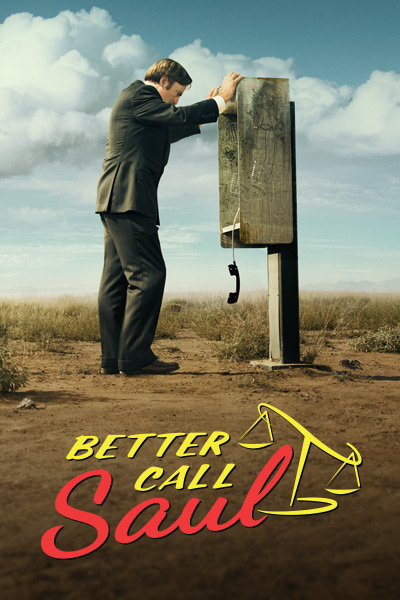
Better Call Saul

Review : Better Call Saul
Aired on : AMC (2015 - )
My Rating : 9 out of 10

I may be the only person who hasn’t watched “Breaking Bad” yet. Yes, it’s in my to-do list. No, it’s not due any desire to be different than the population. It just hasn’t happened yet. In fact, after watching the first season of “Better Call Saul”, I eagerly rented and finished the first season of “Breaking Bad”.

The reason for mentioning this upfront is, to let you know that, this review is written by someone who had no idea of who Saul is or was. I had no expectations, nor could I connect any event with anything that happens in “Breaking Bad”. I watched and enjoyed “Better Call Saul” on it’s own. I only learned later that it was a spinoff from “Breaking Bad” to give the backstory of a character.

This story is told as a flashback. Currently Saul (Bob Odenkirk) is working in a donut shop, and is miserable. The flashback picks up the story years prior to current events, when Saul was a small time struggling lawyer Jimmy McGill, real name of Saul. He has a fake office hidden at the back corner of a nail salon. He is struggling to get a client, and the world treats him like a loser. He takes care of his brother, Charles (Chuck) McGill (Michael McKean), who once was a very reputable lawyer. Chuck is suffering from a psychological disorder that makes him think he is allergic to all forms of electromagnetic radiation. So Chuck lives in a house without electricity, doesn’t go out in sunlight, and needs Jimmy for bringing him food, newspaper and everything.

In his never-ending efforts to overcome his depressing situation, Jimmy works as a public defender. There he constantly gets into minor confrontations with the parking attendant Mike Ehrmantraut (Jonathan Banks). When Mike’s tragic past catches up with him, he takes help from Jimmy, and they form a kind of working partnership. There is also Kim (Rhea Seehorn), who works in Chuck’s previous firm and is a true friend of Jimmy.

These main characters, and a host of others, provide a strong foundation to build a story that’s primarily focused on character development. Like any good story, there are other elements - suspense, surprises, emotional drama, a bit of violence etc. But what you are most likely to remember is the characters. Not just the main characters, but I am sure, many other characters would leave an impression on you. There are some strong normal characters, some quirky, some weird, some tough, some dumb. There is every shade available. It’s also a perfect teamwork by the writers and actors. This series is unusually strong in the acting department. I cannot point out one subpar performance. I guess some credit should also go to the casting manager.

Actually, the series excels in every department, and not just acting. The writers have done a great job of partitioning the story into ten individual episodes. The cinematography is superb. Whether it’s a desert scene, or a dark scene outside the office where Jimmy and Kim meet for chit chat, it’s always done well. The music lends great support. The dialogues are realistic and never oversmart.

I cannot say enough good things about Bob Odenkirk’s performance as the lead character. It’s one of the best I have ever seen, and I will be shocked if he doesn’t win the Emmy. His portrayal of a gifted talker and natural con artist, who is struggling to do the right thing by fighting temptations, is perfect, just perfect. Nothing is easy for Jimmy. Every time he sees a light at the end of the tunnel, something else happens. But he still tries to stay positive. This fight against a constant stream of depressing situations is perhaps the best part of Bob Odenkirk’s performance. It’s not cheesy, it’s not manipulative, it’s honest and classy.

I absolutely recommend this leisurely paced and fabulous drama. It’s shows like this, that have made me spend more time watching a series than movies. There is a lot to this story than what I have provided as a synopsis. I purposefully avoid mentioning any kind of spoiler, not just the ending spoilers, but even the episode spoilers. But trust me, this is a very satisfying series. Near perfect. It’s not at all for kids, but should be fine for older teenagers.

UPDATE : Please click here for the review for Season 2 and 3.


Monday, July 6, 2015

The Big Ratchet

Book Review : The Big Ratchet
Author : Ruth DeFries
My Rating : 4 out of 5 stars

The complete title of the book is "The Big Ratchet: How Humanity Thrives in the Face of Natural Crisis : A biography of an ingenious species".

It's often said that the kids born in this age would take a lot of technology for granted, unable to imagine life without touch screens. Although I agree with it, I think it's not only this generation, rather every generation takes some things for granted. In my view, it’s definitely true in every society that has seen the benefits of what the author calls as "The Big Ratchet".

For example, we do marvel at the wonders of technology, but how many of us who live in a developed country, especially US, marvel at the amount and variety of the food available at the local grocery stores, and how affordable it is? Intellectual progress rarely happens on empty stomach, so this availability and affordability of food has contributed a lot to our success in every other endeavor.

How did that happen? Producing food was not easy, even after humans transitioned from foraging to agriculture. Unpredictable yields, amount of physical labor, heavy dependence on weather, diminishing fertility of soil, plant diseases, pests who attack stored food are just few of the problems that we had to solve to get to this point. All this and more, is discussed at length in this superb book by Ruth DeFries, a professor at Columbia University.

She explains that this progress came with humanity going from one level of success to another, like a ratchet wheel, only to be followed by the problems associated with that success. Then another brilliant idea is needed to solve that, which acts as a pivot to move our species to the next ratchet, and then it’s again followed by a hatchet associated with the new solution. The cycle has been going on forever since we started agriculture.

It’s more common to hear extreme viewpoints which say the planet is doomed due to our over-indulgence, or the unapologetic optimism that proclaims our ingenuity will continue to solve future problems. This book, right at the beginning, announces that a more nuanced approach is needed that looks at a much broader history of the species. And the author delivers in spades. I will highlight a couple of examples.

About 50 years ago, India had a huge problem of generating food. Dire warnings of mass starvation were common. But no such thing happened. In fact, what happened was the “Green Revolution”. I vividly remember my father explaining to me how it happened - the building of dams, the modernization of agriculture (especially in the state of Punjab). What I didn’t know (or remember) was how the hybrid wheat played a major role in improving yields. Thanks to this book, now I know about Norman Borlaug who was crucial in this agricultural revolution, and not only in India, but worldwide. He was awarded Padma Vibhushan, India’s second highest civilian honor, as well as the Nobel Peace Prize. No one is claiming, India doesn’t have people who go hungry to bed, but the impact of Green Revolution is as clear as daylight.

No such success comes without it’s problems. There is no better example of the hatchet-following-ratchet than the now infamous pesticide DDT. Paul Hermann Muller was awarded a Nobel Prize for his discovery of the properties of DDT. It eliminated many deadly diseases in 40s and 50s, and saved countless lives. But its use in agriculture ensured that the toxins went up the food chain, and caused myriad problems for all species, including humans. The battle against DDT was started by one lady, Rachel Carson, with the publication of the milestone book, “Silent Spring”. As a result, once heralded as miraculous, this chemical is now widely banned.

The study of this endless cycle of ratchets and hatchets is fascinating. There is so much more in this book. I vaguely remember studying the Nitrogen cycle in school, but I had forgotten all about the Phosphorous cycle. The kind of solutions that have been tried in history are simply astonishing. I am pretty sure most readers haven’t heard about bird poop being mined and hauled from Chile to Europe! 

If you are looking for vindication of your pessimistic or optimistic stand about what the future holds for us based on how we are treating our planet, then this is not a book for you. If you want to understand the history of how it all came to be, then this is a fabulous place to start. There are no predictions here. But the tone is generally optimistic, without belittling any challenges that face us.

I very highly recommend this book. I hesitated in giving five stars, because I found it a bit repetitive, and thought that it’s a bit dry than it should be. Of course it’s a scientific account, but in recent times, books like Omnivore’s Dilemma, have figured out a much smoother engaging style. It’s a minor quibble. Read this book.


Friday, June 26, 2015

Jurassic World

Movie Review : Jurassic World
Director: Colin Trevorrow 
Genre: Science Fiction/Adventure 
Starring: Chris Pratt, Bryce Dallas Howard, Irrfan Khan
Released: June 2015
My rating: 7 out of 10

As I write this review, two weeks after the release of “Jurassic World”, it is already a very successful summer movie. It certainly seems like the newbie director Colin Trevorrow found a way to breathe life back into a franchise that twenty years ago suffered the same fate as most franchises with incompetent sequels do. Especially for movies that rely on a single main big idea, like the first Jurassic Park. With every sequel the novelty wears off and with it dies the repeat business.

The 2nd and 3rd installment of Jurassic Park tried bigger and badder dinosaurs, brought them to mainland, showed them as intelligent creatures in order to remain cool. They failed miserably. Now, Jurassic World takes an opposite and much smarter approach by presenting us a world, where there is already a fatigue about dinosaurs, just like for real world viewers. In this world, the owners of the Jurassic World have lost the advantage of surprise and awe. They have to make the dinosaurs do tricks, offer a petting zoo and innovate with genetically engineered hybrid dinosaurs. Even that does not seem to be enough, as the park is losing money. This attitude succeeds, as it helps the movie never take itself too seriously while keep poking fun at the lost appeal of an old idea.

I am not going to bother giving any synopsis. Rest assured that the movie has all the elements Hollywood deems necessary. Is the hero a handsome cool dude whose heart is filled with empathy for these creatures? Yes, check that. Is the lead female character trying to be a stiff businesswoman who has a hidden attraction to this cool dude? Yes, check that. Will he help her discover that these are animals and not business assets? Oh, yes, check that. Will the kids in the movie put their lives in danger? Absolutely. Is there a rich eccentric businessma? Yes, there is. Is there an obnoxious person who at the end will get eaten by the dinosaurs? Check that as well. Is there a “villain” dinosaur and a surprise hero? Of course. The movie is shameless in following the formula. Even the casting is formulaic. Don't expect any chemistry between the characters. Teenage girls will love their Chris Pratt, but the rest of the cast is forgettable enough for such forgettable characters.

All sequels invite comparison with the original. Jurassic World goes a step further, and insists that we must do it, by providing numerous references to the original. Most of the time these are witty, but not always. The kids very quickly manage to restart a car from the original movie which was supposedly not operational for twenty years. There are many such big obvious bloopers in this movie, while in the original they were nearly absent. No, I have not and will not forget the unforgivable - “It’s unix system. I know this”. As I said, nearly absent. No one would have argued that the original Jurassic Park was strong on character development. But after seeing Jurassic World, some (like me) would argue that it was as much a successful drama as it was an action flick. Even the cheesy scene at the end of the original movie with kids falling asleep in Dr. Grant’s lap seems like a classic now. As a lifelong fan of the incomparable John Williams, the music of of the first movie is etched in my memory.  Here, yes there is homage to it, but the magic is missing.

But twenty two years (fourteen since the forgotten 3rd installment) is a lot of time. There is a generation that hasn’t watched any of the three movies, and it’s a big enough market segment for Hollywood to try their luck again.

I loved the original movie. Watched it numerous times. Watched it in Hindi as well. When it the studio re-released it in 3D, I did my duty to watch it and give Steven Spielberg even more of my money. I watched the sequels when they came out, even though I had a feeling that I am not going to like them. I hated them. I have read the book, and liked it. With those disclaimers out of the way, I can say this now. Jurassic World is quite good. It’s nowhere near the phenomena of the first movie. But it’s way way better than the sequels, and on its own, it’s a perfectly enjoyable big budget monster movie. The special effects don’t even feel like special effects. It moves fast. Never threatens to be intellectual. Shows a lot of respect to the original movie. And finishes in time.

I have no idea why the Jurassic Park movies are thought of as made for kids. A lot of people die in a horrific way. No dinosaur is cute. But people still take their kids to watch this movie. I was one of these people, and my kids loved this movie, and I am sure most kids would love it too.


Tuesday, June 2, 2015

Elizabeth Ekadashi

Movie Review : Elizabeth Ekadashi
Language : Marathi
Director : Paresh Mokashi
Genre : Drama, Family
Starring : Shrirang Mahajan, Sayali Bandakavathekar, Nandita Dhuri
Released : November 2014
My Rating : 7 out of 10

Just a few days ago when I wrote the review of “Coffee ani barach kahi”, I mentioned that I started watching Marathi movies again only recently. One of the reasons, perhaps the main reason, was Paresh Mokashi’s first movie “Harishchandrachi Factory”. I had heard a lot about it, and it was every bit worth the hype. I absolutely loved that movie. So my expectations were quite high for this movie. They were almost met.

In the holy town of Pandharpur, two young siblings, Dnyanesh (Shrirang Mahajan) and Mukta (Sayali Bandakavathekar) live with their widowed mother (Nadita Dhuri). Their family is going through severe financial troubles. Their only remaining worthwhile possession is a cycle made by their late father. This cycle is lovingly named “Elizabeth”. When the situation becomes dire enough, where even the cycle might get sold, the kids decide to help out on their own. As per a suggestion by their friend, they start a small shop to sell bangles to the pilgrims who visit Pandharpur on the auspicious day of “Ekadashi”. (Hence the name of the movie.) The whole operation is kept secret from the mother, who wants them to focus on studies. Of course, things don’t go as smoothly as the kids had planned. Situation gets worse, before everything gets resolved for better in the end.

That last sentence wasn’t a spoiler. This is not a tear jerker tragedy. It’s a heartwarming, feel good movie. In such movies, predictability is an asset, when managed well.

The story is loosely based on childhood experiences of the script writer Madhugandha Kulkarni, who is the wife of the director Paresh Mokashi. It’s a short story, and doesn’t provide a lot of material for the director to work with. So he has to rely on other technical aspects to make it a meaningful movie. One aspect is authenticity. People behave in the movie as people behave in real life. It feels like you are watching real life events. The movie is shot on actual locations in Pandharpur. I was impressed by the functional and efficient camera work.

Mokashi has managed to extract exemplary support from the child actors. They impart more authenticity than any other aspect of the movie. Unlike the often seen irritating kids of movies/serials, the kids here are adorable and most importantly absolutely believable. They may not have been given the most challenging scenes to act in, but I could relate to them. I loved the character of Dnyanesh,  a respectful, well-intentioned kid and how Srirang Mahajan has acted. Other actors have done superb job as well. Nadita Dhuri as the mother was as natural as the kids.

In spite of this praise that I am offering, I cannot give the movie a higher rating. It’s a very small, simple story. It will touch your heart, but won’t awe you. My recommendation is mainly based on it being a very enjoyable movie that’s great for the whole family. My kids liked it, and I think so will most kids.


Saturday, May 16, 2015

Coffee Ani Barach Kahi


Movie Review : Coffee Ani Barach Kahi
Language : Marathi
Director : Prakash Kunte
Genre : Romantic Comedy
Starring : Prarthana Behere, Vaibhav Tatwawadi, Neha Mahajan, 
Released April 2015
My Rating : 6 out of 10

Just a few years ago, I realized to my absolute delight that, Marathi movies are once again watchable. Now it’s also possible to experience some of the Marathi movies in a theater in Bay Area, thanks to efforts of groups like Maharashtra Mandal, Swar Sudha, and Marathi Cinema Bay Area who organized screening of this movie as perhaps their first effort.

There is no such thing as a plot in this movie. Jaai (Prarthana Behere) is a software engineer, from an upper class family, in Pune. Nishad (Vaibhav Tatwawadi) is also a software engineer, and also from an upper class family, in Pune. They also work in the same office in Pune, and are also mutually attracted to each other, but haven’t been able to express it to each other. As the movie opens, we know that Nishad has invited Jaai for coffee and is going to propose to her. Coincidentally, Jaai’s parents arrange for her to meet a prospective groom on the same day, putting Nishad’s plan in jeopardy. Rest of the movie slowly makes a very uneventful progress towards the predictable conclusion via various flashbacks.

If that sounds like a very plain movie, then because it is a plain movie. Not much happens in the movie as it does a whole lot of talking going exactly nowhere.

In spite of this glaring flaw, it still manages to entertain us because of strengths in many other departments. The acting is on the spot, by everyone involved. Prarthana Behere has the main role and makes the most impression. The atmosphere is clean and fresh with posh surroundings, progressive parents, likeable characters and a complete lack of worldly problems. Editing is smooth and the movie in general is strong on production qualities. The main strength, in my opinion, is the dialogues, which I presume to be written by Aditi Moghe, who is mentioned as the writer. They are smart, funny and thankfully not too cheesy.

The song “tu asatis tar”, is nice on the ears, sung by Sanjeev Abhyankar, and has beautiful poetry penned by none other than Mangesh Padgaonkar. At the same time, I also have to point out that the Urdu couplets used in the movie had many mistakes. It’s good that someone in the team likes Urdu poetry enough to use it, but these mistakes ruin the usage. I am not claiming my reviews are widely read, but just in case, I want to offer my consulting services absolutely free of charge to anyone who wants to use Urdu poetry in their work to ensure correct words, appropriate context, proper pronunciation and anything related. I mean it. 

Coming back to the review. All these niceties prevent the movie from boring us. It remains fun. But in the end, these wrappings are unable to hide the truth that the candy is bland. There is not even a modicum of tension or conflict. The problem faced by the characters is simply superfluous. Everyone is just too nice. I suspect the filmmakers wanted to keep things realistic. I know, we don’t need to see another Amrish Puri not letting go of Kajol’s hand till Shahrukh’s train reaches a certain precise speed etc etc. I get that. But this story is too much of a straight line.

Generally the genre “Romantic Comedy” suffers in the comedy department, and offers cliches in the romance part trying to somehow make it work. Here, the comedy part works really well, and the romance part falls flat on its face. If that’s OK with you, absolutely watch the movie for a light hearted fun of around one and half hours. It’s perfectly OK for kids. The young generation might even enjoy the movie more.


Sunday, May 10, 2015

Ghalib, Iqbal and Faraz :-(

On social media (Facebook, What’sApp groups etc) I am seeing this mentioned again and again. Some ash’aar (couplets) are presented, claiming them to be written by none other than Ghalib, Iqbal and Faraz. A typical post will mention something like following. There will also be claims such as how these poets have expressed this across 3 centuries, and how interesting it is to see them offer different viewpoints on the same subject. Some posts also offer translations.
Ghalib Vs Iqbal Vs Faraz

Ghalib:
Ghalib Sharab Peene De Masjid Mein Beth Ker,
Ya Wo Jagah Bata Jahan Khuda Nahi.

Iqbal:
Masjid Khuda Ka Ghar Hai Peene Ki Jagah Nahi,
Kafir K Dil Mein Ja Wahan Khuda Nahi.

Faraz:
Kafir K Dil Se Ayah On Ye Dekh Ker Faraz,
Khuda Mojood Hai Wahan Per Usay Pata Nahi

This is misinformation at it’s finest. There is so much wrong here, that I do not even know where to begin. Maybe I can start by saying, everything, EVERYTHING is wrong. 

The first sher is well known. Except that the first word is “zaahid”, meaning a religious person. The order of words is wrong, and last word “nahi” is actually “na ho”. That’s not the real problem though. Replacing the first word with “Ghalib” does not make it a sher by Ghalib. Sometimes it’s hard to ascertain the originator of a very old sher. In this case, I am absolutely certain. This sher is not present in Deewaan-e-Ghalib. It’s easy to check. Accuracy of Ghalib’s deewaan is also not a suspect, because Ghalib himself published it. There is no argument here. To some it may be a good sher to recite at party over some wine, but please do not associate this sher with Ghalib.

Second sher is even more of a travesty. First of all it’s not a very good sher to begin with, and it’s definitely not by the great Iqbal. Now I do not have complete works of Iqbal, like I have for Ghalib and Faraz. But I do not need that in order to bet my money that this sher is not written by Alama Iqbal whose poetic prowess was boundless. When it comes to decide who is the best Urdu poet of all, his name features at the top of list, along with Meer and Ghalib. 

It’s not just the question of quality. Let’s get this straight. Iqbal was a devout Muslim. He would have never said that God does not exist in any place. Period. Secondly, he was religious, but not narrow minded. As a man of very high intellect, as a philosopher, he would never disrespect any other religion. Associating that sher with Iqbal is same as insulting him. Let’s not do that mistake. 

Now about the last sher. Faraz in my opinion, is the best Urdu poet of our times. He was primarily a poet of love and emotions. He hardly ever wrote about religion. The last sher is not his style either. More importantly, I have his works, I have checked, and I can tell you, the sher is not in any of his collections. 

All these couplets are not that good, but it’s my subjective opinion. The fact is, there is no deep message here. It’s fluff. And none of the great poets ever wrote those substandard couplets.

When I derive pleasure from the works someone, an artist, a singer, a poet - I feel gratitude. I feel I owe them something back. This is my attempt to do the right thing by bringing more awareness. I urge you to do the same thing. Please spread the word. You can link to this post, or just respond on social media pointing out that the attribution is wrong.

Friday, April 17, 2015

Mother Nature Is Trying To KILL You


Book Review : Mother Nature Is Trying To KILL You
Author : Dan Riskin
My Rating : 5 out of 5

The complete title of the book is “Mother Nature Is Trying To KILL You : A Lively Tour Through the Dark Side of the Natural World”.

In my frank opinion, there is a huge mis-understanding about what Nature is. Maybe it makes us uncomfortable that our modern lifestyle has taken us quite far from raw nature. We want to “live naturally”, “eat naturally”. We want to go out and  “enjoy nature”. We want to “appreciate the beauty in nature” and “thank mother nature for the bounty” when we fill our shopping cart with organic produce. Now there is nothing wrong in being thankful for the food that we obtain from nature, but let’s not forget the fact. Nature did not produce any of this for our enjoyment. We took it, because if we don’t eat, we will die. But Nature is no benign power that looks after our interests, and provides for us.

Dan Riskin has tackled all such myths in this smart and witty book. It’s a mix of two styles. There is quite a bit of personal storytelling from a father’s viewpoint. But mainly it’s an excellent documentation of disturbing behaviour found in all parts of natural world, from a very scientific viewpoint. Interestingly, the mileposts he uses as guide, are religious in nature, namely The Seven Deadly Sins.

For example, in the chapter on Greed, he gives examples of animals who eat their own kind, in order to increase their own chances of survival, and specifically to increase the chances of their DNA’s survival. Lions kill babies of other lions, and even zebras kill off springs of other zebras. For a bear cub in Alaska, an adult male bear is where the real danger is. For some species, it begins in the womb. A baby sand tiger shark eats the other siblings’ eggs right in the uterus.

The not-so-good side of Nature is not an anomaly. Instead it’s everywhere. In the chapter on Lust, he gives example of how complex (and often times dark), reproduction is in many species. All the other sins are abundant too. There is stealing, there is gluttony, there is sloth and so on.

What’s the point of all this? To paint Nature as some kind of evil? Of course not. Nature is not evil. Nature is what it is. The point here is to understand and accept Nature for its totality. Certain things in Nature appeal to us, certain things disgusts us. What we have to realize is that “the natural way”, or “how nature does it”, is not a very good template to model our behavior on. The author has done an excellent job in introducing us to all faces of Nature. He doesn’t just give facts after facts, he weaves a story. It’s engaging, and very very easy to read through.

I have to add a disclaimer if it’s not already obvious. I had already formed similar opinions myself even before reading this book. I have watched countless Nature shows, done some eco-tourism, read other books on similar ideas. I am a “Nature lover”, but not just for taking photographs of flowers, although I love doing that. I am amazed by the complexities of life in nature, and astonished at what tactics evolution has produced into even the simplest of creatures. I have used similar arguments to point out to vegetarians that the almond seed (mistakenly labeled as “nut”) they enjoy is not much different than the egg they think is wrong to eat. Neither was produced for your consumption. Both are “future babies”, and their only purpose is to increase the population of their respective species, not ours. Anyway, that’s a separate and long debate.

I highly recommend this book. Note that this is a scientific tour. Not philosophical. Reading this may make you wonder, why a benevolent God has produced such vicious, and cruel Natural World. Those questions do not belong here. That’s what Spirituality and Religion is for. This book is a fantastic way to educate yourself about the reality of the world we are a small part of. To open your eyes to the true Nature. Read it.

Sunday, March 22, 2015

Django Unchained

Movie Review : Django Unchained
Director : Quentin Tarantino
Genre : Action/Western
Starring : Jamie Foxx, Christoph Waltz, Leonardo DiCaprio, Samuel L. Jackson
Released : December 2012
My Rating : 7 out of 10

Before watching a Quentin Tarantino movie, I guess you should ask yourself if you are a fan or not. Liking ‘Pulp Fiction’ is not enough. I liked it, but I am no fan of him. Maybe “Kill Bill” is a right example. Did you like it? I didn’t like it at all, but if you liked it, then there is a good chance that you might like this movie.

The movie begins in 1858, just a few years before the Civil War. Dr. King Schultz (Christoff Waltz), a dentist turned bounty hunter, forcibly takes a slave, Django (Jamie Foxx) from his recent owners. Dr. Schultz is not interested in keeping Django as a slave, but rather wants Django’s help in identifying other criminals. So he offers Django freedom, and makes him a business partner. Their “business” does quite well, and after accumulating enough money they start their quest to locate and free Django’s wife.

They learn that Broomhilda (Kerry Washington) is now on a plantation owned by Calvin Candie (Leonardo DiCaprio). This man is as deplorable as they come, so Schultz and Django invent an elaborate pretext to be invited there. Not everything can go as planned, and Candie’s sycophant slave Stephen (Samuel Jackson, under a heavy makeup) sees right through them.

Just like his previous endeavour (The Inglourious Basterds) Tarantino has chosen another sensitive subject to impose his style on, and he easily succeeds. There is a lot of vintage Tarantino in the movie, especially in the scenes focused on Christoff Waltz who gives a comparable performance to his famous role in The Inglourious Basterds. These scenes, as we have come to expect now, are full of smart, witty dialogues that build up the tension required for the eventual violent follow-up. Also, we are constantly guessing as to which direction the scenes will move towards. That’s the good part.

What I specifically didn’t like was the mix up of these high quality scenes with deliberately impossible action, in the later part of the movie. Sometimes our two lead protagonists are ordinary human beings, who have to worry about things going wrong. Sometimes they can wipe out an army with a revolver that never runs out of bullets. Either one on it’s own is acceptable, but the combination did not work for me. In fact, in the end, it ruined my experience, and for a long movie like this, it’s a serious shortcoming.

The acting is generally good. Jamie Foxx has done a reasonable job, and Samuel Jackson rarely fails to deliver. Christoff Waltz, as I mentioned, is perfect. The one who impressed me most was Lionardo Do Caprio. His star image, doesn’t bring an evil Southern slave owner to mind, but he has done a wonderful wonderful job. His progression since the romantic hero of Titanic has been a joy over the years.

I repeat. If you have like his previous movies, then there is a good chance that you will like this one, else, not so much. This is correctly rated R, and has copious amounts of violence.


Saturday, March 7, 2015

Kasparov On Kasparov - Part 3

Book Review : Gary Kasparov on Gary Kasparov Part 3 1993 - 2004
Author : Gary Kasparov
My Rating : 5 out of 5 stars

This is the third and last installment of Kasparov’s autobiographical look at his own games.

I have reviewed his previous books, Part 1 and Part 2. Part 3 covers his life and games from his championship match with Nigel Short, upto his last game at Linares. The format is similar to not just the previous two installments, but all the other books in his mammoth series that began with “Great Predecessors”.

Although this covers the last part of Kasparov’s chess career, it’s not the period of deteriorating results. Kasparov was the highest rated player all the way till he retired - only recently Magnus Carslen surpassed that rating. He was unquestionably the best player till his last official game, towering above his contemporaries, winning one tournament after another. A true legend, and in my view the best player ever.

Since he retired at his peak, the quality of the games in this book is astonishingly high. In fact, for a lowly amateur like me, most of the games are just too deep. There are many helpful explanations, ton of annotations, and ample diagrams. Just like his other books. They help, but this is also the period when chess went through a big transformation. Research and preparation were always part of life for a serious chess player. But the advent of affordable computing power, and increasingly smarter software assisted players in finding moves that may seem alien to humans. It led to positions where general principles were often eschewed in favor of complex calculations. Chess became more and more concrete. Kasparov masterfully adapted to this new world. No, he mastered it. Complications were always his territory, and the opening research made him even more invincible.

If computers had an impact on making games more difficult for average players like me, at the same time they also helped us enjoy the game like never before. Chess found a perfect medium - Internet -  to broadcast games to the entire world, at a very low cost. The amount of data that needs to be transferred for indicating a move, is just two coordinates, practically nothing. Because of this, many tournaments were broadcasted live. I have watched many of the games in this book live, and I remember some of them vividly. I remember my own surprise when Kasparov unleashed the Sicilian Dragon on Anand during their match. I remember how Kramnik’s Berlin Wall effectively neutralized Kasparov’s play with white pieces in their match. I even remember Kramnik’s Rb1 against Kasparov’s favorite Gruenfeld. And so on. I was lucky to witness so many great moments, and now, I get to read exactly what Kasparov was thinking and planning during these, in his own words. How he planned his strategy against specific opponents, and how it worked, is a fascinating read.

This commentary, and Kasparov’s deeply personal thoughts, make this book very very interesting, and definitely the spiciest book in his entire series. The reason is, this was also a turbulent period for Chess, especially for the title of World Champion, and Kasparov was at the absolute center of this. This book begins with his first match after he broke away from FIDE, and ends with his retirement due to the hopelessness of reunification. The feud between him and FIDE costed a great deal to the entire chess world. This is a hugely controversial issue. I remember the zealous passionate debates and extreme opinions that were expressed online and in print media. In this book you get to hear Kasparov’s side. He does accept moral responsibility, but also does not mince words when he criticizes the other side - which mostly is the FIDE, and also Kramnik who avoided playing an automatic rematch. It’s all very candid, and mostly honest, keeping in mind that this is his defense. I don’t think he is being completely truthful though. For example, he expresses regret that the reunification was not properly supported by all the grandmasters, in spite of he himself agreeing that it was not a perfect plan. That particular Prague agreement, completely left Anand stranded without a fair chance. It was so distressful to Anand that he lost almost all his games in the Dortmund tournament that he played after the announcement. So Kasparov’s complaint about not getting to play a reunification match based on such an agreement, doesn’t touch my heart considering that it was he who broke away from FIDE. There are more such instances, if you remember the not-so-distant past.

In addition to playing at the highest level to constantly prove that he was the real true chess king, Kasparov was also active in many other endeavours. He started an online chess site, tried very hard to attract corporate sponsorship for chess and became an active politician in Russia. It boggles my mind how someone can do all this, and still win consistently against the top competition. He recounts what else was going on, including his divorces, and how it all affected his play.

I highly recommend this chess treasure. The depth of the games, and the commentary that is bound to touch you emotionally, one way or another, makes it perhaps the most interesting books of the series.

Sunday, February 15, 2015

Maraasim by Ahmed Faraaz

Maybe it’s just me, or maybe it happens with others too. In my mind, some words are inseparably associated with a sher. Probably because it was that sher that introduced to me the specific word.

One such word is ‘मरासिम [maraasim]’. It means ‘having cordial relations’ (or ‘मेल जोल [meljol]’ in Hindi).

I am sure the sher that comes to anyone’s mind when hearing this word is the following.

Note : I am giving translations to convey my interpretations, not trying to write equivalent English poetry.
पहले से मरासिम ना सही, फिर भी कभी तो
रस्म-ओ-रह-ए-दुनिया ही निभाने के लिए आ

रस्म-ओ-रह [rasm-o-rah] == custom, tradition
रस्म-ओ-रह-ए-दुनिया [rasm-o-rah-e-duniyaa] == worldly traditions

pehle se maraasim na sahi, phir bhi kabhi to
rasm-o-rah-e-duniyaa hi nibhaane ke liye aa


[We may no longer have a relationship, but once in a while
Come and meet with me, just for keeping social customs]
This is of course from from one of the most famous GHazals of all time, ‘ranjish hi sahi’. It’s written by one of my favorite poets Ahmed Faraaz, whom I consider to be the best Urdu poet of our times. The entire GHazal is full of innovative ways of pleading with his beloved to return back to him. It’s hard to pick a favourite sher in that GHazal. I love all of them, including the above.

I associate this word, not just with this sher, but also with the poet himself. I do not recollect a single good sher by any other poet, that uses this word. But I know of many ash’aar by Faraaz that employ this word. I must clarify that, I am sure other poets have used this word, it’s just that I associate Faraaz with this word.

Faraaz, first and foremost, is a poet of emotions and relations. Here is a sher to illustrate that point. The reality does not have discrete stages of relationships, like in-love or broken-up. There are many shades, many hard to define stages. The following sher beautifully captures one sad shade of the pre-break-up stage.
अब तो हमें भी, तर्क़-ए-मरासिम का दुख नहीं
पर दिल यह चाहता है, कि आग़ाज़ तू करें

तर्क़ [tarq] ==  to abandon
आग़ाज़ [aaghaaz] == beginning

ab to humeiN bhi tark-e-maraasim ka dukh nahiN
par dil yeh chaahataa hai ki aaghaaz tu kare


[Even I am not going to be saddened by the loss of relationship now.
But my heart wants you to take the first step (towards breaking it).]

[I know we are going to break up, but I don’t have the courage to actually do it. Or I don’t want to be the one who actually does it. Interpret it the way you want it.]
There is feeling of surrendering to the eventuality, but unwillingness to embrace it. I adore this kind of poetry that poets like Sahir and Faraaz were so good at. They perfectly capture the multi-dimensionality of human emotions.

Of course not all couplets are going to be great. The following is one such. Pedestrian by Faraaz’s standard.
क्या कहें, कितने मरासिम थे हमारे उस से
वह जो इक शख़्स है, मुंह फेर के जानेवाला

kya kaheiN, kitne maraasim the hamaare us se
woh jo ik shakhs hai, muNh pher ke jaane waala
People who have only a passing interest in GHazal often associate it with expressing nothing but sadness. That’s understandable. They notice and appreciate the depth of sorrow found in Urdu GHazals. But these casual listeners don’t realize how diverse the paths are to this sadness. Sometimes the poet just tries to find sadness, almost in a masochistic way. The next sher captures the typical depression centric mentality, which finds sorrow even in an improving situation.
अगर किसी से मरासिम बढ़ाने लगते है
तेरे फ़िराक़ के दुख याद आने लगते है

फ़िराक़ [firaaq] == separation

agar kisi se maraasim badhaane lagate hai
tere firaaq ke dukh yaad aane lagate hai


[Whenever I attempt to get back into a relation,
I am reminded of the pain of our separation]
The next one may feel similar, but it's very different.
देख अब क़ुर्ब का मौसम भी न सरसब्ज़ लगे
हिज्र ही हिज्र मरासिम में समोया कैसा

क़ुर्ब [qurb] == nearness
सरसब्ज़ [sarsabz] == green, fertile, successful
हिज्र [hijr] == separation

dekh ab qurb ka mausam bhi na sarsabz lage
hijr hi hijr maraasim me samoya kaisa


[See, even this closeness doesn’t feel real
Why does it seem to contain eventual separation?]
Such ash'aar are perhaps hard to appreciate, and may be that's why you will rarely hear them in GHazals that are sung. I like how they highlight the contradictions often contained within human emotions.

I will leave you with my favorite “maraasimsher.
सिलसिले तोड़ गया वो सभी जाते जाते
वर्ना इतने तो मरासिम थे, कि आते जाते

silsile toD gayaa wo sabhi jaate jaate
warna itne to maraasim the, ki aate jaate
That wordplay is so typically Faraaz! Here it is also crucial to bring out the finality of the break-up. This marvelous sher is the maqta of one of most famous and wonderful GHazals by Faraaz.


Friday, January 16, 2015

The Affair : Showtime Series

Review : The Affair
Aired on : Showtime (2014 - )
My Rating : 7 out of 10

I watched Akira Kurosawa’s landmark movie “Rashomon” when I was quite young. I had heard raving praises about the director, as well as the movie. After watching it, I was disappointed, because I didn’t really get the movie. Now looking back, with much more experience of life, I understand why “Rashomon” is really so great and the point it made. Truth is elusive, and memories are conveniently clouded by our self-serving interpretations of what really happened.

The “Rashomon” technique, as it is often called, involves multiple people recounting the same incidents. Each person’s account can differ, not just because their memories are not perfect, but they perceive and interpret the events differently. Some stories eventually reveal “the” truth. But things get interestingly complex when all the viewer knows is just the different versions of the same story. It can be used to build suspense. When done correctly, it’s also a great tool for defining characters, by hinting at their biases.

The latest series on Showtime, “The Affair” uses this technique as the primary vehicle of narration. Noah Solloway (Dominic West) is a public school teacher, happily married to his college sweetheart Helen (Maura Tierney). Like every year, they and their 4 children leave their suburban New York home to spend the summer in Long Island with Helen’s super-rich parents. They stop at a local diner, where Alison Bailey (Ruth Wilson) has been a waitress since she finished school. She is married to Cole (Joshua Jackson), who is from a local tightly knit family of ranch owners. Something clicks between Noah and Alison, although their recollection differs in interesting ways.

These recollections are happening while they are being interviewed by a detective. Why and what crime was committed? I do not like giving even minor spoilers in the review, so I will end the synopsis here.

As the recounted story progresses, the mystery deepens - as in, even when you get to know what crime was committed, the why, and by whom is not immediately clear. The writers and directors, excel at this aspect. The story of the past affair gets told to us in discrete chunks of two different viewpoints. Each episode has 2 parts, one for Noah, one for Alison. At the same time, some tantalizing hints are given about their present. These devices, acting in unison, capture our attention and make us want to watch more.

Still, the mystery aspect is very much a sideshow. The main focus of the story is human relationships, family issues and particularly marriage. Both the main characters are cheaters, and sometimes act in poor judgement. Stories where main characters are deeply flawed are often uncomfortable. But this is reality. All the characters are very human, not very likeable, but human nonetheless. The writers do an admirable job in exploring the challenges inherent in all types of relationships. Kudos for that.

This is a smartly made series, but I was surprised that it won the Golden Globe award. It has its share of deficiencies. The series never properly explained Noah that well. In the end I understood Alison’s reasons for breaking her marriage, but Noah’s actions seemed inconsistent with the impressions created by earlier scenes. It also felt overdrawn to me. There aren’t enough ingredients to engage us for ten episodes. To be honest, without the narration technique, the story in itself is not very interesting. With so much focus on relationships, misunderstandings between lovers, emotional flip-flops and the broken hearts, I wondered if I am watching the "Lifetime” channel.

Acting is overall very strong. I was not at all surprised to see Ruth Wilson winning the Golden Globe for Best Actress. She has done a fabulous job and it’s a well deserved award. Rest of the cast is also near perfect.

I recommend this sincerely made series, if you are in a mood to watch a serious drama. It’s definitely not for kids, and is correctly rated ‘MA’.

UPDATE : Added Season 2 Review.


Saturday, December 27, 2014

PK

Movie Review : PK
Director : Rajkumar Hirani
Genre : Drama / Comedy
Language : Hindi
Released : December 2014
Starring : Aamir Khan, Anushka Sharma, Sanjay Dutt, Boman Irani
My Rating : 7 out of 10

I don’t get to watch too many new Bollywood movies, and whenever I watch, more often than not, I end up being disappointed at the waste of time. I have yet to understand the hype behind most of the big names, be them actors, or filmmakers. A few exceptions being Aamir Khan, Rajkumar Hirani and Vidhu Vinod Chopra, all associated with this movie. So it was imperative for me to see it.

I try very hard to watch any movie with as little information as possible. In the same spirit, I will try to reveal as little as possible in this review. So in case you like to watch a movie without knowing any plot details, your enjoyment will not be reduced by reading this.

Vidhu Vinod Chopra, has had both hits and misses in his long successful career. As for his directorial work, nothing will ever come close to the 1989 movie Parinda. As a producer, his teaming up with Rajkumar Hirani has produced wonderful movies. The previous movie "3 Idiots" was phenomenally successful at the box office, both in India and abroad. It was a fabulous movie by all measures, so naturally it raises the expectations when the same team gives us ‘PK’.

Unfortunately, it fails to reach those lofty standards of entertainment. In ‘Lage Raho Munnabhai’, Hirani masterfully blended Gandhism with humor. In '3 Idiots', beneath the roaring comedy, the undercurrent had many socially relevant themes that made you ponder. In ‘PK’ the formula is similar, mixing entertainment, with a strong social message. Although here, the concoction lacks potency. Because the comedy is laugh-out-loud only in a few scenes, and the social message is delivered in a borderline crude fashion, lacking any subtlety.

The movie is still very watchable. The topic is blind illogical faith in religion, and it’s misuse by the so called spiritual leaders. It’s a very important topic, and very relevant in India. I would say even necessary.  This same topic was quite nicely handled by Paresh Rawal starring ‘OMG’. I don’t think ‘PK’ delivered the message better.

Aamir Khan never disappoints as an actor. He gets most of the screentime. Anushka Sharma lends perfect support. Rest of the cast, including Sanjay Dutt and Boman Irani don’t get much opportunity.

The music is forgettable, and the picturization just elongates the movie that should have been at least 30 minutes shorter even otherwise. The length of the movie also makes it repetitive. 

I am fond of movies that are entertaining, as well as thought provoking. Over the years, many directors have made commercial movies that are also socially relevant. BR Chopra had his own style. Hrishikesh Mukherjee did it his way. Bimal Roy was the best in my opinion. Now Rajkumar Hirani has established his own style. Using contemporary comedy to drive home the point. For that he deserves full applause.

I recommend the movie, by saying, “good, but not great”. I think it’s appropriate for older teen agers, and they will also enjoy the movie, as well as agree with it.


Thursday, November 20, 2014

The Drunkard’s Walk


Book Review : The Drunkard’s Walk
Author : Leonard Mlodinow
My Rating : 5 out of 5 stars

The complete title of the book is “The Drunkard's Walk: How Randomness Rules Our Lives”.

It’s almost a cliche to say that, we as a society are not quite good at math. But what parts of math? How does it matter if on an average we don’t really understand calculus? I say, it doesn’t matter much. I think what does matter is, we are particularly inept at handling probability, or evaluating uncertainty. The success of many lottery systems worldwide is a good indication of that. I would even argue that the entire city of Las Vegas is built upon our inability to handle probabilities correctly.

The need to handle uncertainty goes beyond gambling and betting. Author Leonard Mlodinow shows how it’s part of our everyday life. Probability assessments happen in legal arguments, medical evaluation, large scale data analysis and so on.

He gives numerous examples of how we get it wrong. Ask yourself. What is more probable? A person being vegetarian, or a person being vegetarian for ethical reasons? This example is innocuous. Other examples, alas, are not so. What is more likely? A defendant fleeing the scene of crime, or a defendant fleeing the scene of crime because of fear of being accused? Most people say second is more probable, not realizing that it is a subset of first.

He uses such examples, to explain the subtleties involved, and also to build the story of how the study of Probability became a formal branch of mathematics. As you can expect, the initial reasons were indeed related to winning at gambling. Probability is closely related to Combinatorics. Instead of using mathematical terms like factorials, he tells us the story of Pascal who came with the ‘Pascal’s Triangle’ to help with calculations.

Interesting - as in simple but subtle - examples are numerous and present throughout the book. Consider my favorite. In a family of 2 children, what is the probability that both children are girls? Yes, it’s 1 out of 4. Let’s change the question slightly. In a family of 2 children, what is the probability that both children are girls, if one of them is known to be a girl? Or this. In a family of 2 children, what is the probability that both children are girls, if one of them is known to be a girl with name Florida. Read the book to understand how such conditional probabilities are calculated.

It’s not just for solving puzzles. The author mentions a terrifying personal experience, when his blood test gave a false positive for HIV. The doctor incorrectly concluded that his chance of dying soon is 999 out of 1000. Author mentions that similar erroneous conclusions happen in many forms of testing, including doping tests for athletes. Even more seriously, such wrong logic was used to convict a British woman of murdering her own children, in 1999. Astonishingly a similar mistake had also happened in the all American trial of OJ Simpson. Mishandling probabilities can have serious consequences.

Probability is also closely related to Statistics, and Statistics is closely related to Economics and Finance. This is about large scale data analysis. How do we determine how closely the data reflects the actual probability? How do we infer probability from a series of measurements? Topics such as the Gaussian curve and standard deviation, are wonderfully explained without getting overly mathematical.

In later chapters, there is some philosophical discussion on the role of chance in our life. Similar to luck versus abilities debate. I didn’t think the author handled these intractable problems well. These discussion are way too big and subjective for a book like this. That’s not a major complaint though.

I absolutely recommend this book. The real life examples, as well as topical puzzles are interesting. The writing is smooth and funny. This is the second book by the same author that I have reviewed, the first one being Euclid’s Window. The real strength of both the books, is how lucidly Leonard Mlodinow explains the complex mathematical concepts. It’s a real feat. This book, just like the previous, is immensely accessible, and will leave you educated and entertained.

Saturday, October 25, 2014

My First Song ... Deewaana

When I started writing the blog a few years ago, I had no idea that one day I will write a post like this. In fact, I had no idea that I will write such a post just an year ago. But here I am, very happy to share my first song.

I wrote the lyrics of this very sad song about a "break up". While composing the tune I have tried adding some shades of Yaman.

I was immensely fortunate to have someone as accomplished as Kamlesh Bhadkamkar help me in arranging the music, enlisting the artists and getting it professionally recorded. I am a novice when it comes to composing, almost an illiterate. This song wouldn't have been possible without his help. Kamalesh is a frequent music arranger on Indian TV, most famously for Zee TV's "Sa Re Ga Ma Pa".

Ketan Patwardhan has provided his superb voice, and has sung it beautifully. Many thanks to him.

Shruti Bhave-Padhye has played the solo violin. She also frequently accompanies "Sa Re Ga Ma Pa" on Zee TV.

Here it is. Hope you like it.


Saturday, October 18, 2014

Broken City


Movie Review : Broken City
Director : Allen Hughes
Genre : Crime / Drama
Released : January 2013
Starring : Mark Wahlberg, Russell Crowe, Catherine Zeta-Jones
My Rating : 5 out of 10

When a movie with A-list star cast is released after the holiday season is over, especially the January-April time-frame, it can be taken as a sign of poor confidence from the movie makers. Broken City is not an exception to this rule of thumb.

The movie starts with a brief introduction to the past events. Billy Taggart (Mark Wahlberg) was a NYPD officer. He had killed a suspect, and while he has been exonerated by the court, there is some damaging evidence. The New York City Mayor Hostetler (Russell Crowe) helps him cover it up, but Billy has to resign. Now Billy is working as a private detective. The Mayor is in the middle of a tightly fought election campaign. The mayor suspects that his wife is having an affair. Billy is called to investigate and find out who is her lover. As we can expect, the investigation reveals that things are not what they seemed at first.

Although not very novel, this is a fine set up for a gripping movie with political manipulations, intrigue, thrilling actions and slow uncovering of a conspiracy. The promises are there, but not much is delivered. The reasons are many. The idea behind the conspiracy itself is not particularly evil, and also not very smart. There doesn’t seem to be a way pull this kind of deal off with any secrecy. The behavior of the characters - especially why someone has an allegiance with someone else, wasn’t always clear to me. It’s fine for the writers to keep the mystery about who is on whose side, but eventually the motives have to become clear. There is a subplot about Billy and his girlfriend, but it’s left unresolved - maybe some scenes were simply removed during editing. Whatever it is, it’s a bit of a mess.

I don’t think Mark Wahlberg was a good choice for this role. Russell Crowe seems to be making an honest attempt, but he is not very convincing either. Catherine Zeta-Jones does a reasonable job, and still looks stunning, but her character doesn’t have much screen time. Casting is an issue, but the real problem is a confusing, unconvincing script.

I cannot recommend this movie, not even as a cookie-cutter action flick.


Sunday, October 5, 2014

State Of Wonder


Book Review : State Of Wonder
Author : Ann Patchett
My Rating : 2 out of 5 stars

There was a time when I used to read a lot of fiction. The books I liked are generally not considered “literature”, and that does not bother me a bit. I still remember the immense joy I got from reading Frederick Forsyth’s books - the depth of the plot, the suspense that you never knew was there, the painstaking research, the smart structure of the storyline that makes it impossible to put the book down. I slowly lost interest in reading fiction, as my favorite authors couldn’t keep up the quality, maybe because they were getting older.. I couldn’t find new authors of the same caliber, and slowly I became interested in reading only non-fiction, maybe because I am getting older.

Once in a while, I try reading a fiction, but almost always end up dissatisfied. When I saw the glowing reviews of “State Of Wonder”, I had to read it. People magazine thinks "the reader will start re-reading the book upon completion". Time magazine said, "the story speeds along like a literary thriller". Even NPR praised it. The author Ann Patchett has won numerous awards for her books, and this one was a national bestseller.

After reading “State Of Wonder”, I am not only dissatisfied as I was in other cases, but I am also angry - extremely angry - at these deceiving reviews. I know very well that reviews are subjective. I write a lot of them, and they are full of my subjective opinions. This book also has hundreds of five star reviews on Amazon, so I know I am in minority. But I still think, it’s intellectually dishonest to praise this book so much. Because the plot holes and loose ends are not subjective. The factual mistakes are not subjective. When hard to believe situations are not explained, the lack of explanation is not subjective.

Dr Marina Singh works as a research scientist  for a pharmaceutical company. Her co-worker Anders is sent to Amazon, to track down another employee Dr. Swenson, who for many years, has been conducting secret research on a lucrative drug. Unfortunately, Anders dies due to illness, but the letter announcing his death from Dr. Swenson lacks details. Marina is asked by his wife to go to Amazon, to find out what happened. The book is the story of Marina’s journey and her coming to terms with her past. It also makes a feeble attempt at raising some important questions about medical research.

There are positives. Author Ann Patchett has a knack of expressing what Marina felt at that moment. She also manages to create the sense of place. You feel you are transported to the Amazon jungle.

Style, sadly, cannot mask the lack of substance. If you are in a book club, this book will serve very nicely as a launching pad for passionate discussions. Morality of drug research is a tough and troubling topic. But we get to hear only one side of the debate, the views of Dr. Swenson. That’s not enough to support the claim about how the book poses “bioethical arguments”.

The characters are not very likeable. Now, that alone is not reason to dislike the book. I have liked many movies (e.g American Beauty) where not a single character was likeable. But here, the characters are flat, and except Marina, there is hardly any explanation for the behavior of anyone else. The tribe is Amazon is in awe of Dr Swenson, and meekly submit themselves to her experiments, even though she cannot speak their language. Why? Why do they respect or fear her? No, you won’t find it explained.

The factual errors are mind boggling. First a small one - in Marina’s dream, she finds herself with her Indian father in Calcutta where she hears Hindi all around her. No, Ms Patchett, it’s very unlikely. They speak Bengali there. Maybe it’s a small slip. Then Marina, who is a doctor, keeps taking Lariam as prevention against Malaria, in spite of the nightmares. I am not a doctor, but I know that there is an alternative called Doxycycline. I took it when I went to Kenya. Shouldn’t she have tried that? Dr. Swenson runs a medical research facility in the heart of Amazon jungle. Where does she get the electricity to keep the freezers running? Dr Swenson also realizes in the end that there is a reason why nature doesn’t want women to get pregnant at a very old age. Really? For a doctor who has been researching women fertility for decades, seeing old women in a tribe going through child birth as her research subjects, this comes as a realization when she herself becomes old? As you can see, this is neither nit picking, nor subjective complaints.

The book is no thriller. It’s extremely boring in many sections, and simply takes forever to proceed. Unlike the Time magazine’s claim that it reaches "a tremendous crescendo", what it reaches is height of unbelievability. The author succeeds in maintaining the suspense, but when it’s revealed, it’s just revealed. Then the book winds down in 15 pages, without an iota of explanation as to what exactly happened.

The correct title for the book should have been “State Of Unexplained”. It’s high on feeling, and low on thinking. Of course, I do not recommend this book at all. I am forever going to be suspicious of reviews written in all the magazines and newspapers.

Saturday, September 27, 2014

Closed Circuit

Movie Review : Closed Circuit
Director : John Crawley
Genere : Thriller
Starring : Eric Bana, Rebecca Hall
Released : August 2013
My Rating : 6 out of 10

It seems to me that there are two clear approaches of making movies categorized as "thrillers". One has dazzling action sequences, fast moving story that tries to not give the viewer any time to find any plot holes and a few twists thrown in to wow them. Second type is based on slow build up, believable characters and maintaining intrigue till the end. "Closed Circuit" is of the second type.

A bomb explodes in a busy market in London killing many people. A tip allows the police to capture the alleged mastermind of the attack and he is put on a trial. This is the starting point of the story. We are given an explanation about the complicated legal procedure for trials involving national security, where some sensitive evidence can be presented only in a closed courtroom. As per the British legal system, there need to be two lawyers for the defense. One for the open trial, and one for the closed trial, and they cannot have contact with each other during the trial.

Martin Rose (Eric Bana) gets chosen as the defense attorney for the open trial, because the previously chosen lawyer commits suicide. The defense attorney for the closed trial is Claudia (Rebecca Hall). They had an affair in the past, but they chose to keep that knowledge to themselves in order to get the rare chance to fight a case with the national spotlight. As Martin digs deeper, he starts getting suspicious that things are quite different than what was being publicly acknowledged. Claudia also starts to feel that she is being constantly monitored. As the movie progresses we get more and more clarity about what actually happened.

Director John Crawley maintains the tension very well. Many times throughout the movie, we see the protagonists being constantly monitored via closed circuit cameras, as referenced by the movie title. The pacing is perfect.

The cast selection here is successful. Almost every one gives a believable performance. Eric Bana has acted well in many movies. He was the only bright spot in Troy for me, while Black Hawk Down and Munich were perhaps his most memorable performances. I had never noticed Rebecca Hall before, and she has provided perfect chemistry to Eric Bana here. Ciran Hinds (The Debt, Rome) and others provide able support.

The movie still falls very short of a satisfying experience. The problem is the shallow plot and lack of good surprising twists. We have seen these themes before. We can guess the secret very early, and it’s also revealed much before the movie is over. So the only question that remains once everything is out in the open is, what will be the final resolution? The ending is grounded in reality to some extent, but it’s still pedestrian. It will not leave you excited at the end, rather you will be feeling, “meh”. The same team produced "Tinker, Tailor, Soldier, Spy", which was far more satisfying.

I can neither recommend for watching this movie, nor against it. It’s a short movie, and doesn’t stray much. For example, the past relation between the leads is covered only in few dialogues. So time passes briskly, but without much payoff. It’s rated R, and should be fine for most teenagers.

Thursday, September 18, 2014

Sum Of Consecutive Primes - Part 2

When I wrote the blog post on “Sum Of Consecutive Primes” I said that it was a pure D! activity. This is D!^2 :-)

One of the comments on the post suggested to do the analysis to find even more special primes. I liked the suggestion and modified my code to look for even more special primes. What kind of specialty are we talking about?

Please read the original blog post for more details. As a quick recap, we are looking for primes that can be written as sum of consecutive primes.

Obtaining primes from adding consecutive primes is just beautiful. As the analysis shows, many of these prime numbers can be written as multiple different sequences of consecutive primes. Some of these sequences are surprisingly large.

Within such primes, how about finding some more specializations, as follows.
1. The length of at least one the sequence itself is prime.
2. More specialization of the first, length of EVERY sequence is prime.
3. For a particular prime, the number of different generating sequences is also a prime.
4. Intersection of 2, and 3 : the number of sequences is prime, and length of every sequence is also prime.

In each case, we are looking for the primes below an arbitrary limit, which is 1 million for Problem 50 in Project Euler.

So here are the answers.

1. At least one sequence with prime length

The largest prime is
999983 = 34337 + 34351 + … + 34613 (29 primes)

The largest sequence is for
981391 = 71 + 73 + … + 3917 (523 primes)

The prime 442019 is noteworthy, as it has the six generating sequences, maximum for this subset. Only the first sequence is of prime length.
442019 = 419 + 421 + … + 2621 (301 primes)
442019 = 7529 + 7537 + … + 8017 (57 primes)
442019 = 13229 + 13241 + … + 13567 (33 primes)
442019 = 17569 + 17573 + … + 17807 (25 primes)
442019 = 49069 + 49081 + … + 147347 (9 primes)

2 All generating sequences are of prime length
There have to be more than 1 generating sequences to be qualified for this criterion.

The largest is
999863 = 13723 + 13729 + … + 14447 (71 primes)
999863 = 199933 + … + 200003 (5 primes)

The largest sequence in this subset is for
973691 = 61 + 67 + … + 3907 (523 primes)
Interestingly it’s the same length (523) for the largest sequence for the previous subset above.

Most prime sequences are for
999049 = 4801 + 4813 + … + 6337 (179 primes)
999049 = 7013 + 7019 + … + 8231 (131 primes)
999049 = 21019 + 21023 + … + 21493 (47 primes)
999049 = 199799 + … + 199819 (5 primes)

3. Number of generating sequence is prime
The largest is same as above 999863.

The largest sequence is for a prime that is an answer to the Project Euler : Problem 50, so I cannot give it here.

The most sequences are for
988321 = 113 + 127 + … + 3923 (515 primes)
988321 = 4673 + 4679 + .. + 6247(181 primes)
988321 = 5107 + 5113 +  … + 6577 (169 primes)
988321 = 89797 + 89809 + … + 89899 (11 primes)
988321 =  329419 + 329431 + 329471
Note that 2nd and 3rd of the above are overlapping sequences!

4. Primest of primes
Now let’s see which are the most special of these. These have ONLY a prime number ways of generating sequences, and length of each of these sequences is also prime.

The largest is 999863, same as subset 2 above.

The largest sequence in this subset is also for the same prime as for subset 2 above.
973691 = 61 + 67 + … + 3907 (523 primes)
973691 = 6841 + 6857 + …  + 8039 (131 primes)
So there are 2 sequences, each has prime number of primes.

And the most sequences are for
993367 = 13679 + 13681 + … + 14387 (71 primes)
993367 = 141863 + 141871 + … + 141941 (7 primes)
993367 = 331099 + 331127 + 331141
Now that’s one beautiful number. It’s the largest prime below 1 million that can be written in most prime number of different ways as sum of prime number of consecutive primes :-)


Friday, August 29, 2014

Ignorance


Book Review : Ignorance
Author : Stuart Firestein
My Rating : 4 out of 5

The complete title of the book is “Ignorance : How it drives Science”.

I don’t get too many chances to label a book as “nice little” in my reviews. This book gives me that chance. It is really a nice little book.

According to author Stuart Firestein, there is a widespread misconception that science works using a deliberate “scientific method”. Start with a hypothesis, make an experiment, collect data, prove a new fact etc. He disagrees and says, discovering is more like trying to find a black cat in a dark room, and when more than often, there is no cat to begin with. He also wants to stress that it’s the ignorance that drives science, not the knowledge.

He clarifies what he means by ignorance. There is bad ignorance, which is wilful denial of facts and logic. Then there is good ignorance, the lack of knowledge and hence the desire to acquire it. He explains this in detail in a bit lengthy preamble before he starts the main discourse.

First he explains how there might be limits to what we can know. It’s not that we are limited by our senses, but by our imagination and our intellect. The universe may consist of things that we simply will never find out or understand. That’s an interesting idea, but not new. What I found really novel was his take on two of the most shocking and discomforting discoveries of the last century - Heisenberg’s Uncertainty Principle and Godel's Incompleteness Theorem. They both put a limit on what can be known, or specified. That did not discourage the scientific community, but quite to the contrary, helped drive even more discoveries. This kind of ignorance actually drove more discoveries. I had never thought about it this way before.

Then he explains, how the good discoveries actually increase our ignorance by generating even more questions. Firestein stresses that this is real progress. The rest of the book expands on this idea in many different ways. He makes many good points. The esense is always similar. The real challenge facing science is always about how to choose the dark room to start their search, from a seemingly infinite choice of dark rooms. So our focus as  a society should be on preparing ourselves for managing this ignorance. The real excitement is in understanding what new questions need to be answered, not in accumulating answers of already solved questions. This is a very fresh perspective.

This is really a fun book to read. Quotes and humor are sprinkled throughout the book. The engaging writing style and small size makes it an easy read. Still I hesitate to give this a full five star rating. As much as I like the perspective, I think his thesis is thin even if fresh and correct. Perfect for a nice main article, but not for a full book. So the book doesn’t feel well organized, and similar arguments are repeated. With that minor complaint, I definitely recommend this book.

Sunday, August 3, 2014

Sau Shashi Deodhar

Movie Review : Sau Shashi Deodhar
Language : Marathi
Director : Amol Shetge
Genre : Suspense / Thriller
Actors : Sai Tamhankar, Ajinkya Deo, Tushar Dalvi,Avinash Kharshikar, Aniket Kelkar
Released : 2014
My Rating : 7 out of 10

This is my only second review of a Marathi movie, the first being “Mani Mangalsutra”. I don’t get to watch many Marathi movies till they are available on TV channels, or DVD. Thanks to MMBA, who organized a screening, I got to watch this movie in a real theater.

Dr Ajinkya Vartak (Ajinkya Deo) is a middle aged successful psychiatrist. At the beginning of the movie, his car accidentally hits a woman (Sai Tamhankar) standing in the middle of the road on a rainy night. Fortunately she doesn’t suffer major injuries, but loses consciousness. When she wakes up, she gives her name as Shubhada, and her husband’s name as Shashi Deodhar, hence the title of the movie. Dr Vartak accompanies the police as she is taken to her home. But when they reach there, they find out that the house belongs to someone else. They go to the art gallery where her husband is supposed to be organizing an exhibition, but some other artist (cameo by Ranjit, the producer) is holding an exhibition there and her husband is nowhere to be found.

Since none of the information given by the lady can be verified, the police give an ad in local newspapers. The plot thickens when a man named Aniket Kelkar comes claiming that Shubhada is his wife, and her real name is Nilima. He has photos from their marriage to prove his case, but Shubhada refuses to even recognize him. Sensing something amiss, Dr Vartak decides to use his training as a psychiatrist to understand the truth.

This is a potent idea for a story, and it can take many possible routes from here. This will keep you guessing and completely engaged. It’s possible that an alert experienced viewer will be able to guess some of secrets of the story. Still I am sure the impact is no less disturbing due to darkness of the events that eventually get exposed. The credit completely goes to writer/director Amol Shetge who ably maintains the tension without diluting the seriousness of the theme. The movie never loses its focus, a very admirable quality.

There are very few characters in the story, and all actors without exception have done a wonderful job. Sai Tamhankar has played a much different role than what I have seen her in Duniyadari, and Balak Palak. As the central character, she has successfully delivered what was needed. Ajinkya Deo is perfectly cast for his role.

It’s not a perfect movie. Although it is only 100 minutes, it’s still a slow paced movie and not all scenes are convincing. Making a suspense movie is a bold decision, especially for Marathi movies, as the nature of the story makes it very hard for getting repeat viewers. The production, by which I mean the limited number of sets, grandness (or lack of it) makes it feel more like a stage production or TV series, than a movie. I guess you can attribute that to the budgetary constraints of the business of producing Marathi movies. I must add that, it does not take away anything from the movie being a satisfactory experience. This is a maiden production of actress turned producer Shilpa Shirodkar and her husband Ranjit. I applaud their sincere effort and wish them best for future productions.

What I watched had subtitles, and while my Marathi is excellent, this is good for wider audience. I definitely recommend this movie. The theme is uncomfortable for watching with kids, and the movie is correctly rated U/A in India, which I guess is equivalent to something like TV-14 in US.


Related Posts Plugin for WordPress, Blogger...