Thursday, April 11, 2013

Banknotes Of Bhutan

It gives me great pleasure and pride to say that my classmate - Anil Bohora - from my undergraduate days at COEP (College Of Engineering Pune) is a Guinness World Record holder for largest collection of banknotes.

I always have great admiration for people who pursue their hobbies and interests, in addition to their day job. But to reach the level of world record is simply amazing. He has collected over ten thousand different banknotes from all over the world. Yes, you read that right, more than ten thousand. You can get a glimpse of this large collection in his book “Banknotes of Bhutan”.


Bhutan is a small independent country in the Himalayan mountains. It’s very likely that many people haven’t heard much of this country. I knew almost nothing. So the book introduces the reader to history, culture and many other aspects of Bhutan.

But why Bhutan ? Because Anil is fascinated by that country. After reading the book, I can see why, at least as far as the architecture of the monasteries and palaces is concerned. These impressive, highly symmetric buildings are constructed on beautiful locations that seem like an impossible choice. These structures and many other symbols occur frequently on the different notes from Bhutan. Anil has given explanations of all of the symbols.

In addition to the symbols, most notes also feature a royalty. A small biography of each important royalty has been included for the reader.

This book is almost like an encyclopedia of notes from Bhutan. Every single imaginable detail has been painstakingly tabulated along with beautiful photos of all the notes. Just see one example.


This book is definitely a labor of love. It’s printed on high quality paper and is a pleasure to the eyes. If you are interested, please contact Anil directly by email.

Wednesday, April 3, 2013

GaDiMa-5

Sometime the words of a song leave an impact on our minds like no other. The musically gifted amongst us remember the minute details related to the composition. For most of us, what remains in our memories are the words - if not exact words then it’s the meaning that stays with us forever.

This is one of such songs for me. I remember watching this movie on TV while growing up. It was perhaps the first philosophical song that I heard, and I was so impressed by the message, that even now, I seek comfort in it once in a while.

It is a very good movie by one of the greatest Marathi directors, Raja Paranjape. He often acted in his own movies, and here the song is picturised on him. Music and singing is by another giant, and incomparable Sudhir Phadke. The audio quality is not great in the following video, but his voice still sounds very nice and soothing.

The best part of the song is of course the words. I have always been amazed by the ability of poets like GaDiMa or Sahir to strike the balance between profoundness and accessibility. It is evident here. It’s simple, but not crass. Philosophical but not abstruse. Even a child can understand it, and an adult can appreciate it.
एक धागा सुखाचा, शंभर धागे दुःखाचे,
जरतारी हे वस्त्र माणसा, तुझिया आयुष्याचे
My favourite stanza is the last. I also like the subtle touch added by Babuji when he sings the words “नसती दोन”.
ह्या वस्त्राते विणतो कोण,
एक सारखी नसती दोन,
कुणा न दिसले, त्रिखंडात ह्या, हात विणकऱ्याचे
Enjoy ...


Previously :

Saturday, March 23, 2013

Sum of consecutive primes

When I was in college there was a term for such kind of activities - “D!” - pronounced as “D not”. which was an acronym for “Dhandaa not” - meaning someone who has nothing better to do. The following can be classified as a pure "D!" activity!

The Problem 50 in Project Euler is stated as
The prime 41, can be written as the sum of six consecutive primes:
41 = 2 + 3 + 5 + 7 + 11 + 13
This is the longest sum of consecutive primes that adds to a prime below one-hundred.
The longest sum of consecutive primes below one-thousand that adds to a prime, contains 21 terms, and is equal to 953.
Which prime, below one-million, can be written as the sum of the most consecutive primes?
I had no idea that consecutive primes can be added to get another prime ! That’s simply beautiful.

Once you have a prime number generator, solving problems related to prime numbers becomes easier, if not easy. The best generator is of course the Sieve Of Eratosthenes, for which you can find the code here.

Using it, you can generate primes up to the required limit, and implement a brute force algorithm. Just have a loop iterating over the list of primes, and keep adding up all the primes starting from that position. The sum is prime if it exists in our list. Note it down and how many primes were added to get it. Keep only the sum that was generated using more number of primes than the last one.

Well, what’s the fun in doing only that ? So I just added a data structure to keep track of which primes can be generated by adding a set of consecutive primes, and if there are more than one set of consecutive primes that add up to a prime, keep a track of that as well. The results are fun to analyze.

It’s not that just 2 or 3 primes can be added to get another prime, some of the primes below 1 million, can be constructed by adding over 500 consecutive primes. More, some of these can be constructed using more than one list ! Astonishing.

The number 41, mentioned in the problem, can also be written as sum of a different set of consecutive primes, 41 = 11 + 13 + 17. That’s the only 2-digit prime that can be obtained via adding more than one set of consecutive primes.

So what other primes can be written as sum of more than 1 set of consecutive primes ? To save typing, I am going to define a new function SCP for “sum of consecutive primes”.
SCP(n) = the number of sets of consecutive primes that can be added to get n.
So SCP(41) = 2
There are many 3 digit primes that have SCP number more than 1. For example
983 = 23 + 29 + … + 89 + 97 (17 primes)
983 = 47 + 53 + … + 101 + 103 (13 primes)
So SCP(983) = 2.
There are no 3 digit primes with SCP = 3. But There are 2 primes with SCP number as 4.
311 = 11 + 13 + .. + 43 + 47 (11 primes)
311 = 31 + 37 + … +  53 + 59 (7 primes)
311 = 53 + 59 + 61 + 67 + 71
311 = 101 + 103 + 107
The other prime is 863.

On the other hand, the smallest prime with SCP number 3 is 1151.

The smallest prime with SCP number 5 is 34421.
34421 = 269 + 271 + … + 701 + 709 (71 primes)
34421 = 1429 + 1433 + … + 1567 + 1571 (23 primes)
34421 = 3793 + 3797 + … + 3851 + 3853 (9 primes)
34421 = 4889 + 4903 + … + 4933 + 4937 (7 primes)
34421 = 11467 + 11471 + 11483
Below one million, the largest prime with SCP number as 5 is 988321. One of the set of consecutive primes that add up to that number is
988321 = 113 + 127 + … + 3919 + 3923
This has a whopping 515 consecutive primes !
And it’s NOT the answer to the Project Euler problem. The SCP number for the answer is just 3.

Below 1 million, there is only one prime with SCP number as 6, and that is 442019.
442019 = 419 + 421 + … + 2617 + 2621 (301 primes)
442019 = 7529 + 7537 + … + 8011 + 8017 (57 primes)
442019 = 13229 + 13241 + … + 13553 + 13567 (33 primes)
442019 = 17569 + 17573 + … + 17791 + 17807 (25 primes)
442019 = 49069 + 49081 + … + 49139 + 49157 (9 primes)
442019 = 147331 + 147341 + 147347
That’s a special number. There is no prime below 1 million with SCP = 7.

What’s the point of all this ? Not much, except that prime numbers are fascinating. If you want to know more about the mathematical research done on them, I highly recommend reading Prime Obsession. Don’t let the topic turn you away from reading it. It’s a very easy book to read, and is enormous fun. I know that’s hard to believe, but it really is, and that’s why it’s one of my all time favorite books.

UPDATE : Added some more analysis in a follow-up post.

Friday, March 8, 2013

We Bought A Zoo

Movie Review : We bought A Zoo
Director : Cameron Crowe
Genre : Drama
Starring : Matt Damon, Scarlett Johansson
Released : 2011
My Rating : 5 out of 10

I have a bias towards movies based on real life stories. Reality is not only stranger than fiction, it can also be more uplifting, and sometimes more traumatic. This movie is loosely based on the true story of Benjamin Mee who bought a zoo in England and wrote a book about it.

In the movie, Benjamin Mee (Matt Damon) is in California, and a widower who is trying his best to take care of his two children. The daughter is too young and is attached to her dad, but the son is having a hard time getting over the loss of his mother. When he gets expelled out of the school, Benjamin decides a change might be better for all. He starts looking for a new house, and ends up buying one with a small zoo, just because the young daughter loves it. He has no idea what zoology is, and what kind of commitment it requires. In addition, the staff is running very low on morale. Benjamin desperately needs the zoo to be opened, but he has to first satisfy the demands of a tough inspector. To make matters worse, his relationship with his son gets more and more stressful.

This is a feel good movie, so we know Benjamin is eventually going to beat the odds, and everything is going to be fine. We just want to enjoy the ride, have a few good laughs and be genuinely happy for the characters. Benjamin is likeable, and we understand why he doesn’t want any more sympathy. We understand what his son is going through. The movie does a good job of setting the context, and then fails at convincing us how the problems got solved. We want to cheer for Benjamin and his team, but we never know when to cheer for them.

This is a huge problem with the script, and the direction by Cameron Crowe does not help. He has many successes under his belt, but this one feel like a halfhearted effort. The actors do a decent job with whatever material they have been given. The story has all the elements needed for making a fun, uplifting movie. Unfortunately it remains very flat and never rises above cliched, ineffective scenes.

I cannot recommend this movie. But it’s an OK movie to watch with the entire family. My guess would be that, no one is going to get really bored, but no one is going to love it either.

Thursday, February 28, 2013

Live like you were dying

Tim McGraw is one of the Country superstars. A best selling artist, actor, good looking and married to another beautiful and successful county singer Faith Hill. Although I am not a huge fan, I like a couple of his songs.

This one "Live like you were dying" became a big hit in 2004, and is really a very good song. I totally agree with the lyrics. That's how everyone should live. It was written in the memory of his father, Tug McGraw, who was a successful baseball pitcher.

It tells a story of a person who has been told by the doctor that he doesn't have a lot of time. The lyrics are simple, yet make you philosophical.
Asked him when it sank in, that this might really be the real end.
How's it hit you, when you get that kind of news.
Man what you do?
And he says ...

I went sky diving,
I went rocky mountain climbing,
I went 2.7 seconds on a bull name Fumanchu.
And I loved deeper,
And I spoke sweeter,
And I gave forgiveness I've been denying,
And he said someday I hope you get the chance,
To live like you were dying.

On YouTube :

Tuesday, February 5, 2013

Napa Safari - Birds

The Napa Safari also has a nice collection of exotic birds, in addition to all the herbivores. They are mostly in an open air aviary. You are allowed to walk around, and the birds are quite used to people.

You can click on any photo to start a slideshow.

Of course, there are flamingos too !


The rest are very uniquely beautiful birds, that I hadn't seen anywhere before.


This one is breathtaking, gives the peacock a tough competition. The photo does not do proper justice.


A bit weird, but the red flame like color is very interesting.


Perhaps the best looking pigeon.


Red beauty.


There is something really beautiful, in spite of lack of vibrant colors. Just black and white, still pretty.


This is really exotic.


Sunday, January 13, 2013

The Righteous Mind


Book Review : The Righteous Mind
Author : Jonathan Haidt
My Rating : 5 out of 5 stars

The complete title of the book is “The Righteous Mind: Why Good People Are Divided by Politics and Religion”.

Before I present the review of this phenomenal book, let me tell you about my moral beliefs, and ask you to pass a judgement on me.

Even before I came to US, when I was living in India, I remember getting a bit uncomfortable while watching a scene from an American movie that showed the American flag design - stars and stripes - being used on bikinis. Why would they do that, I wondered. I wouldn’t show such disrespect to any country’s flag, let alone my own country’s flag.

What did you think when you read the previous paragraph ? Leaving aside the funny responses like, “Dude, just enjoy the scene”, did you understand the reason for my discomfort ? That certain symbols should be treated as sacred. Now do you agree with me ? Or do you think I need to loosen up, accept that fashion is a freedom of expression, and most likely no disrespect was intended anyways.

Now take a step back, and answer a deeper question. How did you decide whether I was right or wrong in feeling that way ? Did you go through a long chain of reasoning weighing pros and cons of both sides of the argument ? Or did you just instinctively know if I was being right or wrong ? Think about that for a second. Do you see that people from different generations, from different countries, from different cultures would have different opinions about my discomfort ?

OK, you might now ask, so what’s the point ? Different people think differently, what’s the big deal ? Well, that’s true, but WHY do different people think differently ? That’s the real question.

That’s what this fascinating book is all about. How do people decide what’s right and what’s wrong ? And why do people disagree so vehemently about these decisions, especially when it comes to politics and God ? Why is it so subjective ? Or the people who disagree with “you” are being emotional or just not smart enough ?

I will only present a very short and superficial summary here, because I want you to read the book, which I have no problem proclaiming as one of the most illuminating books in recent times.

In the first part of the book, author Jonathan Haidt argues that, intuitions come first, moral reasoning comes next. He presents a lot of empirical evidence in support of this argument that we first decide what’s right or wrong, and then build up an elaborate case to support that decision. Note that he says, intuition, not emotion. After presenting the eternal debate over nature vs nurture, and reason vs feelings, he carefully separates intuitions from emotions.

In the second part, he shows that these intuitions are result of our evolution. Evolution which is based on not just competition between individuals but also between groups. This has created automatic responses in us, and they are multidimensional. He then explains each of this dimension, how it came to be and what role it plays in our decision making. This is why people disagree, because they have evolved with different intuitions. Such intuitions are further shaped by culture and our own life experiences.

In the third part, he shows how we use this intuition based morality, to bind with other people who think like us, and collectively become blind to those who disagree with us. Hence the disagreements are so strong. As you can expect, religion often does that. But, as the author shows, so does liberalism.

This is a very complex subject, and there is no shortage of all sorts of strong opinions. I am sure, not all the readers will be be equally convinced. That’s just the nature of the things. In such matters, even when it’s likely that we won’t agree with everything the author presents, I think a competent argument always enriches our thinking, and makes it worth reading.

As for me, in keeping with the spirit of the book, I should say that I was naturally predisposed to like it. Reading the first part was an “aha” moment - intuitively everything just made sense. Of course, we decide first, and argue later. We see it happening every day. When the second part of the book argues that Evolution has shaped both our bodies and minds, it’s hard to not agree with it. The last part of the book, was a formal confirmation of what I always speculated to be true. I am not religious at all, but I think the atheists make a mistake when they try to argue against God. Because the real benefit of religion in our history, according to me, was to bring together people, build communities and compete as a group. These benefits came so at a great cost, no doubt. As the author says, morality binds, and blinds. This has always been my view, so it was easy for me to agree with the author.

There is an important point to keep in mind here. The author, Jonathan Haidt, is a professor of psychology. He is interested in finding out what is, not what it ought to be. His arguments are not philosophical. They are mostly empirical. He builds his case on his own research, as well as many others, giving proper credit. He is absolutely not trying to find what is the “correct” morality. Do not make the mistake of evaluating this book based on what the author’s own viewpoints are on many contentious topics. This book is about how we decide, not what we should decide. The author makes it clear, and I too cannot stress it enough.

I absolutely highly recommend this book, and I am adding it to my “Must Read” recommendation. In this day and age of extreme and divisive politics, the timing couldn’t be better. Even otherwise, a book that makes great progress in explaining to us what we are and how we came to be this way, is always worth reading.

Sunday, January 6, 2013

Mani Mangalsutra

Movie Review : Mani Mangalsutra
Language : Marathi
Director : Gauri Karekar Sarwate
Genre : Drama
Starring : Hrishita Bhatt, Ravindra Mankani, Umesh Kamat, Anjali Kurse
Released : 2010
My Rating : 8 out of 10

With a title that comes across as a tear-jerker, I was very skeptical of this movie. I watched it only because it was highly recommended by a friend, and I am glad I followed the recommendation. To those unaware of the Indian custom, the title refers to the symbol of marriage, a necklace made out of black beads, worn by married women.

Today, in US, there is a lot of heated debate about the meaning of marriage. Is it a sacred institution or just a legal convention ? But the debate about live-in relationships has been settled a while ago. They are now acceptable. It wasn’t always the case. The social taboos are even stronger in India, and they were a lot more stronger a generation ago. So I was quite taken by surprise when the movie started with a note saying it is based on a true story that happened at a time when it was completely unthinkable for a couple to live together without being formally married.

What makes it even more unusual is that, there was no secret that Savitri (Hrishita Bhatt), and Purushottam (Ravindra Mankani) lived together without being married. When Purushottam dies, the landlord asks the Court to evict Savitri, claiming that she has no legal right to continue living there. On the other hand, Shantanu (Umesh Kamat) who lived next door, and who was attached to Savitri while growing up, idolizes the relationship between her and Purushottam. To him, it’s a proof that marriage is not really needed for a lifetime of companionship. His fiancee Swati (Anjali Kurse) seems to agree with him in the beginning of the movie. They take pride in being rebels, and want to follow the footsteps of Savitri.

Would the court honor the live-in relationship to grant the similar privileges ? Should it ? That’s just the backdrop, and rightly so. Because this is really a moral dilemma, not a legal question. Not just the sacredness of marriage, Shantanu is questioning even the necessity of it. Interestingly, that is not the only focus of the story. Every character gets to express their viewpoints on the situation, but the real puzzle is, why did Savitri and Purushottam chose to have that relationship in that conservative period ? Were they far ahead of their times ? Was it a compromise of some sorts ? Was it something that a twist of fate forced onto them ?

As the story progresses we learn more about Savitri and Purushottam via numerous flashbacks, and each brings us closer to the truth. At the same time, Shantanu and Swati also start understanding what marriage is all about. When the complete truth comes out, we realize that reality is much more complex. There is no big suspense that shocks the viewers. It’s just that human beings and the relationships are multifaceted, a strange mixture of goodness and selfishness.

It’s not the best technical production. Marathi movies have very limited budgets. What works for it is the potency of the issues, and the slow smart manner in which the story reveals its cards. Most actors do a good enough job, but I cannot call any performance great. As the lead, Hrishita Bhatt gets the most screen time, and does justice to the role. Many veterans (Ashalata, Lalan Sarang, Vandana Gupte) also lend their hand in small, but important roles. Ravindra Mankani gives a nice restrained performance as Purushottam.

This a debut for director Gauri Karekar Sarwate, who based this movie on a book written by her late mother-in-law, Advocate Supriya Sarwate. I haven’t read the book, so I do not know if the style of presentation that reveals the truth slowly via flashbacks came from there, or if it was an original idea of the screenplay. Wherever it came from, it is brilliantly done.

I highly recommend this movie, I hope you find a version with subtitles. There is nothing visually explicit, but as you can imagine, these are mature themes, so use your judgement before showing it to the kids.

(I could not find any official trailer, this is the closest that comes to it.)

Tuesday, January 1, 2013

Napa Safari

Nestled in the heart of Wine country, there is a private park - Safari West. A ranger drives you around, and you are surrounded by wild African animals - all herbivores - moving around freely. It's better than a zoo, but a bit overpriced. Kids are guaranteed to have fun.

It's a good opportunity to try out some animal photography as well.

You can click on any image to start a slideshow.


This is a prize shot.


This Oryx can be a mean animal with those long  deadly horns.


Gazelle.

The guide told us many stories about how these buffaloes can be revengeful. Do not mess with them.


The giraffes and the zebras were very comfortable around people.


The monkeys are of course in the cage. 


Tuesday, December 25, 2012

Red Riding Hood

Movie Review : Red Riding Hood
Director : Catherine Hardwicke
Genre : Fantasy / Mystery
Starring : Amanda Seyfried, Gary Oldman, Virginia Madsen
Released : 2011
My Rating : 4 out of 10

I debated a lot with myself before writing this review, as in, do I even want to admit that I watched this movie ? I decided the least I could do is save your time.

Some ideas have a perennial appeal. Vampire stories have fascinated people since hundreds of years. No matter how many books are written, how many movies (and TV serials) are made, and how bad many of those are, there is always a market for them. The whole "Twilight" saga has proved just how effective this money making machine is. But those poor Werewolves, they are not so lucky. Just by themselves, they cannot dupe lot of people in parting with their money.

That does not stop Hollywood from trying. This time, the werewolves are being forced to draw references from the classic children's story. Of course, there is a love triangle involving a teen-aged girl as the central character, and 2 boys - one rich, one poor. Well, this movie is directed by Catherine Hardwicke, who also directed the first movie of Twilight saga. Now you know who the target audience is, and why I should have stayed away. Alas, I missed all the danger signs.

The story happens in a fictional medieval village. Werewolves are breaking their long held agreement and are terrorizing the villagers. In this village lives Valerie (Amanda Seyfried) - the girl with a red hood. She is the center of the story, surrounded by her family and the two young men who are courting her. She has a curious encounter with the Werewolf, whose identity is unknown. To solve that mystery and to capture the werewolf, an obnoxious werewolf hunter comes to help the villagers. To complete the reference to the children's story, Valerie has a grandmother, and this character adds to the mystery.

Such a plot is part of the problem, but just a part. The bigger issue is the poorly written and unbelievably amateurish love triangle. It's boggles the mind that the movie got funded with such a glaring flaw in the script. Even harder to believe is the fact that, the two male leads manage to do a worse job than the writers. Absolutely no one can accuse them of having any acting skills. How on earth, a movie aimed at teen-aged girls can hope to have any success with such wooden male actors ? As Twilight has shown, if you want to get away with poor plot, you need to hire actors that can attract droves of teenage girls. Else your market disappears faster than the werewolves can change back to a human form.

When compared to these flaws the mystery aspect of the movie seems to work well, even though it's filled with holes. The writers deliberately provide clues that try to misguide the viewers, but they just seem forced. The best part of the movie is the cinematography. The atmosphere is maintained quite well, but it's not enough to carry the movie.

Amanda Seyfried does as best as she can with the material. I wish Virginia Madsen, who plays the role of Valerie's mother, had more screen time. She still looks gorgeous. Gary Oldman plays the obnoxious part well, but his character is pointlessly forced onto the story.

This is one of those movies with better promotions (trailers, posters) than the actual product. I say, skip this one. In any case, it's not for the kids.


Tuesday, December 18, 2012

Anand-Morozevich 2007 Mexico WCC

Every true sports fan has his or her unforgettable moments, both happy and sad. I am no exception. From Cricket, Soccer, Tennis, Field Hockey, NFL etc and Chess. Yes, chess does that too. I often watch chess games live on the internet, and sometimes get goose bumps when my favorite player is playing an exciting, razor sharp position. Once in a while, there is simply a "Wow" moment, and it's etched in the memory forever.

This is from the Round 11 game of 2007 World Chess Championship in Mexico.Anand won the tournament to become the unified world chess champion. Later he successfully defended that title against Kramnik, Topalov and most recently Gelfand. He was at the height of his chess creativity in those years, which has sadly been absent from his recent play.

Let's first look at the position before the final move.
Morozevich has just played
55. ... Qe4

Position after Black's 55 ... Qe4
What would you do in this position ? White has 3 connected passed pawns that will net him a win easily, as long as the black queen can be neutralized. Right now, the black queen is attacking both the white knight and the e pawn. The pawn needs only 2 moves to become a queen, but just the rook alone is not enough of a support. So giving up the knight to protect the pawn may be risky. Giving up this advanced pawn, means a long hard struggle to queen the other 3 pawns. So what should be done ?

Before we look at Anand's brilliant trick, let's take a few steps back.
During the game following position arose.
Position after Black's 32. ... Rh4-h5

In this position, Morozevich indicated a desire to draw by repetition of moves. It's roughly even but unclear position. Anand could have accepted the draw and still kept a comfortable lead. But he decided to press on. White then went on to capture the queen side pawns, Black captured pawns on the king side.Eventually queens got exchanged. Morozevich had sacrificed his central pawns to gain tempo, and reached a position where he was guaranteed to get the queen. Still White is better.

Position after Black's 50. ...Kh7-h6

At this point Black is willing to sacrifice the bishop to get his queen. Anand played the following move. Later it became clear that he had calculated all the way till the end.
51. Rc4!
Position after White's 51. Rc4!

Game continued ...
51. ...  h3
52. Rxc5 h2
The race is getting closer, and there is nothing to stop black from getting his queen. My heart had started beating faster.

Position after Black's 52. ... h2

53. Ne3! blocks the rook from attacking the pawn
53. ... Ra1+
Position after Black's 53. ... Ra1+

This helps Black get his queen with a check.
54. Kxa1 h1Q+
55. Ka2 Qe4

This is the problem position mentioned earlier. I thought Morozevich's queen could be enough to prevent Anand from winning, and I was on the edge of my seat.
Now comes the knockout punch
56. Re5!

1-0
Black resigned.

Whit's e4 pawn is unstoppable now ! Because if
56. ... Qxe5
57. Ng4
forks the king and the queen.

As beautiful as 56. Re5! is, here is why it's great. Anand had seen this when he played 51.Rc4!, meaning he had seen the problem position in his mind, and solved it before even being played. So if you solved the puzzle, ask yourself, can you "see" it in your mind 4 moves before and solve it too ?

Anand played all his last 5-6 moved very fast. And when I saw the last rook move, it was the ultimate wow moment, forever etched in the memory.


Saturday, December 8, 2012

Cool to be a fool

Sometimes you like just one or two songs from an artist, but not many other. That's what happened to me with this song from Joe Nichols. He has a few other songs that have made it to the Billboard charts for Country Songs, but this is the only one I really like. Mainly because of the lyrics.

It's from the 2002 album "Man With A Memory". The album earned him Grammy nominations, and an award from Academy of Country Music. A couple of other songs from the same album were more popular than the one I have chose. The most famous, "Impossible" is quite good too.

It's a short song, so I am presenting the full lyrics here. The self-mocking is quite common in country songs, and this is a great example.
Here I sit, a nobody with no one
Bein' me, ain't really all that fun
Leavin' her, wasn't very smart
Admittin' I was wrong wouldn't be so hard

If it was cool to be a fool
I'd be the hippest guy around
If a heartache made you famous
I'd be known from town to town
If tears were made of pennies
And a cold beer brought her back
My bank account and self esteem
Would both be in the black
If some Hollywood producer made a movie that was sad
About some guy who lost the best thing he ever had
Hey, I could be a star
If it was cool to be a fool

But we all know the way it really is
You don't get recognized, for doin' things like this
You spend a lot of time, feelin' sorry for yourself
It doesn't really mean that much to anybody else
The video didn't make a whole lot of sense to me, but that's not uncommon with music videos. Enjoy ...


Friday, November 30, 2012

The Miracle of Freedom


Book Review : The Miracle of Freedom
Authors : Chris Stewart, Ted Stewart
My Rating : 3 out of 5

The complete title of the book is "The Miracle of Freedom : Seven Tipping Points That Saved the World"

Do you think that we are extremely lucky to be born in these times ? I do. My understanding of History suggests that, common people on an average have never lived a better life. In many parts of the world, people have the freedom to self-govern. It's not a perfect world, there is hunger and oppression in many countries, but remember, just a couple of centuries ago, democracy was virtually unknown to the most of the planet. Even in Western Countries with established democracies, suffrage became universal only in last 150 years or so.

All throughout history, almost everywhere in the world, lives of commoners had been considered near meaningless by whatever form of regime that existed. Wars and destruction have been all too frequent. The chance of being born to slavery was always much higher than being born in a privileged family.

Today's democratic system is not a logical outcome of any evolutionary process. It happened by chance. Considering how fragile it is in many societies, it's continuation is not a guarantee either. So how did our species come to this social destination that values individual freedom, and pursuit of happiness for everyone above some vague glory for a king or a religion ?

That is an enormously fascinating subject that the authors Chris Stewart (Republican Congressman from Utah) and Ted Stewart (Chief Judge of US District Court in Utah) tackle in their book. Or should I say, claim to tackle in this book.

First the good part. Their position about the exceptional state of today's political system is easy to agree with. They have a knack of engaging writing and make this a page-turner. The format of interleaving history, with stories of completely fictional characters works most of the time. Much of the presented history is accurate.

The bad news is plenty. I have no issues with their choice of events. I didn't always agree with the importance they give to a certain event, but it's a subjective choice. The problem is not this choice. The problem is the assertions they make.

If I have to summarize the book's arguments in once sentence, it is this. These key events saved Christianity and Western Europe, hence we have a political system that is based on individual freedom.

That's a bold claim bordering on propaganda. Especially the Christianity part. It's really hard to accept that any organized religion can be given credit for capitalism and freedom of thought. I am always willing to listen to a well-reasoned argument. No such argument came forth in the book. Instead, just a lot of assertions are made. Even for the not-religious aspect, arguments are not strong enough. I don’t think the defeat of Xerxes saved the world. Because I don’t think there is any evidence that the Greek kings were in support for democracy, and by all accounts the Persian Empire founded by Cyrus the Great was famous for its respect for human rights.

Although I am not a religious person, I happen to have a favorable view of most religions. I think a lot of good has come from Christianity or any other religions. I am not making a politically correct statement. I very sincerely think that, even when you subtract all the atrocities committed in the name of the religion, the impact of religion on human happiness is still positive. That's just my viewpoint on this gray area. Nevertheless, I simply cannot accept that capitalism and freedom derived from Christianity.

On the other hand, I do agree somewhat with authors about the positive contributions of the Western Europe to the development of democracy and capitalism. This is another touchy subject for most people. But it is not as gray subject to me. Foundation of most of the "modern" achievements in all forms of human thinking indeed happened in Western Europe. This is not to say, that no other society achieved anything, or have not made any contribution. Hence the keyword "modern". Why this happened is a complex subject, and I encourage everyone to read Pulitzer Prize winning "Guns, Germs and Steel" by Jared Diamond - one of the best books I have read.

But was this achieved in Europe because of Christianity or in spite of it ? The authors agree that there was a dark medieval period due to corruption in the Church, but still claim that Christianity is somehow responsible for reason and freedom of thought. That's simply an overreach. I am aware that most of the scientists, including Newton and Darwin, were Christian and religious. Still, if Christianity played a role in their discoveries and inventions, it was miniscule. And what about the political thinkers and philosophers, who formulated the theories and affected our way of thinking ? How much of the credit for the work done by all the thinkers from Adam Smith to Carl Marx can be attributed to Christianity - probably none.

If there were no religious angle to their arguments, the book would have had great merit. As it is, I guess this book will have an appeal to someone leaning towards the Conservative Christian spectrum of politics. For most others, it will be frustratingly unsatisfying.

Sunday, November 25, 2012

Alaska Animals and Birds

One of the main reasons to go to Alaska was to see the wildlife - especially the Grizzly Bears. Watching a grizzly bear fishing in the Kenai river was like a dream come true.

As I found out, taking pictures of wildlife is not so easy. They have more important things to do - like finding food for themselves and their family - and are not really willing to pose for the camera. In spite of the not-so-great quality of the photos, they still are warm reminders of an unforgettable experience.

You can click on any photo to start a slideshow.

This big guy was just over 50 feet away. He had found a nice secluded spot for fishing. He quickly found a fish and disappeared into the woods to eat.

It's very common to see the moose along many spots near the highway. This baby moose was slow to follow its mother into the thick tall bushes, so I could capture a few snaps.


Denali visitors are greeted with this sign. Notice the nails on the border. When the bears started chewing on the sign, these were put to prevent them from devouring the whole board !

We saw more than a dozen bears in one day.


A sow with 2 cubs.


The biggest surprise was seeing a wolf. In the millions of square miles, there are just over 70 wolves. So their sightings are rare.


There are many types of marine mammals too. The cutest are the Sea Otters. They prefer relaxing in ice cold water.


Another main attraction of Alaska is the Bald Eagle. It's a pleasure to see this huge and majestic bird smoothly glide across the sky.


Magpie is a very common bird seen nearly everywhere in Alaska.


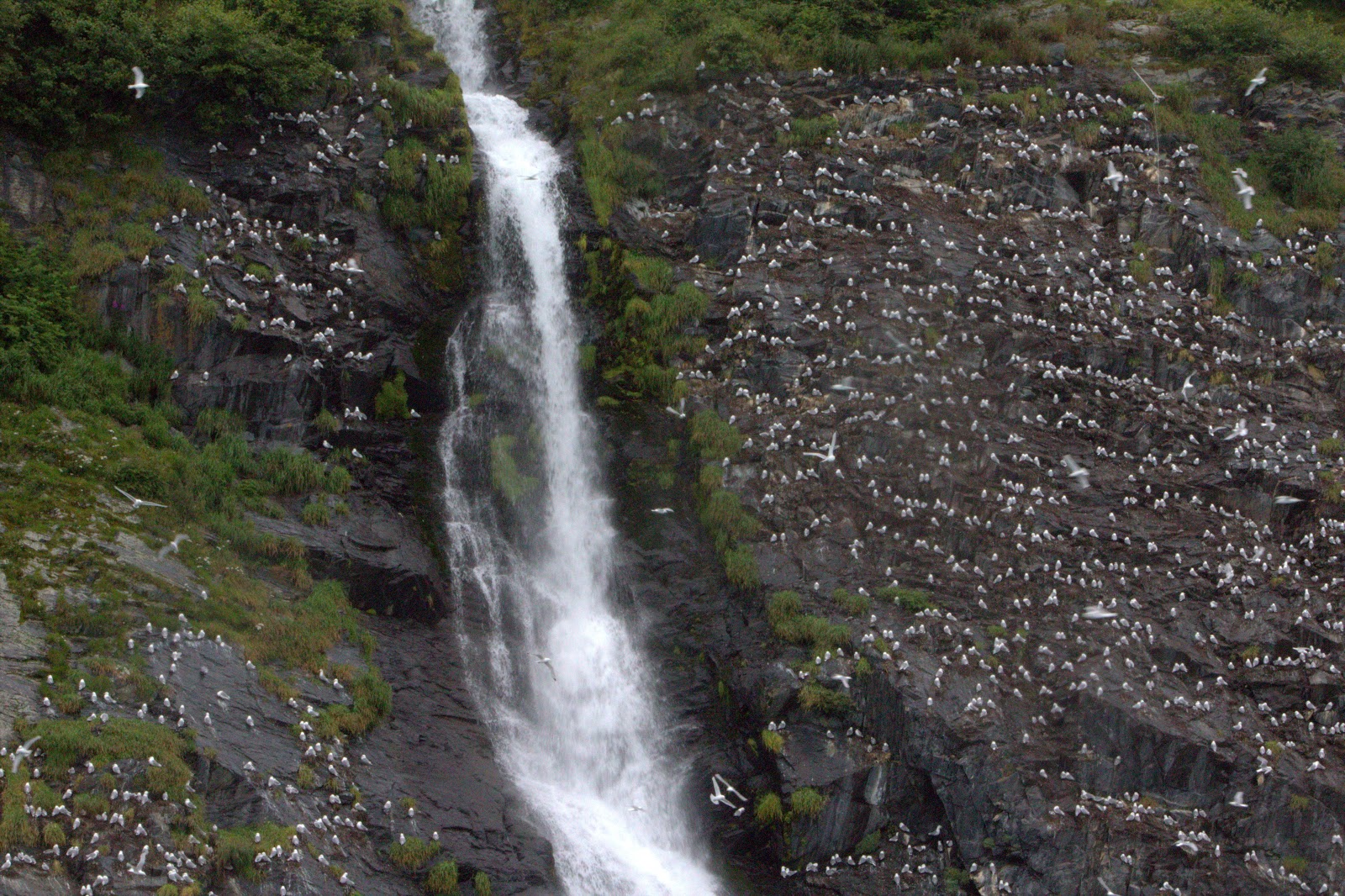
One highlight was the colony of Kittiwakes, thousands of them nesting on sheer vertical cliffs.


Among the many migratory birds are the famous Sandhill Cranes.


These are all in the wild. If you love nature, Alaska is definitely a place to visit.

Related Posts Plugin for WordPress, Blogger...