Wednesday, July 10, 2013

Maasai Mara : Zebras and Wildebeests

Serengeti is a huge region mostly in Tanzania. The part of it that is in Kenya, is called Maasai Mara. It's considered on of the natural wonders of the world, due to "The Great Migration". An estimated 2 million animals move as part of this migration, following the rains and fresh grass. This large collection of herbivores support a high population of predators, especially lions, leopards and cheetahs. Hence it has provided a frequent settings for documentaries related to nature and made it a popular tourists destination.

Watching this migration is an experience that simply cannot captured. Neither in words, nor in pictures. The documentaries have captured amazing moments and unforgettable scenes, but there is nothing like being surrounded by countless zebras and wildebeests, stretching as far as you can see.

You can click on any photo to start a slideshow.

In the picture below, all the dots in the distance are wildebeests!


They often form a single line while moving.


The wildebeest is not a particularly good looking animal. But they are crucial in supporting the ecosystem and the circle of life here.


Even the babies are not all that cute.


The zebra on the other hand is a beautiful animal.


Their babies are adorable.


Sometimes, all you can see is zebras, without wildebeests.

For more photos, check out the set of photos on Flickr.

Sunday, June 9, 2013

Diary Of A Rose - Part 1

The first bloom of 2013 is over. This year, I tried taking photos of the roses as they go through various stages of the bloom.

Exactly two years ago, (see post here) I moved this rose plant, and it took a while for it to recover from the shock, but it has come back strong.

First, a few photos of some flowers as they were blossoming. Some have been taken with my Samsung Galaxy 3. Others with a prime lens, and it's obvious which are these :-)

You can click on any photo to start a slideshow.

First the young buds.


As I captured previously (see post here), ladybugs are frequent visitors on a rose plant due to aphids.


Blossoming !


Getting bigger and bigger.


Even bigger.


A size comparison is needed to truly appreciate the size of these flowers. Every flower is size of a small cabbage. :-)


Now some photos of the plant in the full glory - in different stage of blossom.


Tuesday, May 21, 2013

Tinker Tailor Soldier Spy

Movie Review : Tinker Tailor Soldier Spy
Genre : Thriller / Suspense
Director : Tomas Alfredson
Starring : Gary Oldman, Colin Firth, Tom Hardy, John Hurt
Released : 2011
My Rating : 8 out of 10

David Cornwell worked in the UK Secret Service in the 50 and 60s. Drawing from his experience with MI5 and MI6, he wrote psychological thrillers that portray the world and life of spies as realistically as possible. His novels are unlike anything you will ever find in James Bond movies/novels. They are also unlike anything Ludlum ever wrote in his many end-of-the-world conspiracy novels or his celebrated Jason Bourne series. When his spy novels started becoming international bestsellers, Cornwell chose to become a full time author. The novels written using his pen name - John Le Carre - have defined the standard by which all spy novels are measured.

These novels are devoid of physical action and packed with mental tension. Leisurely paced and full of jargon, they require complete attention from the readers to follow the chess games that are being played in the minds of spymasters. It's well worth the effort. But keep this point in mind when you watch this adaptation of what's often considered as John Le Carre's finest novel.

George Smiley (Gary Oldman) is the central character here as in many of Le Carre's novels. An operation goes terribly wrong and he is forced out of service, along with his boss - known to us as "Control" (John Hurt). When a British undersecretary receives a tip that there is a double agent very high up in the organization, he asks Smiley to head a secretive investigation, outside the scope of the "circus" or MI6. This is the story of that investigation. It's also the beginning of the trilogy that pitted Smiley against the head of KGB, referred as "Karla".

It's a complex book, with a large number of characters, and many subplots that don't lend to the 2 hours movie format. There was a very popular BBC serial with none other than Alex Guinness starring as Smiley. A TV serial is the right format for so much material. Making a movie out of this book is a daunting task. Director Tomas Alfredson succeeds in maintaining the atmosphere, the tension - but fails in clarifying everything that goes on. I felt a bit confused at multiple junctions in the movie, and I am sure I am not alone.

It's just the nature of this particular book that makes it so hard for the director and the writer. Le Carre's other novels have been successfully adapted. I really like "Tailor From Panama", and I highly recommend it. I was less impressed by "Constant Gardener", even though it earned many nominations and Academy award for Rachel Weiss.

Gary Oldman was nominated for Oscar for his performance as George Smiley. No disagreements there. I haven't seen Alex Guinness play this role in the TV serial, so I cannot compare. I am sure it's hard to top Sir Guinness, but Oldman was fantastic for me here. The entire cast is filled with A-list actors. John Hurt, Colin Firth and everyone else gives a perfect performance.

The director has to be complimented for remaining faithful to the book in the style of presentation. This movie uses camera far more than words. There are many silent scenes and they are potent. When "Control" and Smiley are dismissed from the service, they say a silent goodbye to each other. That short scene conveys so much. You immediately know that they were close allies, but it's all over now, and there is nothing left to say.

I recommend this movie to anyone who is in a mood for a satisfying experience and willing to work the little grey cells. With many jumps back and forth using flashbacks, the structure of the movie doesn't make it simpler. A few scenes make it unsuitable for kids, but even otherwise, I don't suspect kids of any age to have the attention span required to enjoy this movie.

Wednesday, May 15, 2013

Integer Partitions

Integer Partitioning is a standard problem that arises in many situations. If math is what you do, then perhaps you would classify this as a simple problem. For the rest of us, it's far from straightforward.

The basic problem can be stated as follows.

For any given positive integer N, in how many different ways can it be partitioned, that is, written as sum of smaller positive integers ?

Let's define the function P(N) as the number of integer partitions of N.

For example, 4 can be written in 5 different ways (partitions)
1 + 1 + 1 + 1
1 + 1 + 2
1 + 3
2 + 2
4

So P(4) = 5.

Note that
1. Order of integers does not matter. So 1 + 4 is considered as the same partition as 4 + 1.
2. An integer can appear multiple times in a partition.

As is often the case, if you don't already know the trick, it's not easy to figure it out. For example, the first thing I tried was using induction, as in, can P(N+1) be expressed in terms of P(N)? I couldn't find any easy way to express it. Maybe there isn't a natural way.

The common trick in solving combinatorics problems is to use the principle of mutual exclusion. But how do I break the problem down to mutually exclusive smaller problems ? I couldn't find a way, so I gave up and surrendered myself to the all-knowing Wikipedia. Sure enough, the answer is there and this time the trick is to use an intermediate function.

Well that gave me the formula, but the explanation wasn't lucid enough on the Wikipedia page. So I decided to try to explain it in much simpler way.

It's a very nice trick and worth writing about.

Let's define another function - I am calling it partial partitions - PP(N,k) as the number of integer partitions, in which the smallest addend is at least k. It's important to note the language. The smallest addend doesn't have to be k, it can be more than k. In other words, no addend can be less than k.

For PP(4,2) we have 2 partitions in which every addend is equal or greater than 2
2 + 2
4
So PP(4,2) = 2.

For PP(4,3) and PP(4,4) we have just one same partition
4
So PP(4,4) = PP(4,3) = 1

Now, note that P(N) = PP(N,1). So if we can find a formula for PP(N,k), we will be able to determine P(N).

This neat trick of considering a more general problem, allows us to use the divide and conquer strategy. Now PP(N,k) can be divided into categories.

1. Where the smallest addend is exactly k. Let's call it PP(N,=k)
2. Where the smallest addend is strictly greater than k. Let's call it PP(N,>k).

It's easy to see that the second category is same as PP(N,k+1) because every addend must be strictly greater than k, so it's at least k+1.

What about the first category ? In this, every partition has to have k as an addend. There may be more than one addend equal to k. Since every partition has k, if we remove it, then we get partitions for N-k, and each of this partition satisfies the condition that no addend is less than k. This is PP(N-k,k). A diagram might help visualize this.


We must make sure that it is indeed the case that PP(N,=k) = PP(N-k,k) for all values of 1 <= k <= N for all integers N.

Consider a partition in PP(N,=k). As we have noticed already, removing the addend k, leaves us with a partition that adds up to N-k, with every addend >= k. Since we removed the same addend k, and every partition was different no two remaining partitions can be same. So we get proper set of distinct partitions. So PP(N,=k) must be a subset of PP(N-k,k).

Now let’s try from the other side. Consider PP(N-k,k). If we add the addend k to every partition, each partition will add up to N. Since we added the same term to each partition, they still remain distinct, so we have a proper set. Also, since we added the addend k to it, every partition of course has an element that's exactly k. So this PP(N-k, k) must be a subset of PP(N,=k).

Since PP(N-k,k) and PP(N,=k) are subsets of each other, they must be equal.

Combining all this together

PP(N,k) = PP(N,>k) + PP(N,=k) because of mutual exclusion
PP(N,k) = PP(N,k+1) + PP(N-k,k) as explained above

Now this is a recursive formula, so we need terminating conditions

PP(N,k) = 0 if k > N
PP(N,k) = 1 if k = N


To wrap up,

P(N) = PP(N,1) = PP(N-1, 1) + PP(N, 2)
That’s one pretty looking formula. In such recursive formulas, like partial derangement, both the terms reduce N and k to terminate the recursion. Here, one term reduces N, while other increases k. That’s got to put a smile on your face if you like recursion!

Wednesday, May 8, 2013

I told you so

Randy Travis is now an elderly figure in Country music. He enjoyed great success in late 80s, and left a permanent mark with his traditionalist approach. His songs from that period define country music to me. Simple music, touching words, great voice and sung with pathos.

The song "I told you so" is one of his biggest hits, reaching the top of the charts in 1988. The lyrics are a bit too cheesy, but it's still one of my favourite songs for his well controlled delivery. The melody is just wonderful.
Would you tell me that you've missed me too, and that you've been so lonely
And you've waited for the day that I returned
And we'd live and love forever, and that I'm your one and only
Or would you say the tables finally turned

Would you say I told you so, Oh, I told you so
I told you someday you'd come crawling back and asking me to take you in
I told you so, But you had to go
Now I found somebody new and you will never break my heart in two again
This is original solo from Randy Travis.


The song was later covered by Carrie Underwood. Her duet version with Randy Travis made the song a huge hit once again, more than 20 years after the original version.

This is a live performance at the American Idol show. The tonal qualities of the two singers provide an interesting contrast. Of course, Randy Travis sounds aged and anyway it's hard to keep up with the range of pitch in Carrie Underwood's voice.

Thursday, May 2, 2013

Ladybug

Ladybugs are cute, maybe the best looking insect after a butterfly. They do more than inspiring attractive toys for babies. They are a friend of a gardener. Especially when it comes to roses. Because they prey on aphids. Aphids are those small tiny creatures who invade a tender rose shoot in hundreds. So the ladybugs serve as a natural defense against these horrible little aphids.

I was lucky to capture this on camera. I got a few great shots of the ladybug and one absolute prize shot of it attacking the aphid.

You can click on any photo to start a slideshow and view the photos in large size.

All the photos were taken with my Canon T3i, and at f/1.8 with a 50mm prime Canon lens.

I was holding the branch, twisting it, turning it so that I can have the ladybug in the front. It took me a long time, and a few cuts on the arm from thorns, but it was totally worth it.


Next, the predator on the prowl.


The search is still on. You can see the aphid on the branch above.


Still looking.


Found it!


Thank you Madam, for finishing up those little rascals, as well as posing for the camera.


Sunday, April 21, 2013

Sebastopol

Sebastopol is a charming small town in Sonoma County, north of San Francisco. On one of its streets, Florence Avenue, there is an interesting display of "junk art" on the front yard of many homes. All these pieces are made by artist Patrick Amiot and are made from scraps and junks.

Florence Avenue.


Most of the "junk art" is very creative.

As a Barcelona fan, I was very happy to see this, who would have thought of finding a "junk art" piece related to FC Barcelona on a small town in USA!


This is for Oakland A's fans.

This is just cool.


A music festival in the downtown.


It's springtime, so the golden poppy - California state flowers are everywhere.


 Another random flower.


I am not going to let go of a photo opportunity!


Completely unrelated, but from a nearby area. I have not seen a rosemary plant of this size, over 6 feet tall and 20 feet wide. This will feed many Italian restaurants for many weeks!


Monday, April 15, 2013

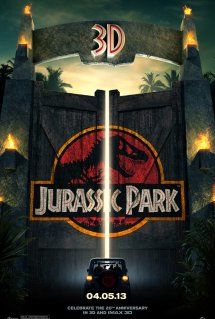
Jurassic Park 3D

Movie Review : Jurassic Park
Director : Steven Spielberg
Genre : SciFi / Adventure
Starring : Sam Neill, Jeff Goldblum, Richard Attenborough, Laura Dern
Released : Original released in 1993, 3D version released in 2013
My Rating : 8 out of 10

Jurassic Park is a milestone in the history of cinema. Most would remember it for the unbelievable special effects and rightly so. It took us into a fantasy-land that seemed completely real. There was nothing like it before.

Many would remember it for the action scenes. Alan and Alexis avoiding the falling jeep by grabbing another cable on the cliff, or Alan and Tim being chased by the same falling jeep in a tree.

Of course, most would also remember the smarter scenes. T-Rex appearing in the side view mirror, or the falling banner “When Dinosaurs Ruled The Earth” at the end of the fight between the T-Rex and velociraptors. 

In addition to all that, I remember it for two more things. First, I think this movie wrote the textbook on how to make even the quieter scenes unforgettable. Let’s start the list with the helicopter landing in front of a majestic waterfall. And who doesn’t remember the ripples in the glass of water ? Such a build up of tension befits the sheer awesomeness of the T-Rex scenes that follow. Even the scene where the gates to the park open at the beginning of the ride, sent a chill down my spine because of that creepy font and the signature music. That’s the second thing I remember the movie for. The music. Another feather in the crowded cap of the legendary John Williams.

Enough adulations. It’s an endless list, and everyone already knows it. The real question is, how is the 3D version, and is it worth spending the money ? My answer is a resounding yes.

I must add a disclaimer. I am not a big fan of 3D movies. I find most of the special effects cheesy, and sometimes the experience is a bit disorienting to me. I also have a very unfavorable view of re-releasing older movies with some touch up, just to squeeze more money out of a dead franchise.

I think the Jurassic Park experience is certainly enhanced with the 3D technology. It’s not perfect, I noticed some artifacts in some scenes, and some blurriness at the edges in some scenes. That’s a minor complaint. Most scenes felt even more real. The darker scenes do not lose details, in fact I think the details were crisper in most scenes.

It’s amazing how fresh and contemporary the movie still feels. Technology has drastically changed in 20 years. But this is Spielberg, so the movie may rely on technology, but excels at technique - which never feels jaded.

I was delighted when the audience burst into spontaneous applause at the end of the movie. The element of surprise was never there, as most had watched the movie. It’s a proof that  the awesomeness is still intact. I was even more pleasantly surprised when there was another round of clapping as the titles rolled and John Williams name came up. It felt wonderful. So this time, instead of the movie trailer, I am embedding a clip of his performance of the theme song from Jurassic Park. Listen to it and get the same goose bumps, without any visual aid.

Thursday, April 11, 2013

Banknotes Of Bhutan

It gives me great pleasure and pride to say that my classmate - Anil Bohora - from my undergraduate days at COEP (College Of Engineering Pune) is a Guinness World Record holder for largest collection of banknotes.

I always have great admiration for people who pursue their hobbies and interests, in addition to their day job. But to reach the level of world record is simply amazing. He has collected over ten thousand different banknotes from all over the world. Yes, you read that right, more than ten thousand. You can get a glimpse of this large collection in his book “Banknotes of Bhutan”.


Bhutan is a small independent country in the Himalayan mountains. It’s very likely that many people haven’t heard much of this country. I knew almost nothing. So the book introduces the reader to history, culture and many other aspects of Bhutan.

But why Bhutan ? Because Anil is fascinated by that country. After reading the book, I can see why, at least as far as the architecture of the monasteries and palaces is concerned. These impressive, highly symmetric buildings are constructed on beautiful locations that seem like an impossible choice. These structures and many other symbols occur frequently on the different notes from Bhutan. Anil has given explanations of all of the symbols.

In addition to the symbols, most notes also feature a royalty. A small biography of each important royalty has been included for the reader.

This book is almost like an encyclopedia of notes from Bhutan. Every single imaginable detail has been painstakingly tabulated along with beautiful photos of all the notes. Just see one example.


This book is definitely a labor of love. It’s printed on high quality paper and is a pleasure to the eyes. If you are interested, please contact Anil directly by email.

Wednesday, April 3, 2013

GaDiMa-5

Sometime the words of a song leave an impact on our minds like no other. The musically gifted amongst us remember the minute details related to the composition. For most of us, what remains in our memories are the words - if not exact words then it’s the meaning that stays with us forever.

This is one of such songs for me. I remember watching this movie on TV while growing up. It was perhaps the first philosophical song that I heard, and I was so impressed by the message, that even now, I seek comfort in it once in a while.

It is a very good movie by one of the greatest Marathi directors, Raja Paranjape. He often acted in his own movies, and here the song is picturised on him. Music and singing is by another giant, and incomparable Sudhir Phadke. The audio quality is not great in the following video, but his voice still sounds very nice and soothing.

The best part of the song is of course the words. I have always been amazed by the ability of poets like GaDiMa or Sahir to strike the balance between profoundness and accessibility. It is evident here. It’s simple, but not crass. Philosophical but not abstruse. Even a child can understand it, and an adult can appreciate it.
एक धागा सुखाचा, शंभर धागे दुःखाचे,
जरतारी हे वस्त्र माणसा, तुझिया आयुष्याचे
My favourite stanza is the last. I also like the subtle touch added by Babuji when he sings the words “नसती दोन”.
ह्या वस्त्राते विणतो कोण,
एक सारखी नसती दोन,
कुणा न दिसले, त्रिखंडात ह्या, हात विणकऱ्याचे
Enjoy ...


Previously :

Saturday, March 23, 2013

Sum of consecutive primes

When I was in college there was a term for such kind of activities - D! - pronounced as “D not”. which was an acronym for “Dhandaa not” - meaning someone who has nothing better to do. The following can be classified as a pure "D!" activity!

The Problem 50 in Project Euler is stated as
The prime 41, can be written as the sum of six consecutive primes:
41 = 2 + 3 + 5 + 7 + 11 + 13
This is the longest sum of consecutive primes that adds to a prime below one-hundred.
The longest sum of consecutive primes below one-thousand that adds to a prime, contains 21 terms, and is equal to 953.
Which prime, below one-million, can be written as the sum of the most consecutive primes?
I had no idea that consecutive primes can be added to get another prime ! That’s simply beautiful.

Once you have a prime number generator, solving problems related to prime numbers becomes easier, if not easy. The best generator is of course the Sieve Of Eratosthenes, for which you can find the code here.

Using it, you can generate primes up to the required limit, and implement a brute force algorithm. Just have a loop iterating over the list of primes, and keep adding up all the primes starting from that position. The sum is prime if it exists in our list. Note it down and how many primes were added to get it. Keep only the sum that was generated using more number of primes than the last one.

Well, what’s the fun in doing only that ? So I just added a data structure to keep track of which primes can be generated by adding a set of consecutive primes, and if there are more than one set of consecutive primes that add up to a prime, keep a track of that as well. The results are fun to analyze.

It’s not that just 2 or 3 primes can be added to get another prime, some of the primes below 1 million, can be constructed by adding over 500 consecutive primes. More, some of these can be constructed using more than one list ! Astonishing.

The number 41, mentioned in the problem, can also be written as sum of a different set of consecutive primes, 41 = 11 + 13 + 17. That’s the only 2-digit prime that can be obtained via adding more than one set of consecutive primes.

So what other primes can be written as sum of more than 1 set of consecutive primes ? To save typing, I am going to define a new function SCP for “sum of consecutive primes”.
SCP(n) = the number of sets of consecutive primes that can be added to get n.
So SCP(41) = 2
There are many 3 digit primes that have SCP number more than 1. For example
983 = 23 + 29 + … + 89 + 97 (17 primes)
983 = 47 + 53 + … + 101 + 103 (13 primes)
So SCP(983) = 2.
There are no 3 digit primes with SCP = 3. But There are 2 primes with SCP number as 4.
311 = 11 + 13 + .. + 43 + 47 (11 primes)
311 = 31 + 37 + … +  53 + 59 (7 primes)
311 = 53 + 59 + 61 + 67 + 71
311 = 101 + 103 + 107
The other prime is 863.

On the other hand, the smallest prime with SCP number 3 is 1151.

The smallest prime with SCP number 5 is 34421.
34421 = 269 + 271 + … + 701 + 709 (71 primes)
34421 = 1429 + 1433 + … + 1567 + 1571 (23 primes)
34421 = 3793 + 3797 + … + 3851 + 3853 (9 primes)
34421 = 4889 + 4903 + … + 4933 + 4937 (7 primes)
34421 = 11467 + 11471 + 11483
Below one million, the largest prime with SCP number as 5 is 988321. One of the set of consecutive primes that add up to that number is
988321 = 113 + 127 + … + 3919 + 3923
This has a whopping 515 consecutive primes !
And it’s NOT the answer to the Project Euler problem. The SCP number for the answer is just 3.

Below 1 million, there is only one prime with SCP number as 6, and that is 442019.
442019 = 419 + 421 + … + 2617 + 2621 (301 primes)
442019 = 7529 + 7537 + … + 8011 + 8017 (57 primes)
442019 = 13229 + 13241 + … + 13553 + 13567 (33 primes)
442019 = 17569 + 17573 + … + 17791 + 17807 (25 primes)
442019 = 49069 + 49081 + … + 49139 + 49157 (9 primes)
442019 = 147331 + 147341 + 147347
That’s a special number. There is no prime below 1 million with SCP = 7.

What’s the point of all this ? Not much, except that prime numbers are fascinating. If you want to know more about the mathematical research done on them, I highly recommend reading Prime Obsession. Don’t let the topic turn you away from reading it. It’s a very easy book to read, and is enormous fun. I know that’s hard to believe, but it really is, and that’s why it’s one of my all time favorite books.

UPDATE : Added some more analysis in a follow-up post.

Friday, March 8, 2013

We Bought A Zoo

Movie Review : We bought A Zoo
Director : Cameron Crowe
Genre : Drama
Starring : Matt Damon, Scarlett Johansson
Released : 2011
My Rating : 5 out of 10

I have a bias towards movies based on real life stories. Reality is not only stranger than fiction, it can also be more uplifting, and sometimes more traumatic. This movie is loosely based on the true story of Benjamin Mee who bought a zoo in England and wrote a book about it.

In the movie, Benjamin Mee (Matt Damon) is in California, and a widower who is trying his best to take care of his two children. The daughter is too young and is attached to her dad, but the son is having a hard time getting over the loss of his mother. When he gets expelled out of the school, Benjamin decides a change might be better for all. He starts looking for a new house, and ends up buying one with a small zoo, just because the young daughter loves it. He has no idea what zoology is, and what kind of commitment it requires. In addition, the staff is running very low on morale. Benjamin desperately needs the zoo to be opened, but he has to first satisfy the demands of a tough inspector. To make matters worse, his relationship with his son gets more and more stressful.

This is a feel good movie, so we know Benjamin is eventually going to beat the odds, and everything is going to be fine. We just want to enjoy the ride, have a few good laughs and be genuinely happy for the characters. Benjamin is likeable, and we understand why he doesn’t want any more sympathy. We understand what his son is going through. The movie does a good job of setting the context, and then fails at convincing us how the problems got solved. We want to cheer for Benjamin and his team, but we never know when to cheer for them.

This is a huge problem with the script, and the direction by Cameron Crowe does not help. He has many successes under his belt, but this one feel like a halfhearted effort. The actors do a decent job with whatever material they have been given. The story has all the elements needed for making a fun, uplifting movie. Unfortunately it remains very flat and never rises above cliched, ineffective scenes.

I cannot recommend this movie. But it’s an OK movie to watch with the entire family. My guess would be that, no one is going to get really bored, but no one is going to love it either.

Thursday, February 28, 2013

Live like you were dying

Tim McGraw is one of the Country superstars. A best selling artist, actor, good looking and married to another beautiful and successful county singer Faith Hill. Although I am not a huge fan, I like a couple of his songs.

This one "Live like you were dying" became a big hit in 2004, and is really a very good song. I totally agree with the lyrics. That's how everyone should live. It was written in the memory of his father, Tug McGraw, who was a successful baseball pitcher.

It tells a story of a person who has been told by the doctor that he doesn't have a lot of time. The lyrics are simple, yet make you philosophical.
Asked him when it sank in, that this might really be the real end.
How's it hit you, when you get that kind of news.
Man what you do?
And he says ...

I went sky diving,
I went rocky mountain climbing,
I went 2.7 seconds on a bull name Fumanchu.
And I loved deeper,
And I spoke sweeter,
And I gave forgiveness I've been denying,
And he said someday I hope you get the chance,
To live like you were dying.

On YouTube :

Tuesday, February 5, 2013

Napa Safari - Birds

The Napa Safari also has a nice collection of exotic birds, in addition to all the herbivores. They are mostly in an open air aviary. You are allowed to walk around, and the birds are quite used to people.

You can click on any photo to start a slideshow.

Of course, there are flamingos too !


The rest are very uniquely beautiful birds, that I hadn't seen anywhere before.


This one is breathtaking, gives the peacock a tough competition. The photo does not do proper justice.


A bit weird, but the red flame like color is very interesting.


Perhaps the best looking pigeon.


Red beauty.


There is something really beautiful, in spite of lack of vibrant colors. Just black and white, still pretty.


This is really exotic.


Related Posts Plugin for WordPress, Blogger...